
Every year, thousands of startups are launched with excitement, optimism, and big dreams. Yet most of them fail.
The reason is rarely a lack of passion. It is rarely a lack of intelligence. And it is often not even a lack of funding.
The biggest reason startups fail is because they build something nobody wants.
Entrepreneurs spend months or years developing products, renting offices, hiring employees, designing logos, building websites, and creating elaborate business plans—only to discover that customers simply do not care.
This painful reality led to the creation of one of the most influential business frameworks of the modern era: the Lean Startup Methodology.
The Lean Startup approach transformed entrepreneurship by replacing assumptions with evidence, replacing lengthy planning with rapid experimentation, and replacing waste with learning.
Today, some of the world’s most successful startups and technology companies use Lean Startup principles to test ideas, reduce risk, and accelerate growth.
If you are launching a new business, developing a product, starting a side hustle, or building a startup, mastering Lean Startup principles can dramatically increase your chances of success.
What Is the Lean Startup Methodology?
The Lean Startup Methodology is a business development approach that focuses on:
- Building quickly
- Testing rapidly
- Learning continuously
- Improving constantly
Instead of spending years perfecting a product before launch, entrepreneurs create a simple version, release it to real customers, gather feedback, and improve based on actual market responses.
The concept was popularized by Eric Ries in his bestselling book, “The Lean Startup”.
The core philosophy is simple: Stop guessing what customers want. Start learning what customers actually want.
In traditional business planning, entrepreneurs often begin with assumptions.
In Lean Startup, entrepreneurs begin with experiments.
This difference changes everything.
The Fundamental Philosophy Behind Lean Startup
Lean Startup is built on a powerful truth: Assumptions Are Dangerous.
Many entrepreneurs believe:
- Customers need their product
- People will pay for it
- Marketing will be easy
- Growth will happen naturally
Unfortunately, markets do not reward assumptions. Markets reward solutions to real problems.
The Lean Startup methodology forces founders to test assumptions before investing heavily.
Instead of asking: “Will this business work?”
It asks: “How quickly can I find out whether this business will work?”
That shift in thinking is what separates successful founders from dreamers.
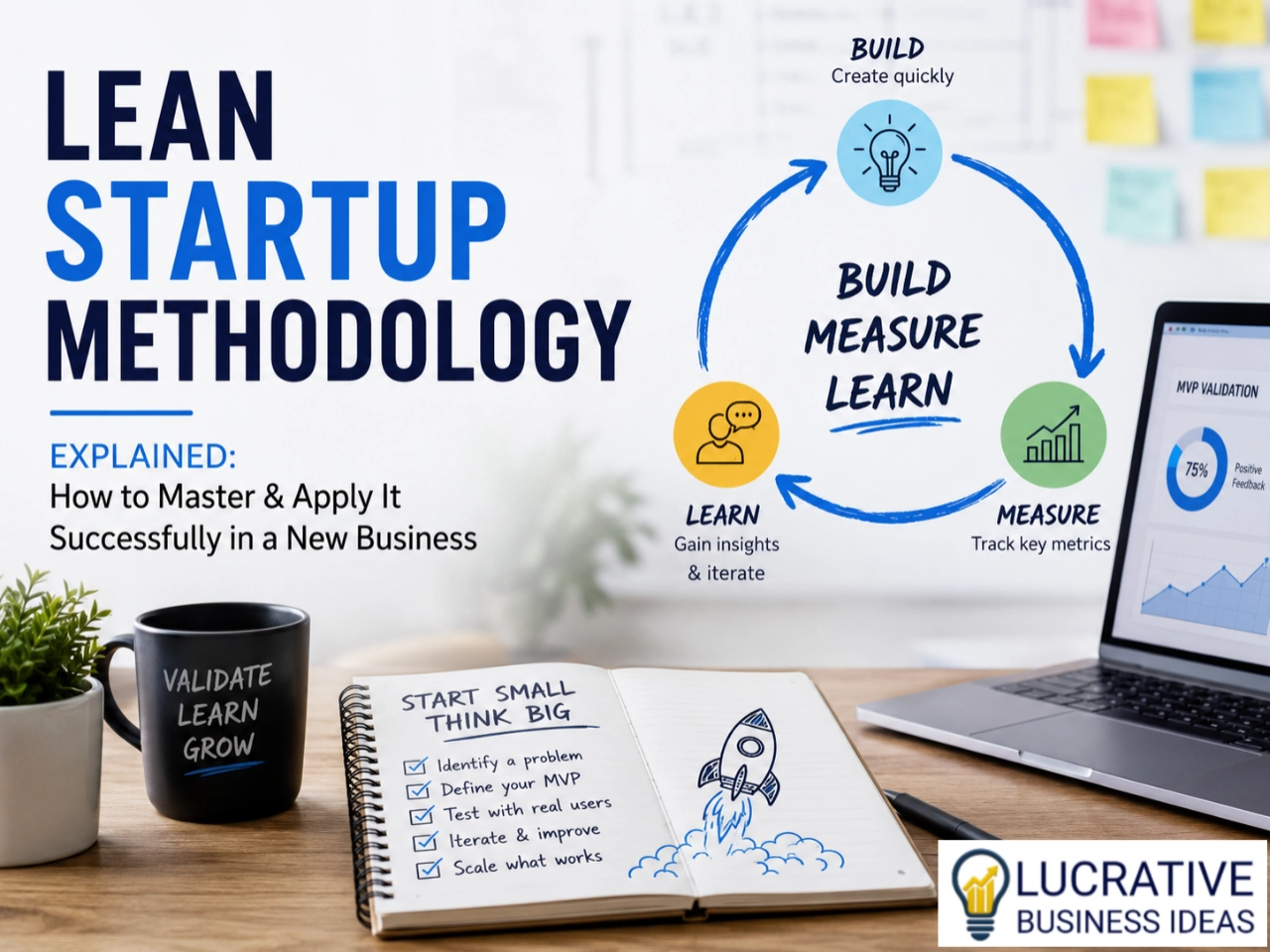
The Three Pillars of Lean Startup
1. Build
Create the simplest version of your idea.
Not the perfect version. Not the complete version. Just enough to test whether people care.
The objective is learning, not perfection.
2. Measure
Collect real customer feedback. Track behavior. Analyze responses.
Observe what customers actually do rather than what they say they will do.
Actions are more reliable than opinions.
3. Learn
Use the information gathered to make decisions.
Determine:
- What’s working
- What’s failing
- What customers want
- What customers ignore
Then improve accordingly.
This creates the famous Lean Startup cycle:
Build → Measure → Learn → Repeat
The faster this cycle operates, the faster a startup grows.
Understanding the Minimum Viable Product (MVP)
The MVP is the heart of Lean Startup. A Minimum Viable Product is the simplest version of a product that allows you to test a business idea.
Many entrepreneurs misunderstand MVPs.
An MVP is not:
- A poor-quality product
- A broken product
- A half-finished product
An MVP is simply the smallest experiment that helps you learn.
Example
Suppose you want to create an online food delivery business.
Traditional thinking:
- Build an app
- Hire developers
- Raise funding
- Launch nationwide
Lean Startup thinking:
- Create a simple website
- Accept orders manually
- Deliver food yourself
- Test customer demand
If nobody orders, you’ve saved thousands of dollars. If customers love it, you’ve validated demand.
That is Lean Startup thinking.
Different Types of MVPs
1. Concierge MVP
You manually provide the service before automating it.
Example:
Instead of building software, perform the service yourself.
This tests demand without expensive development.
2. Landing Page MVP
Create a webpage explaining the product.
Measure:
- Signups
- Clicks
- Interest levels
- Before building anything.
3. Wizard of Oz MVP
Customers think the system is automated.
Behind the scenes, humans do the work.
This helps validate demand before investing in technology.
4. Single-Feature MVP
Focus on solving one problem exceptionally well.
Avoid unnecessary features. Start small. Expand later.
Customer Discovery: The Hidden Superpower
One of the most important Lean Startup practices is customer discovery.
Many founders become emotionally attached to their ideas. Successful founders become obsessed with customer problems. The difference is enormous.
Instead of saying: “I have a great solution.”
Ask: “What problem frustrates people enough that they will pay to solve it?”
Questions to Ask Customers
- What challenges do you face regularly?
- How are you solving this problem today?
- What frustrates you most?
- How much does this problem cost you?
- Would you pay for a better solution?
Listen more than you speak. The goal is discovery, not persuasion.
Validated Learning: The Real Goal
Most entrepreneurs think success comes from building products. Lean Startup teaches that success comes from learning.
This concept is called validated learning.
Validated learning means: You gather evidence from real customers that supports or disproves your assumptions.
Examples:
- Customers signed up
- Customers purchased
- Customers returned
- Customers referred friends
These actions provide validation. Opinions alone do not.
Innovation Accounting
Traditional businesses measure:
- Revenue
- Profit
- Expenses
Startups need additional metrics. This process is called innovation accounting.
Key startup metrics include:
- Customer Acquisition Cost (CAC): How much money is spent to acquire a customer.
- Customer Lifetime Value (LTV): How much revenue a customer generates over time.
- Conversion Rate: Percentage of visitors who become customers.
- Retention Rate: Percentage of customers who keep using the product.
- Churn Rate: Percentage of customers who leave.
Tracking these metrics helps founders make better decisions.
Pivoting: Knowing When to Change Direction
One of the most misunderstood concepts in entrepreneurship is pivoting.
A pivot is not failure. A pivot is intelligent adaptation.
When evidence shows that an idea is not working, successful founders adjust.
Many legendary companies began with pivots.
Examples include:
- YouTube
- Slack
Their original ideas evolved significantly before success arrived.
The market often teaches lessons that business plans never reveal.
Common Types of Pivots
- Customer Pivot: Same product. Different customers.
- Problem Pivot: Different problem. Same customers.
- Technology Pivot: Same solution. Different technology.
- Revenue Model Pivot: Different way of making money.
- Channel Pivot: Different method of reaching customers.
How to Apply Lean Startup in a New Business
Step 1: Identify a Real Problem
Start with pain points.
People pay to eliminate pain. They rarely pay for interesting ideas alone.
Step 2: Form Hypotheses
Document assumptions such as:
- Who the customer is
- What problem exists
- Why the solution matters
- Why people will pay
Treat every assumption as unproven.
Step 3: Build an MVP
Create the smallest test possible.
Speed matters more than perfection.
Step 4: Launch Quickly
Get real-world feedback. Do not hide in development mode.
The market is the ultimate judge.
Step 5: Measure Everything
Track:
- Signups
- Sales
- Retention
- Referrals
- Engagement
Data reveals truth.
Step 6: Learn and Improve
Analyze results. Make adjustments. Run another experiment.
Repeat continuously.
Major Benefits of Lean Startup
- Lower Risk: You discover failures early.
- Faster Learning: Customer feedback arrives quickly.
- Reduced Waste: Less money is spent building unwanted products.
- Better Product-Market Fit: Products evolve according to customer needs.
- Improved Capital Efficiency: Resources are invested more intelligently.
- Increased Survival Rate: Startups become adaptable and resilient.
Common Lean Startup Mistakes
1. Building Too Much Too Soon
Many founders overbuild. Keep initial versions simple.
2. Ignoring Customer Feedback
Customers often reveal opportunities founders miss. Listen carefully.
3. Measuring Vanity Metrics
Social media likes and page views can be misleading. Focus on meaningful business metrics.
4. Falling in Love with the Idea
Love the problem. Not the solution. Solutions can change. Problems remain.
5. Refusing to Pivot
Markets change. Customer needs evolve. Adaptation is essential.
Lean Startup in the Age of Artificial Intelligence
The Lean Startup methodology is more powerful today than ever before.
Modern entrepreneurs can use AI tools to:
- Create MVPs faster
- Generate prototypes quickly
- Build websites rapidly
- Analyze customer feedback
- Automate research
- Test business ideas at low cost
A founder who once needed months can now validate ideas in days.
The future belongs to entrepreneurs who combine Lean Startup principles with AI-powered execution.
The speed of learning is becoming the ultimate competitive advantage.
Advanced Lean Startup Strategies
Once basic validation is achieved:
- Run Weekly Experiments: Treat business growth as a series of experiments.
- Build Feedback Loops: Continuously gather customer insights.
- Create Rapid Testing Systems: Test pricing, marketing messages, features, and sales approaches.
- Focus on Product-Market Fit: Nothing matters more. A perfect marketing campaign cannot save a product nobody wants.
- Develop a Learning Culture: Encourage constant experimentation.Every failure becomes useful information.
The Future of Lean Entrepreneurship
The next generation of successful businesses will not necessarily be those with the largest budgets. They will be the businesses that learn fastest.
Technology is reducing the cost of experimentation. Artificial intelligence is accelerating development.
Global connectivity is expanding market access.
In this environment, the ability to test, learn, and adapt rapidly becomes a superpower.
The Lean Startup methodology is not merely a startup framework.
It is a mindset. A way of thinking. A disciplined approach to reducing uncertainty. A system for transforming assumptions into knowledge.
And ultimately, a practical path toward building products and businesses that customers genuinely want.
See Also:
- Adaptive Thinking & Critical Thinking in Business: The Ultimate Guide to Smarter Decisions, Innovation & Long-Term Success
- How to Build AI Agents That Run Businesses on Autopilot: The Complete Beginner-to-Advanced Blueprint for the AI-Driven Future
Final Thoughts
The greatest lesson of the Lean Startup methodology is surprisingly simple:
Do not spend years building what people might want. Discover what people actually want, then build it.
Successful entrepreneurs are not necessarily those who have the most brilliant ideas.
They are the ones who learn the fastest. They test relentlessly. They listen carefully. They adapt intelligently.
And they understand that every startup begins as a hypothesis that must be validated by the market.
Master the Lean Startup methodology, and you dramatically improve your odds of creating a business that survives, grows, and thrives in an increasingly competitive world.
Conclusion
The Lean Startup Methodology is not simply a startup framework; it is a disciplined approach to reducing uncertainty in business. By focusing on rapid experimentation, customer feedback, validated learning, and continuous improvement, entrepreneurs can make smarter decisions and dramatically increase their chances of success.
Whether you are launching a technology startup, a small local business, an online venture, or a global enterprise, the principles of Lean Startup can help you build faster, learn smarter, and grow with confidence.
Frequently Asked Questions (FAQs) About the Lean Startup Methodology
1. What is the main purpose of the Lean Startup Methodology?
The primary purpose of the Lean Startup Methodology is to reduce the risk of building a business around assumptions rather than facts. Instead of spending months or years developing a product in isolation, the methodology encourages entrepreneurs to test ideas quickly, gather feedback from real customers, and continuously improve based on what they learn.
The ultimate goal is not merely to build a product but to build a product that customers genuinely want and are willing to pay for. By focusing on learning and validation, entrepreneurs can avoid wasting time, money, and resources on ideas that have little market demand.
In simple terms, Lean Startup helps entrepreneurs discover the right business model before making major investments.
2. What is a Minimum Viable Product (MVP), and why is it important?
A Minimum Viable Product (MVP) is the simplest version of a product that allows entrepreneurs to test their business assumptions with real customers.
An MVP is not a low-quality product. Instead, it is a strategic tool designed to answer important questions such as:
- Do customers want this solution?
- Will they pay for it?
- Which features matter most?
- What improvements are needed?
For example, before spending thousands of dollars building an e-commerce platform, an entrepreneur might create a simple landing page and manually process orders. If customers show strong interest, the entrepreneur gains confidence that the idea is worth further investment.
The MVP is important because it helps founders learn quickly while minimizing financial risk.
3. How is Lean Startup different from traditional business planning?
Traditional business planning often involves creating detailed forecasts, writing lengthy business plans, and developing products before customers have a chance to provide feedback.
Lean Startup takes a different approach. Instead of assuming the business plan is correct, entrepreneurs treat every assumption as a hypothesis that must be tested.
Traditional Approach:
- Plan extensively
- Build completely
- Launch later
- Hope customers respond
Lean Startup Approach:
- Test assumptions
- Build quickly
- Launch early
- Learn continuously
This makes Lean Startup more adaptable, especially in uncertain markets where customer needs and industry trends can change rapidly.
4. Does Lean Startup only work for technology startups?
No. Although the methodology became popular in the technology sector, its principles can be applied to almost any type of business.
Examples include:
- Restaurants
- Retail stores
- Consulting firms
- Manufacturing companies
- Agribusiness ventures
- Educational institutions
- Healthcare startups
- Real estate businesses
Any business that serves customers can benefit from testing assumptions, gathering feedback, and improving based on real-world data.
The methodology is not about technology; it is about learning what customers truly value.
5. How do I know when it is time to pivot?
A pivot becomes necessary when evidence consistently shows that your current strategy is not producing the desired results.
Common signs include:
- Low customer interest
- Poor sales performance
- Weak customer retention
- Negative market feedback
- Lack of product engagement
However, a pivot should never be based on emotions or temporary setbacks.
Instead, it should be based on data and validated learning.
The best entrepreneurs understand that changing direction is not a sign of failure. It is often a sign of intelligence and adaptability.
A successful pivot can transform a struggling startup into a thriving business.
6. What are the biggest mistakes entrepreneurs make when applying Lean Startup principles?
Some of the most common mistakes include:
- Building too many features too early. Entrepreneurs often try to create a perfect product before understanding what customers truly want.
- Ignoring customer feedback. Many founders ask for feedback but fail to act on it.
- Measuring vanity metrics. Likes, followers, and website visits may look impressive but do not necessarily indicate business success.
- Falling in love with the solution. Entrepreneurs should focus on solving problems rather than defending their original ideas.
- Refusing to pivot. Some founders continue pursuing failing strategies despite overwhelming evidence that changes are needed.
Avoiding these mistakes can significantly improve a startup’s chances of success.
7. How much customer feedback is enough before making decisions?
There is no universal number because different businesses require different levels of validation.
The key is to look for patterns rather than isolated opinions.
If one customer complains about a feature, it may be a personal preference.
If twenty customers identify the same issue, it likely indicates a genuine problem.
Entrepreneurs should collect feedback continuously and combine qualitative insights (interviews, surveys, conversations) with quantitative data (sales, retention rates, usage metrics).
The goal is to gather enough evidence to make informed decisions while avoiding analysis paralysis.
8. Can Lean Startup help entrepreneurs with limited budgets?
Absolutely. In fact, Lean Startup is especially valuable for entrepreneurs with limited financial resources.
Instead of spending large sums on product development, advertising, equipment, or inventory, entrepreneurs can validate demand using low-cost experiments.
Examples include:
- Creating landing pages
- Running small advertising tests
- Offering services manually
- Conducting customer interviews
- Building simple prototypes
By testing before investing heavily, entrepreneurs can preserve capital and reduce financial risk.
Many successful businesses began with modest budgets and a strong commitment to learning.
9. How does Lean Startup improve the chances of finding product-market fit?
Product-market fit occurs when a product effectively solves a problem for a specific group of customers and generates consistent demand.
Lean Startup accelerates the journey toward product-market fit because it creates a continuous feedback loop.
Entrepreneurs:
- Build a solution
- Test it with customers
- Measure results
- Learn from feedback
- Improve the product
Each cycle brings the business closer to understanding what customers truly want.
Rather than relying on guesswork, founders make decisions based on evidence, which significantly increases the likelihood of achieving product-market fit.
10. Is the Lean Startup Methodology still relevant in the age of Artificial Intelligence?
More than ever. Artificial Intelligence has actually amplified the effectiveness of Lean Startup principles.
Today, entrepreneurs can use AI tools to:
- Create prototypes faster
- Build websites quickly
- Generate marketing content
- Analyze customer feedback
- Conduct market research
- Automate repetitive tasks
- Test business ideas at a fraction of traditional costs
What once took months can now be accomplished in days or even hours.
However, one thing has not changed: entrepreneurs still need real customer validation.
AI can help build products faster, but only customers can confirm whether those products solve meaningful problems.
The entrepreneurs who will thrive in the future are those who combine AI-powered execution with the Lean Startup mindset of experimentation, learning, and continuous improvement.