
Many people assume that success in business is primarily about intelligence, education, capital, or experience. While these things matter, history repeatedly shows that some of the smartest and most experienced people still fail, while others with fewer resources build extraordinary companies.
The difference often comes down to two powerful skills: Adaptive Thinking and Critical Thinking. These are not merely academic concepts. They are survival tools.
In today’s business environment, technology changes overnight, consumer behavior evolves rapidly, competitors emerge unexpectedly, and economic conditions shift without warning. The entrepreneurs and leaders who thrive are those who can think clearly when others panic and adjust quickly when circumstances change.
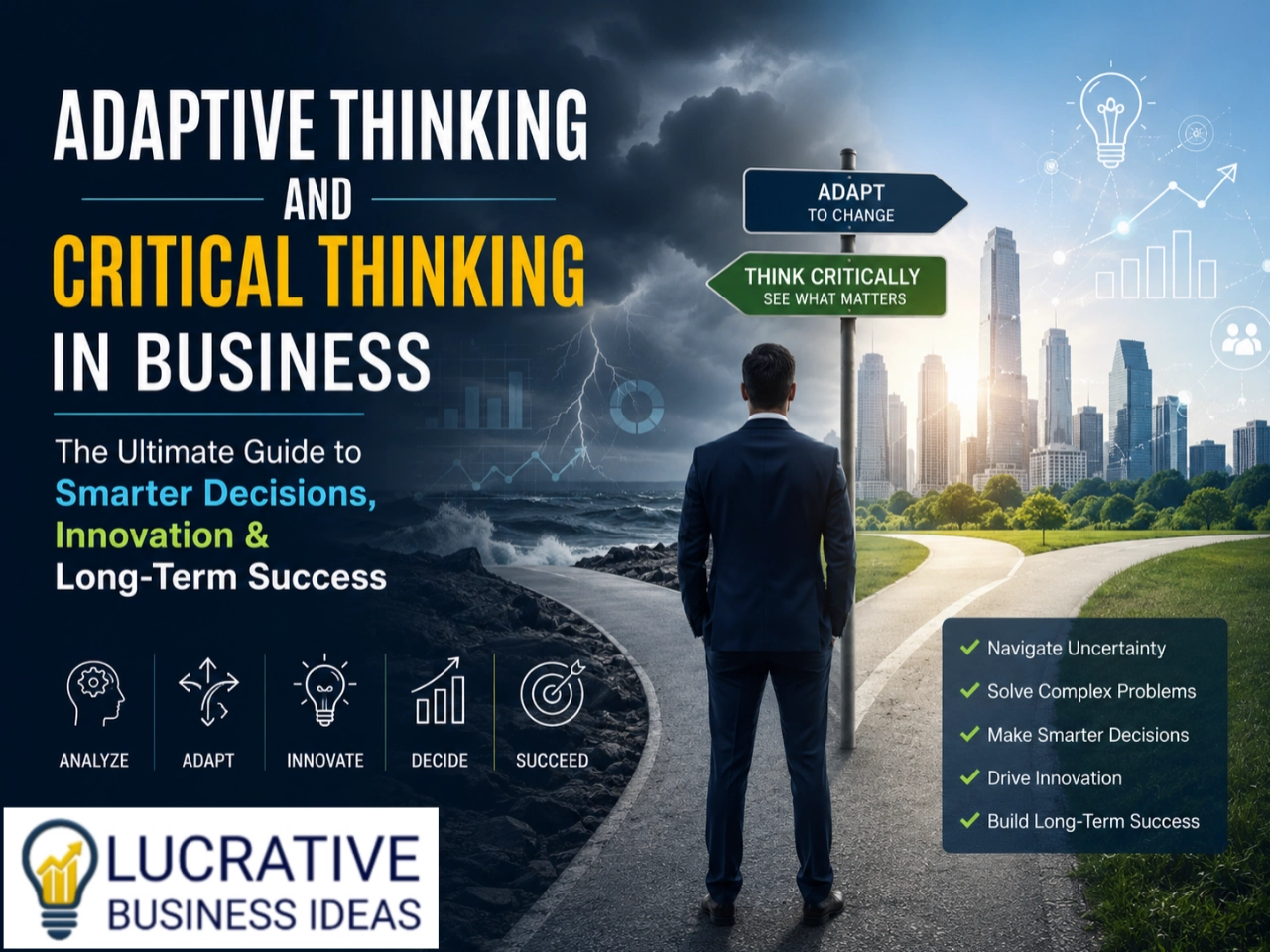
Adaptive thinking helps you respond effectively to change.
Critical thinking helps you make better decisions.
When combined, they become one of the most powerful competitive advantages a business leader can possess.
Part 1: Understanding Adaptive Thinking
What Is Adaptive Thinking?
Adaptive thinking is the ability to adjust your mindset, strategies, decisions, and actions when circumstances change.
It is the capacity to remain effective in unfamiliar, uncertain, or rapidly changing situations.
An adaptive thinker understands that:
- Markets change
- Technologies evolve
- Customer preferences shift
- Competitors innovate
- Unexpected crises happen
Instead of resisting change, adaptive thinkers embrace it.
They do not ask: “How can I preserve the old way?”
They ask: “How can I succeed in the new reality?”
The Core Philosophy of Adaptive Thinking
Adaptive thinking is built upon one simple truth: The world does not care about your plans.
Business plans are important. Strategies are valuable. Forecasts are useful. But reality often has different ideas.
Adaptive thinkers understand that success is not about predicting every change. It is about responding effectively when change occurs.
Characteristics of Adaptive Thinkers
1. Flexibility: They can change direction without feeling defeated. They understand that changing a strategy is not failure. It is intelligence.
2. Curiosity: Adaptive thinkers constantly learn. They seek new information, trends, technologies, and opportunities.
3. Emotional Stability: When unexpected events occur, they remain calm. Panic destroys judgment. Calmness improves decision-making.
4. Experimentation: They are willing to test ideas. Rather than betting everything on one assumption, they run experiments and learn from results.
5. Growth Mindset: They believe abilities can improve through learning and effort. Challenges become opportunities for growth.
Part 2: Understanding Critical Thinking
What Is Critical Thinking?
Critical thinking is the ability to objectively analyze information, evaluate evidence, challenge assumptions, and make sound judgments.
It is disciplined thinking. It helps people separate facts from opinions, truth from assumptions, and opportunities from illusions.
A critical thinker does not automatically accept information because:
- It sounds convincing
- An expert said it
- Everyone believes it
- It confirms existing beliefs
Instead, they investigate.
The Purpose of Critical Thinking
The purpose of critical thinking is not to criticize. The purpose is to arrive at better conclusions.
Critical thinkers ask:
- Is this true?
- What evidence supports this?
- What evidence contradicts this?
- What assumptions are being made?
- What alternative explanations exist?
These questions dramatically improve decision quality.
Characteristics of Critical Thinkers
1. Intellectual Humility: They recognize they may be wrong. This openness allows learning.
2. Evidence-Based Reasoning: They prioritize facts over emotions.
3. Logical Analysis: They look for cause-and-effect relationships.
4. Independent Judgment: They do not blindly follow crowds.
5. Skepticism: They verify claims before accepting them.
Part 3: The Difference Between Adaptive Thinking and Critical Thinking
Many people confuse these concepts. They are different but complementary.
- Adaptive thinking focuses on change while Critical thinking focuses on analysis.
- Adaptive thinking helps you adjust while Critical thinking helps you evaluate.
- Adaptive thinking deals with uncertainty while Critical thinking deals with decision quality.
- Adaptive thinking encourages flexibility while Critical thinking encourages objectivity.
- Adaptive thinking answers “What now?” While Critical thinking answers “Why?”
Think of it this way:
- Critical thinking helps you choose the right direction.
- Adaptive thinking helps you keep moving when the road changes.
You need both.
Part 4: Why Businesses Need Adaptive Thinking More Than Ever
The Age of Constant Disruption
The business world has entered an era of continuous disruption – Artificial Intelligence. Automation. Remote work. Economic instability. Changing consumer expectations. Global competition.
Companies that fail to adapt disappear.
Case Study 1: Netflix
Netflix began as a DVD rental business.
When streaming emerged, the company adapted. When original content became important, it adapted again. When global expansion became necessary, it adapted once more.
Many competitors resisted change. Netflix embraced it. The result was massive growth.
Case Study 2: Kodak
Kodak actually invented digital camera technology. Yet leadership feared digital products would hurt film sales.
Instead of adapting, they protected the old business model. The market moved forward without them.
The lesson is powerful: Ignoring change is often more dangerous than embracing it.
Part 5: Why Businesses Need Critical Thinking
1. The Cost of Poor Decisions
Businesses rarely fail from lack of effort. They fail from poor decisions.
Examples include:
- Hiring the wrong people
- Entering the wrong market
- Launching unwanted products
- Misreading customer demand
- Overspending on ineffective marketing
Critical thinking reduces these mistakes.
2. Decision-Making in the Information Age
Today we are drowning in information – Social media. News. Reports. Expert opinions. AI-generated content. Data dashboards.
The challenge is no longer finding information. The challenge is identifying what matters.
Critical thinking helps filter noise from signal.
Part 6: How to Apply Adaptive Thinking in Business
1. Monitor Trends Continuously
Never assume today’s success guarantees tomorrow’s success.
Study:
- Consumer behavior
- Emerging technologies
- Industry shifts
- Regulatory changes
- Economic developments
The earlier you spot change, the easier adaptation becomes.
2. Build Flexible Business Models
Rigid businesses break under pressure. Flexible businesses evolve.
Ask yourself:
- Can we serve new customer segments?
- Can we modify our products?
- Can we change distribution channels?
Flexibility creates resilience.
3. Encourage Experimentation
Many companies wait for certainty. Adaptive companies test quickly.
Run:
- Pilot programs
- Limited launches
- Small-scale experiments
- Customer trials
Small experiments reduce large risks.
4. Learn Faster Than Competitors
In modern business, learning speed often beats company size. Organizations that learn rapidly adapt rapidly.
Encourage:
- Reading
- Training
- Industry research
- Skill development
Knowledge compounds.
5. Embrace Failure as Feedback
Adaptive thinkers do not view failure as a verdict. They view it as data. Every failed experiment teaches something valuable.
The key question becomes: “What can we learn?”
Not: “Who should we blame?”
Part 7: How to Apply Critical Thinking in Business
1. Challenge Assumptions
Many business disasters begin with assumptions.
Examples:
- Customers want this feature
- This market is growing
- Competitors are weak
- This strategy will work
Never assume. Verify.
2. Ask Better Questions
The quality of answers depends on the quality of questions.
Instead of asking: “How do we sell this product?”
Ask: “Do customers actually need this product?”
The second question may save millions.
3. Analyze Root Causes
When problems arise, do not stop at symptoms.
Example: Sales are declining. The symptom is lower sales.
The root cause could be:
- Poor marketing
- Product quality issues
- Changing customer preferences
- Stronger competitors
Critical thinkers investigate deeper.
4. Consider Multiple Perspectives
One perspective creates blind spots.
Gather insights from:
- Customers
- Employees
- Partners
- Industry experts
Diverse viewpoints improve decision quality.
5. Use Data Wisely
Data is valuable. But data without interpretation can be misleading.
Ask:
- What does the data actually mean?
- What factors might distort it?
- What important information is missing?
Critical thinking transforms data into insight.
Part 8: Combining Adaptive Thinking and Critical Thinking
The most effective business leaders use both simultaneously.
Critical Thinking Helps You:
- Understand reality
- Evaluate options
- Assess risks
- Make informed decisions
Adaptive Thinking Helps You:
- Execute effectively
- Adjust quickly
- Respond to surprises
- Remain competitive
Together they create a powerful cycle: Observe → Analyze → Decide → Act → Learn → Adapt → Repeat
This cycle drives sustainable success.
Part 9: Practical Framework for Entrepreneurs
Whenever you face a major business challenge, use this six-step framework:
Step 1: Define the Problem Clearly – What exactly is happening?
Step 2: Gather Relevant Information – Collect facts, not rumors.
Step 3: Challenge Assumptions – What beliefs might be wrong?
Step 4: Explore Alternatives – What other options exist?
Step 5: Take Action – Implement the best solution.
Step 6: Review and Adapt – Evaluate results and adjust as necessary.
This framework strengthens both adaptive and critical thinking.
Part 10: The Future Belongs to Adaptive and Critical Thinkers
The future business landscape will become even more complex.
Artificial intelligence will transform industries. Automation will reshape jobs. Global competition will intensify. Consumer expectations will continue evolving.
The winners will not necessarily be the biggest companies. They will be the companies that think better and adapt faster.
In the coming decades, adaptive thinking and critical thinking will become as important as capital, technology, and expertise.
Organizations that cultivate these abilities will identify opportunities others miss, avoid costly mistakes others make, and remain resilient during periods of uncertainty.
See Also:
- 50 Jobs AI May Replace & 50 Jobs That Are Safest from Artificial Intelligence
- 10 Powerful Time Management Techniques Successful Entrepreneurs Use to Dominate their Day
Final Thoughts
Business success is not determined solely by what you know today. It is determined by how effectively you respond when tomorrow looks different from today.
Critical thinking helps you understand reality.
Adaptive thinking helps you succeed within reality.
One sharpens your judgment. The other strengthens your resilience.
Master both, and you develop one of the rarest and most valuable capabilities in business: the ability to make intelligent decisions in a constantly changing world.
That ability is not merely a skill. It is a strategic advantage that compounds over a lifetime.
Frequently Asked Questions (FAQs) About Adaptive Thinking and Critical Thinking
1. What is the difference between adaptive thinking and critical thinking?
Although they are closely related, adaptive thinking and critical thinking serve different purposes.
Critical thinking is the ability to objectively analyze information, evaluate evidence, challenge assumptions, and make logical decisions. It helps you determine what is true, what is false, and what course of action makes the most sense.
Adaptive thinking, on the other hand, is the ability to adjust your strategies, behaviors, and decisions when circumstances change. It helps you remain effective in uncertain, dynamic, or unexpected situations.
Think of critical thinking as the tool that helps you make the best decision today, while adaptive thinking helps you remain successful when tomorrow’s conditions are different.
The most successful business leaders combine both skills. They carefully analyze situations before making decisions and remain flexible enough to adjust when reality changes.
2. Why are adaptive thinking and critical thinking important in business?
Modern business operates in an environment of constant disruption. New technologies emerge rapidly, customer expectations evolve, competitors innovate, and economic conditions can change unexpectedly.
Without critical thinking, businesses make poor decisions based on assumptions, emotions, or incomplete information.
Without adaptive thinking, businesses become rigid and unable to respond to market changes.
Together, these skills help organizations:
- Identify opportunities early
- Reduce costly mistakes
- Improve decision-making
- Solve complex problems
- Navigate uncertainty
- Build long-term resilience
- Maintain competitive advantages
In many cases, a company’s ability to think and adapt is more important than the resources it possesses.
3. Can adaptive thinking and critical thinking be learned, or are they natural talents?
They can absolutely be learned and developed.
While some people naturally display greater flexibility or analytical ability, both adaptive thinking and critical thinking are skills that improve through practice.
You can strengthen these abilities by:
- Reading widely
- Studying different viewpoints
- Asking better questions
- Challenging assumptions
- Solving unfamiliar problems
- Reflecting on past decisions
- Learning from mistakes
- Experimenting with new approaches
Like physical fitness, these thinking skills become stronger the more consistently you use them.
The good news is that even individuals who currently struggle with decision-making or change management can significantly improve with deliberate effort.
4. How can entrepreneurs develop stronger adaptive thinking?
Entrepreneurs can develop adaptive thinking by intentionally exposing themselves to uncertainty and learning how to respond effectively.
Practical strategies include:
- Staying informed about industry trends
- Testing ideas through small experiments
- Seeking customer feedback regularly
- Learning new technologies
- Building flexible business models
- Developing multiple contingency plans
- Viewing setbacks as learning opportunities
One of the most powerful habits is asking:
“If the market changes tomorrow, how would I respond?”
Adaptive entrepreneurs do not wait for disruption to occur before preparing for it.
Instead, they constantly anticipate change and position themselves to benefit from it.
5. What are the biggest obstacles to critical thinking in business?
Several factors can undermine critical thinking.
The most common include:
i. Confirmation Bias
People tend to seek information that supports their existing beliefs while ignoring contradictory evidence.
ii. Emotional Decision-Making
Fear, excitement, anger, or overconfidence can distort judgment.
iii. Groupthink
Teams sometimes prioritize agreement over objective analysis.
iv. Overreliance on Authority
Accepting ideas simply because an expert or leader said them.
v. Lack of Information
Making decisions without gathering sufficient evidence.
To overcome these obstacles, business leaders should encourage questioning, promote open discussion, and create a culture where assumptions are regularly challenged.
6. How do adaptive thinkers handle failure differently?
Adaptive thinkers view failure as feedback rather than defeat.
When something goes wrong, they focus on extracting lessons instead of assigning blame.
Instead of asking: “Why did this happen to me?”
They ask: “What can this teach me?”
This mindset allows them to:
- Recover more quickly
- Improve future decisions
- Reduce fear of experimentation
- Discover new opportunities
- Build resilience
Many of the world’s most successful businesses emerged from failed ideas, unsuccessful launches, or unexpected setbacks that leaders transformed into learning experiences.
Adaptive thinkers understand that failure is often part of the path to innovation and growth.
7. How can critical thinking improve business decision-making?
Critical thinking improves decision-making by helping leaders evaluate situations more accurately and avoid costly errors.
Before making major decisions, critical thinkers typically:
- Gather relevant data
- Verify facts
- Identify assumptions
- Analyze risks
- Consider alternative solutions
- Evaluate long-term consequences
For example, instead of launching a product simply because it seems promising, a critical thinker investigates customer demand, market size, competitive threats, and financial viability.
This disciplined approach reduces uncertainty and increases the likelihood of success.
Better thinking generally leads to better decisions, and better decisions often lead to better business outcomes.
8. What industries benefit most from adaptive and critical thinking?
Every industry benefits from these skills, but they are especially valuable in sectors experiencing rapid change.
Examples include:
- Technology
- Artificial Intelligence
- Healthcare
- Finance
- E-commerce
- Manufacturing
- Energy
- Education
- Media and Entertainment
- Consulting
However, adaptive and critical thinking are not limited to fast-moving industries.
Even traditional businesses such as agriculture, construction, retail, and transportation must continuously adapt to changing customer expectations, regulations, and market conditions.
Regardless of industry, organizations that think effectively generally outperform those that rely solely on tradition or intuition.
9. How can business leaders build a culture of adaptive and critical thinking?
Creating this culture begins with leadership.
Leaders must model the behaviors they want employees to adopt.
Key strategies include:
- Encouraging curiosity
- Rewarding innovation
- Welcoming constructive disagreement
- Supporting experimentation
- Promoting continuous learning
- Asking thoughtful questions
- Analyzing both successes and failures
- Avoiding blame-focused environments
Employees should feel safe challenging assumptions and presenting alternative perspectives.
Organizations that encourage thoughtful discussion and learning often become more innovative, agile, and resilient than competitors.
10. Which is more important in business: adaptive thinking or critical thinking?
Neither is more important than the other because they work together.
Critical thinking without adaptive thinking can lead to excellent analysis but poor execution when conditions change.
Adaptive thinking without critical thinking can lead to constant movement but poor decisions.
Business success requires both.
Critical thinking helps you determine the right strategy.
Adaptive thinking helps you adjust that strategy when circumstances evolve.
The most effective entrepreneurs, executives, investors, and innovators are those who combine rigorous analysis with exceptional flexibility.
In an increasingly unpredictable world, the real competitive advantage is not choosing between adaptive thinking and critical thinking—it is mastering both and applying them consistently.