

Artificial Intelligence is no longer “coming.” It is already here. Quietly. Aggressively. Relentlessly.
In the next 10 to 20 years, entire industries will be redesigned around AI systems that are faster, cheaper, more scalable, and available 24/7. Millions of workers are underestimating how dramatic this shift could become. Many people still think AI is merely a tool. That is a dangerous misunderstanding.
AI is rapidly becoming a labor force.
But here is the important part most headlines miss: AI will not replace all humans equally.
Some jobs are extremely vulnerable because they are repetitive, predictable, rules-based, and data-heavy. Other jobs are surprisingly resilient because they depend on human trust, emotional intelligence, physical dexterity, ethical judgment, creativity, leadership, unpredictability, or real-world adaptation.
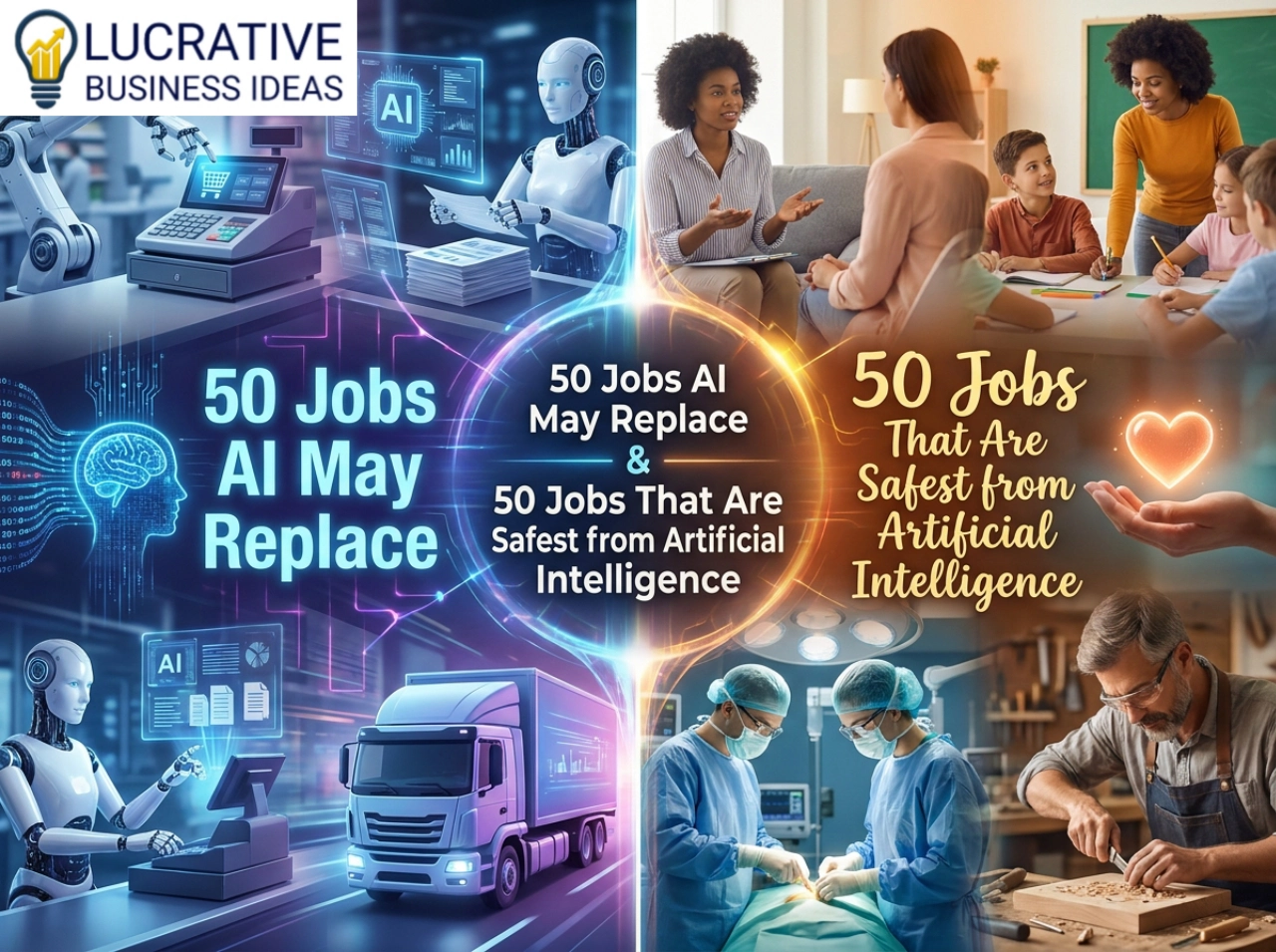
The future will not belong to people who simply “work hard.” It will belong to people who do work AI struggles to replicate.
This article explores both sides of that reality.
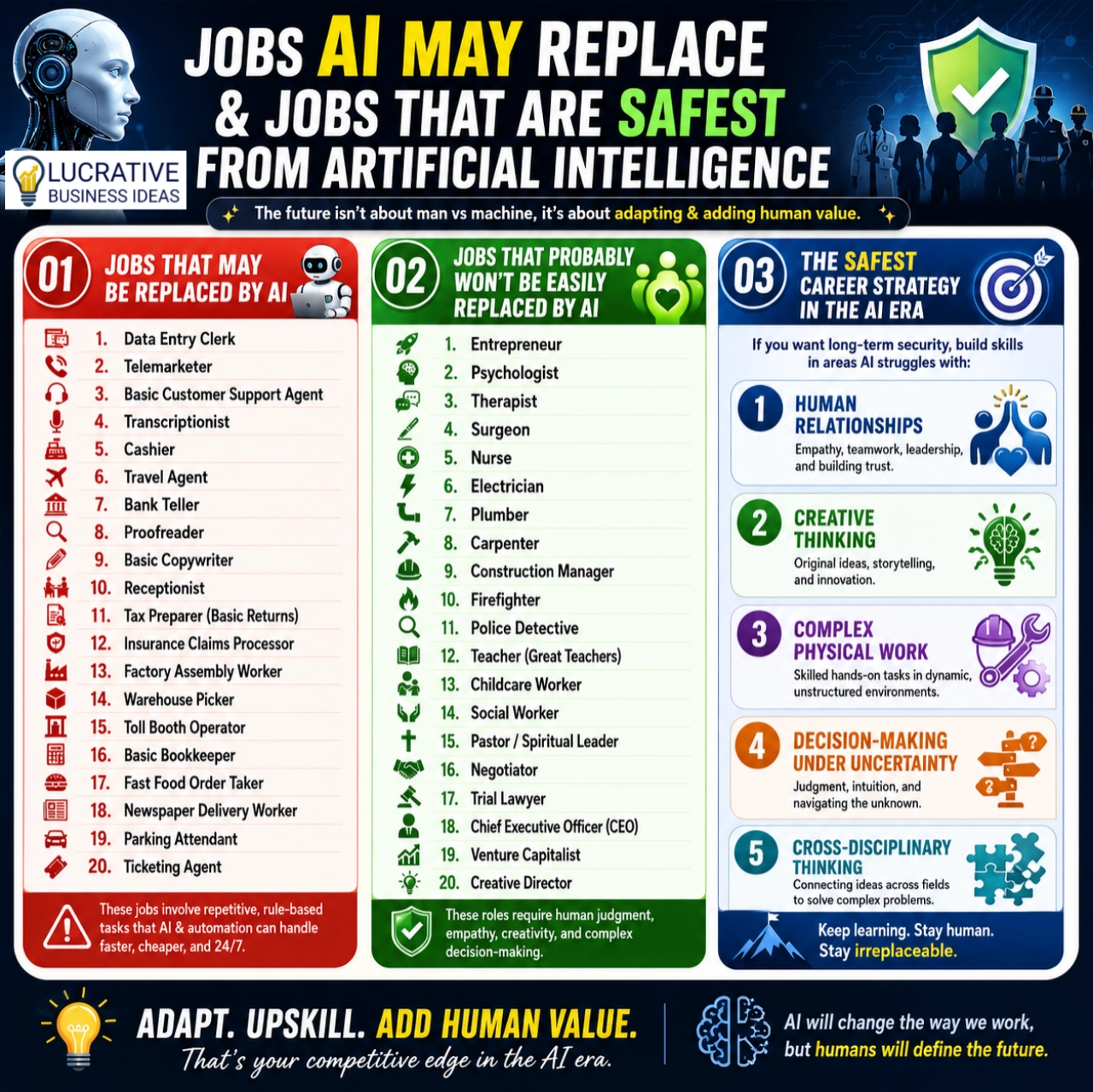
Part 1: 50 Jobs That May Be Replaced by AI
These jobs are not guaranteed to disappear completely. But many of them may shrink dramatically, become partially automated, or require far fewer humans than today.
1. Data Entry Clerk
AI systems can already process forms, invoices, spreadsheets, and documents faster and more accurately than humans.
2. Telemarketer
AI voice systems can now conduct natural conversations, answer objections, and operate endlessly without fatigue.
3. Basic Customer Support Agent
Chatbots increasingly handle FAQs, refunds, troubleshooting, and ticket routing with minimal human involvement.
4. Transcriptionist
Speech-to-text technology has improved so dramatically that human transcription is rapidly losing value.
5. Cashier
Self-checkout systems, AI retail stores, and digital payments are reducing the need for human cashiers.
6. Travel Agent
AI can compare flights, hotels, pricing, reviews, and itineraries instantly.
7. Bank Teller
Mobile banking, AI financial assistants, and automated service kiosks are replacing routine banking tasks.
8. Proofreader
Grammar AI tools now detect spelling, tone, punctuation, and style errors in seconds.
9. Basic Copywriter
Simple ad copy, product descriptions, captions, and generic marketing content can now be generated instantly.
10. Receptionist
AI scheduling systems and virtual assistants are replacing front-desk administrative tasks.
11. Tax Preparer (Basic Returns)
AI accounting systems can already automate simple tax filing processes.
12. Insurance Claims Processor
AI can evaluate documents, detect fraud patterns, and approve straightforward claims faster than humans.
13. Factory Assembly Worker
Robotics and AI-driven automation continue to dominate repetitive manufacturing environments.
14. Warehouse Picker
Autonomous robots are increasingly handling inventory retrieval and logistics.
15. Toll Booth Operator
Digital toll systems already eliminated many of these jobs.
16. Basic Bookkeeper
Modern AI accounting software can categorize transactions and generate reports automatically.
17. Fast Food Order Taker
Voice AI ordering systems are entering restaurants globally.
18. Newspaper Delivery Worker
Digital media and automation destroyed much of this industry already.
19. Parking Attendant
Automated parking systems and cashless technology reduce human involvement.
20. Ticketing Agent
Online booking and AI kiosks have drastically reduced staffing needs.
21. Market Research Analyst (Basic Level)
AI can analyze consumer trends and large datasets much faster than junior analysts.
22. Simple Graphic Designer
AI image generators now create logos, banners, and marketing visuals in minutes.
23. Photo Editor
AI editing software can automatically enhance, retouch, crop, and color-correct images.
24. Basic Video Editor
AI video tools now generate subtitles, transitions, cuts, and even short-form videos automatically.
25. Loan Underwriter (Routine Cases)
AI models can evaluate risk profiles with massive speed and consistency.
26. Retail Sales Associate
E-commerce, AI shopping assistants, and automated stores are reducing dependence on in-person sales staff.
27. Switchboard Operator
Telecommunications automation made this role nearly obsolete.
28. Basic Legal Assistant
AI can scan contracts, search legal databases, and summarize documents rapidly.
29. Medical Scheduler
Automated appointment systems increasingly handle booking and reminders.
30. Inventory Clerk
AI tracking systems monitor stock levels in real time.
31. Basic Translator
Machine translation has become shockingly accurate for common language tasks.
32. Survey Interviewer
AI-driven digital surveys can gather and analyze responses instantly.
33. Mortgage Processor
Document verification and risk assessment are increasingly automated.
34. Dispatch Operator
AI logistics systems can optimize routing dynamically.
35. Resume Screener
Recruitment AI can filter thousands of applications rapidly.
36. Basic Financial Analyst
AI can detect trends, summarize reports, and analyze large datasets efficiently.
37. Radio DJ (Generic Stations)
AI-generated voices and automated playlists are already appearing.
38. Junior Programmer
AI coding assistants can now generate simple applications and debug routine problems.
39. SEO Content Writer (Low-Level)
Mass-produced informational articles are increasingly AI-generated.
40. Security Monitor Operator
AI surveillance systems can detect suspicious activity automatically.
41. Manufacturing Quality Inspector
Computer vision systems identify defects with extraordinary precision.
42. Typist
Voice AI and automation drastically reduced the need for manual typing specialists.
43. Simple Social Media Manager
AI can schedule posts, generate captions, and analyze engagement data.
44. Delivery Route Planner
AI logistics software optimizes routes better than humans in many cases.
45. Basic Research Assistant
AI can summarize papers and collect information at massive speed.
46. Billing Clerk
Automated payment systems increasingly handle invoicing and reconciliation.
47. Call Center Agent
Voice AI is rapidly becoming more conversational and emotionally convincing.
48. Retail Stock Replenisher
Smart inventory systems and robotics reduce labor needs.
49. Basic Paralegal
Document review and legal summarization are becoming heavily automated.
50. News Reporter for Commodity Content
AI can generate weather updates, financial summaries, and sports recaps instantly.
The Brutal Pattern Behind Most Replaceable Jobs
Most vulnerable jobs share at least one of these characteristics:
- Repetitive
- Predictable
- Rules-based
- Highly structured
- Data-heavy
- Low emotional complexity
- Easily digitized
- Measurable by efficiency alone
If a job mainly involves processing information using fixed patterns, AI will likely absorb a significant portion of it.
That does not mean humans become useless. It means humans must move higher.
Part 2: 50 Jobs That Probably Won’t Be Easily Replaced by AI
Now comes the surprising part. Some careers are becoming more valuable because of AI, not less.
Why? Because the more artificial the world becomes, the more society values deeply human capabilities.
1. Entrepreneur
Building businesses requires risk-taking, intuition, leadership, persuasion, and adaptability.
2. Psychologist
Human emotional complexity is difficult for AI to fully understand and treat.
3. Therapist
People often need human empathy, presence, and trust — not merely information.
4. Surgeon
Advanced surgery requires dexterity, judgment, and unpredictable decision-making.
5. Nurse
Nursing combines technical skill with emotional care and human interaction.
6. Electrician
Physical troubleshooting in unpredictable environments remains difficult for robots.
7. Plumber
Real-world repair work requires adaptability AI still struggles with physically.
8. Carpenter
Custom craftsmanship and onsite problem-solving are hard to automate.
9. Construction Manager
Managing people, timelines, chaos, and field realities demands human coordination.
10. Firefighter
Dynamic emergencies remain extremely difficult for autonomous systems.
11. Police Detective
Human intuition, interrogation, and contextual judgment matter enormously.
12. Teacher (Great Teachers)
Exceptional teaching involves inspiration, mentorship, emotional intelligence, and adaptation.
13. Childcare Worker
Children need emotional connection and human development support.
14. Social Worker
Complex human crises require trust, ethics, and compassion.
15. Pastor / Spiritual Leader
Spiritual guidance depends heavily on human connection and moral authority.
16. Negotiator
High-level negotiation depends on reading emotions, leverage, and hidden motives.
17. Trial Lawyer
Persuasion, courtroom dynamics, and emotional storytelling remain deeply human.
18. Chief Executive Officer (CEO)
Strategic vision and leadership under uncertainty are difficult to automate.
19. Venture Capitalist
Identifying human ambition and future potential is highly intuitive.
20. Creative Director
Original cultural vision still requires human imagination and taste.
21. Film Director
Managing emotion, actors, storytelling, and artistic nuance is deeply human.
22. Actor
Authentic human performance and emotional expression remain valuable.
23. Musician
AI can imitate music, but human identity and emotional resonance still matter.
24. Stand-Up Comedian
Comedy depends on timing, culture, unpredictability, and audience energy.
25. Athlete
Sports are fundamentally human competition and entertainment.
26. Fashion Designer
Taste, cultural relevance, and creative intuition remain human-driven.
27. Chef
High-end culinary experiences depend heavily on creativity and sensory judgment.
28. Event Planner
Managing people, emotions, logistics, and live unpredictability is difficult for AI.
29. Interior Designer
Human lifestyle understanding and emotional aesthetics remain essential.
30. Relationship Coach
People seek human understanding, not just algorithmic advice.
31. Political Leader
Leadership requires persuasion, charisma, and social trust.
32. Human Rights Advocate
Moral courage and activism remain profoundly human.
33. Military Commander
Strategic wartime judgment under uncertainty is highly complex.
34. Emergency Medical Technician
Real-world emergency response requires rapid physical adaptability.
35. Veterinarian
Animal care combines medical expertise with physical examination and compassion.
36. Physical Therapist
Hands-on rehabilitation and motivation are hard to automate fully.
37. Dentist
Precision physical procedures still require human oversight.
38. Archaeologist
Field interpretation and contextual analysis remain human strengths.
39. Scientist (Frontier Research)
True scientific breakthroughs require creativity and unconventional thinking.
40. Product Visionary
Inventing entirely new categories still depends heavily on human imagination.
41. Luxury Sales Consultant
High-end buyers often value trust, exclusivity, and human relationships.
42. Mediator
Conflict resolution depends heavily on emotional nuance and trust-building.
43. Diplomats
International relations require cultural intelligence and strategic communication.
44. UX Researcher
Understanding real human behavior goes beyond raw data.
45. Leadership Coach
Transforming people psychologically requires deep interpersonal skill.
46. High-Level Software Architect
Complex systems thinking and strategic design remain difficult to automate completely.
47. Robotics Technician
Ironically, humans will still be needed to maintain the machines.
48. Crisis Manager
Handling chaos, uncertainty, and public emotion requires human leadership.
49. Community Builder
People crave belonging, identity, and authentic human connection.
50. Inventor
AI can optimize existing ideas, but true invention often comes from human curiosity and unconventional insight.
The Hidden Truth Most People Ignore
AI does not merely replace jobs. It changes the economic value of skills.
Average skills become cheaper. Rare human abilities become more expensive. That is the real shift happening.
The future belongs increasingly to people who combine:
- Human creativity
- Emotional intelligence
- Strategic thinking
- Adaptability
- Leadership
- Communication
- Technical leverage
- Courage under uncertainty
People who only perform repetitive tasks are in danger. People who solve difficult human problems are becoming more valuable.
The Safest Career Strategy in the AI Era
If you want long-term security, build skills in areas AI struggles with:
1. Human Relationships
Trust, persuasion, leadership, negotiation, empathy.
2. Creative Thinking
Original ideas remain incredibly valuable.
3. Complex Physical Work
Especially unpredictable real-world environments.
4. Decision-Making Under Uncertainty
AI struggles when rules are unclear.
5. Cross-Disciplinary Thinking
People who combine technology with psychology, business, design, or storytelling will dominate.
How to Transition from AI-Threatened Jobs to AI-Resilient Careers
The worst mistake people can make in the AI era is waiting until their industry collapses before adapting.
History shows that technological revolutions reward people who move early. The people who survive disruption are rarely the strongest or the smartest. They are usually the fastest adapters.
If your current role falls into the “high-risk” category, do not panic. Many of the safest and highest-paying careers of the future are still accessible — even if you are starting from scratch.
The key is not merely changing jobs. The key is evolving your value.
1. Stop Thinking Like an Employee — Start Thinking Like a Problem Solver
Most vulnerable jobs are task-based. Most resilient jobs are problem-based.
AI is excellent at repeating tasks. Humans still dominate in solving messy human problems.
For example:
- A data entry clerk types information.
- A business consultant solves operational inefficiencies.
- A cashier processes transactions.
- A customer experience strategist improves loyalty and retention.
- A basic copywriter writes generic articles.
- A brand strategist shapes perception and emotional influence.
The more your work involves judgment, leadership, creativity, emotional intelligence, or complex human interaction, the safer you become.
2. Move Toward Human-Centered Careers
AI struggles most in environments that require:
- Empathy
- Trust
- Negotiation
- Leadership
- Emotional intelligence
- Real-world adaptability
That is why careers involving people are becoming more valuable.
Smart Career Shifts (Format: Threatened Job – Better Long-Term Direction)
- Data Entry Clerk – Business Analyst
- Telemarketer – High-Ticket Sales Consultant
- Basic Customer Support – Customer Success Manager
- Cashier – Retail Operations Manager
- Basic Copywriter – Brand Strategist
- Call Center Agent – Relationship Manager
- Junior Programmer – AI Systems Architect
- Basic Graphic Designer – Creative Director
- Warehouse Worker – Robotics Technician
- Bookkeeper – Financial Strategist
- Basic Translator – International Business Consultant
- SEO Writer – Content Strategist
- Legal Assistant – Trial Lawyer or Mediator
- Factory Worker – Automation Specialist
- Dispatcher – Logistics Operations Manager
The goal is upward movement — not lateral survival.
3. Learn to Use AI Instead of Competing Against It
This is one of the most important survival strategies of the modern era.
People who refuse AI may become less competitive. People who master AI may become dramatically more valuable.
For example:
- Writers who use AI can produce faster.
- Designers who use AI can prototype quicker.
- Lawyers who use AI can research faster.
- Doctors who use AI can diagnose earlier.
- Entrepreneurs who use AI can scale leaner.
AI is becoming a force multiplier.
The future may reward people who combine:
- Human judgment
- Human creativity
- AI leverage
That combination is extraordinarily powerful.
4. Build Skills That Machines Struggle to Copy
If you want career durability, prioritize these skill categories:
A. Communication Skills
Public speaking, persuasion, storytelling, negotiation, leadership communication.
B. Emotional Intelligence
Conflict management, empathy, relationship building, influence.
C. Strategic Thinking
Long-term planning, business judgment, systems thinking.
D. Creative Problem Solving
Original thinking is still difficult for machines to replicate authentically.
E. Technical Adaptability
You do not need to become a programmer, but you should become technologically fluent.
5. Enter Fields with Physical Complexity
Robots still struggle in unpredictable physical environments.
That is why skilled trades remain surprisingly resilient.
Strong Long-Term Options
- Electrician
- Plumber
- HVAC Technician
- Construction Manager
- Robotics Maintenance Specialist
- Solar Installation Expert
- Industrial Safety Specialist
Ironically, many blue-collar jobs may become safer than some white-collar office jobs.
6. Build a Personal Brand
In the AI era, anonymity is becoming economically dangerous.
People trust people more than algorithms.
A strong personal brand creates:
- Trust
- Visibility
- Authority
- Opportunity
- Pricing power
Start:
- Sharing insights online
- Building a portfolio
- Teaching what you know
- Networking intentionally
- Becoming known for something valuable
The future may increasingly reward reputation.
7. Develop Multiple Income Streams
One of the biggest risks of the future is depending on a single employer or skill.
The smartest professionals are building:
- Freelance income
- Consulting income
- Digital products
- Online audiences
- Investments
- Side businesses
Economic flexibility may become one of the greatest forms of security.
8. Focus on Industries AI Will Expand — Not Destroy
Some industries may grow massively because of AI.
Promising Future Industries
- AI consulting
- Cybersecurity
- Robotics
- Renewable energy
- Healthcare
- Mental health services
- Biotechnology
- Education technology
- Human performance coaching
- Elderly care
- AI governance and ethics
Do not merely ask: “What jobs will disappear?”
Also ask: “What new problems will AI create?”
That is where future wealth often emerges.
9. Become Exceptionally Good at Something
Average skills are becoming cheaper. Exceptional skills are becoming more valuable. Mediocrity is increasingly vulnerable to automation.
The future belongs to people who become:
- Top communicators
- Top strategists
- Top creators
- Top leaders
- Top technicians
- Top problem solvers
Depth matters more than ever.
10. Think Long-Term, Not Temporary Comfort
Many people stay in dying industries because change feels uncomfortable.
But comfort can become dangerous. The world is changing too quickly for passive career planning.
The people who thrive will likely be those who:
- Learn continuously
- Adapt aggressively
- Reinvent themselves repeatedly
- Stay technologically aware
- Move before crisis forces them to move
That mindset alone may separate future winners from future casualties.
The Smartest Position Is Not “Anti-AI”
Many people are making a major mistake: They are fighting AI instead of learning how to leverage it.
That is like trying to stop electricity during the Industrial Revolution.
The winners of the next decade will likely be:
- Writers who use AI
- Doctors who use AI
- Lawyers who use AI
- Entrepreneurs who use AI
- Engineers who use AI
- Creators who use AI
The future may not belong to AI alone. It may belong to humans who know how to work with AI better than everyone else.
See Also:
- 30 Best Lucrative Agribusiness Ideas & How to Start Them (Ultimate Guide for Beginners & Investors)
- 10 Powerful Time Management Techniques Successful Entrepreneurs Use to Dominate their Day
Final Thoughts
The AI revolution is not simply a technology story. It is an economic restructuring of human value.
Some careers will shrink dramatically. Others will explode in value.
The safest path is not blind optimism or fear. It is adaptation.
Learn faster. Think deeper. Become more human in the areas machines struggle to imitate.
Because in a world filled with artificial intelligence, authentic human capability may become the rarest and most valuable asset of all.
10 Frequently Asked Questions (FAQs) About Jobs Ranked by AI Risk
1. Will AI completely replace humans in the workplace?
Probably not completely. AI will replace certain tasks more than entire professions. Most jobs will likely evolve rather than vanish entirely. Humans who learn to work alongside AI may become far more productive and valuable.
2. Which workers are most at risk from AI?
Workers performing repetitive, predictable, rules-based tasks face the highest risk. This includes jobs involving routine data processing, basic customer service, simple content creation, and administrative repetition.
3. Which careers are safest from AI disruption?
Careers involving emotional intelligence, leadership, creativity, physical adaptability, and complex human interaction are generally safer. Examples include therapists, entrepreneurs, skilled tradespeople, surgeons, teachers, negotiators, and creative directors.
4. Is learning coding still worth it in the AI era?
Yes — but the nature of programming is changing. Basic coding may become heavily automated, but high-level software architecture, systems design, AI integration, cybersecurity, and complex engineering remain highly valuable.
5. Can AI replace entrepreneurs?
Not easily. Entrepreneurship involves vision, risk-taking, leadership, persuasion, adaptability, and decision-making under uncertainty. AI can assist entrepreneurs, but it struggles to replace entrepreneurial instinct completely.
6. What skills should young people prioritize today?
Young people should focus heavily on:
- Communication
- Critical thinking
- Emotional intelligence
- Creativity
- Leadership
- Technological adaptability
- Strategic problem-solving
These skills are becoming more economically valuable in an AI-driven world.
7. Are university degrees becoming less important?
In some industries, yes. Employers increasingly value practical skills, adaptability, portfolios, experience, and problem-solving ability over credentials alone. However, specialized professions like medicine, engineering, and law still require formal education.
8. Can AI create new jobs too?
Absolutely. Every major technological revolution creates new industries and opportunities.
AI may generate demand for:
- AI trainers
- Prompt engineers
- Robotics technicians
- AI ethicists
- Human-AI collaboration specialists
- AI consultants
- Digital creators
- Cybersecurity experts
The future will likely create jobs that do not even exist today.
9. How can older workers adapt to AI changes?
Older workers should focus on learning AI-assisted tools rather than resisting them. Their experience, judgment, and industry knowledge remain valuable. Combining wisdom with modern tools can create a strong competitive advantage.
10. What is the single best career strategy for the next 20 years?
Become highly adaptable.
The future belongs less to people with fixed knowledge and more to people who can:
- Learn quickly
- Reinvent themselves
- Use technology intelligently
- Solve difficult human problems
- Lead and communicate effectively
Adaptability may become the ultimate career skill.



One point that stood out is the idea that AI won’t replace every job equally, especially roles that depend on trust, emotional intelligence, and real-world adaptability. A lot of people focus only on which jobs may disappear, but the bigger conversation is probably how workers can start building skills that complement AI instead of competing directly with it. That shift in mindset will matter just as much as the technology itself.