
One of the biggest mistakes people make in business is choosing an opportunity because it looks profitable on the surface.
That is how many entrepreneurs end up trapped:
- exhausted
- broke
- frustrated
- emotionally drained
- constantly restarting
A business can be profitable and still be completely wrong for you. That is the part many people do not understand.
The internet is full of people shouting:
- “Start this business!”
- “This industry is booming!”
- “This side hustle makes millions!”
- “Anybody can do this!”
But business is not one-size-fits-all.
The right business for one person may destroy another person financially, mentally, or emotionally.
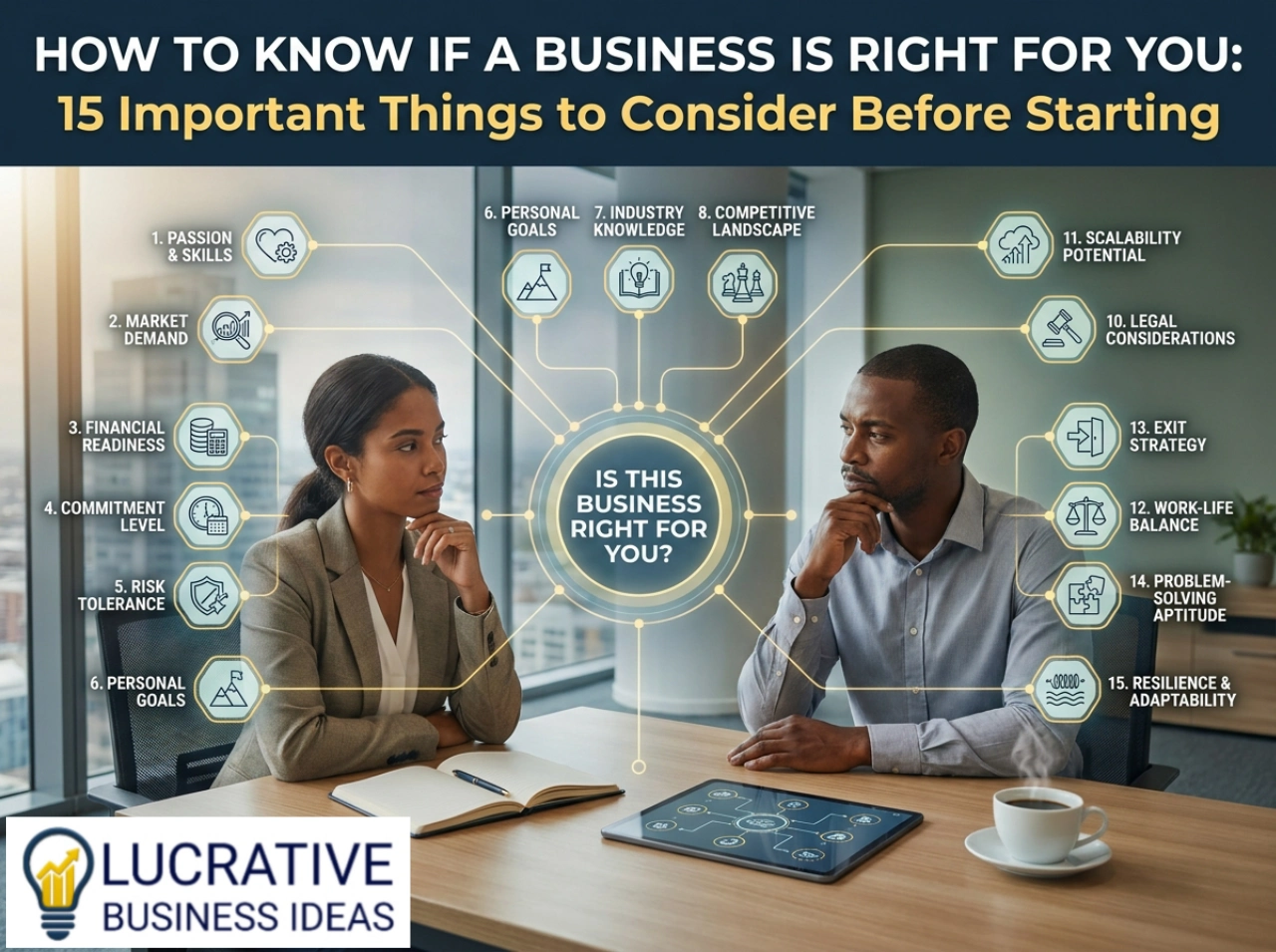
A business is not just about money. It is about:
- personality
- timing
- skills
- psychology
- lifestyle
- energy
- risk tolerance
- long-term alignment
This is why some people thrive in fast-moving startups while others succeed quietly in stable local businesses.
Some people love sales. Others hate it. Some people enjoy managing people. Others prefer systems and automation.
Some people can tolerate uncertainty for years. Others need predictable income to function properly.
If you choose the wrong business model for your personality and reality, you create permanent internal resistance. And internal resistance destroys execution.
So before starting any business, you need to ask a deeper question:
“Is this business truly aligned with who I am, how I think, what I can handle, and the future I want to build?”
That question can save you years of pain.
Why Most People Choose the Wrong Business
Most people choose businesses based on:
- hype
- social media influence
- emotional excitement
- envy
- trends
- desperation
- fear of missing out
That is dangerous.
Many people see someone making money online and immediately assume: “I should do that too.”
But they never stop to ask:
- Do I actually enjoy this type of work?
- Do I understand this industry?
- Can I handle the stress?
- Can I survive the learning curve?
- Does this fit my strengths?
- Is the timing right?
- Is the market sustainable?
- Do I even want the lifestyle attached to this business?
They chase income but ignore compatibility. That mistake becomes expensive later.
The First Truth: Every Business Has a Hidden Cost
Every business pays money. But every business also charges a hidden emotional price.
Some businesses demand:
- constant customer interaction
- high stress
- aggressive networking
- endless marketing
- operational chaos
- inventory management
- legal complexity
- emotional resilience
Others require:
- patience
- technical depth
- long learning curves
- delayed gratification
Before entering any business, ask:
“What type of suffering does this business require?”
Because every business comes with pressure.
The question is whether you can handle that specific type of pressure long term.
1. Check Whether the Business Matches Your Personality
This is one of the most ignored factors in entrepreneurship.
A business should align with your natural behavioral tendencies.
For example:
If You Are Highly Social
You may thrive in:
- consulting
- sales
- networking businesses
- real estate
- media
- community-based businesses
If You Prefer Deep Focus and Independence
You may thrive in:
- software
- writing
- design
- investing
- research
- automation businesses
If You Love Fast Action
You may enjoy:
- trading
- startups
- agency businesses
- product launches
If You Prefer Stability
You may prefer:
- essential services
- logistics
- agriculture
- manufacturing
- boring but stable industries
Trying to force yourself into a business model that conflicts with your personality creates burnout. And burnout quietly destroys entrepreneurs every day.
2. Check Whether the Business Fits Your Desired Lifestyle
This is critical. Many people chase business success without understanding the lifestyle attached to it.
Some businesses demand:
- constant travel
- 24/7 availability
- customer emergencies
- heavy management
- endless meetings
Others provide:
- flexibility
- remote work
- automation
- scalability
- location freedom
Ask yourself:
- Do I want freedom or structure?
- Do I want a team or independence?
- Do I want high growth or peace of mind?
- Do I want mobility or physical operations?
- Do I want predictable income or high upside potential?
The business you choose will shape your life for years. Choose carefully.
3. Check Market Demand
A business without demand is merely an expensive hobby.
You must verify:
- Are people already spending money in this market?
- Is the demand growing or shrinking?
- Is this solving a real problem?
- Are customers actively searching for solutions?
- Is this problem painful enough for people to pay?
The market determines survival. You do not need everyone to love your business. You need enough people with enough pain willing to pay consistently.
4. Check Timing
Timing matters more than many people realize.
Some businesses fail not because the idea was bad, but because the market was not ready yet.
Others succeed because they entered at exactly the right moment.
Good timing happens when:
- consumer behavior shifts
- technology evolves
- regulations change
- infrastructure improves
- economic conditions create demand
A mediocre business with perfect timing can outperform a brilliant business launched too early.
5. Check Whether the Business Has Long-Term Potential
Do not build your future on temporary excitement.
Ask:
- Will this industry still exist in 10 years?
- Is this trend sustainable?
- Could technology replace this?
- Is demand increasing globally?
- Is this business future-proof?
Many people build businesses around temporary hype cycles and become shocked when demand disappears. Long-term thinking creates durable wealth.
6. Check Your Skill Compatibility
Every business rewards specific skill sets.
Some require:
- communication
- persuasion
- creativity
- technical expertise
- systems thinking
- management
- analytical ability
Be honest about:
- your current strengths
- your weaknesses
- what you are willing to learn
- what you hate doing
You can absolutely learn new skills. But ignoring your natural strengths is inefficient.
Smart entrepreneurs often build around their strengths while gradually improving weaknesses.
7. Check the Profit Margins
Revenue is vanity. Profit is survival.
Some businesses generate huge sales but tiny margins. Others generate smaller revenue but massive profitability.
Ask:
- What are the operating costs?
- What are the margins?
- How scalable is profitability?
- How much capital is required?
- How much cash flow pressure exists?
A business that looks glamorous online may secretly be financially fragile. Always study the economics deeply.
8. Check Scalability
Can the business grow without destroying your life?
Some businesses scale beautifully. Others become more stressful as they grow.
Scalable businesses often include:
- software
- digital products
- media
- platforms
- automation systems
Less scalable businesses often rely heavily on:
- physical labor
- manual operations
- constant supervision
Neither is automatically better. But you must understand what you are building.
9. Check Your Risk Tolerance
Different businesses carry different levels of risk.
Some industries are highly volatile:
- crypto
- startups
- trading
- speculative technology
Others are more stable:
- food
- healthcare
- logistics
- agriculture
- essential services
Ask yourself honestly: “Can I emotionally handle uncertainty?”
Many people underestimate the emotional pressure of unstable income. Self-awareness matters enormously here.
10. Check Competition Carefully
Competition is not always bad. In fact, strong competition often proves market demand exists.
But you must ask:
- What makes me different?
- Why would customers choose me?
- Do I have a unique angle?
- Can I compete sustainably?
- Is the market overcrowded?
A crowded market without differentiation becomes a survival war.
11. Check Whether You Actually Enjoy the Core Work
This is massive. Many people love the idea of a business but hate the actual daily work involved.
For example:
- People love the idea of restaurants but hate operations
- People love fashion but hate inventory management
- People love content creation but hate consistency
- People love startups but hate uncertainty
Ask: “Would I still enjoy parts of this business even before major success arrives?”
Because business success often takes longer than expected. You must survive the journey emotionally.
12. Check the Learning Curve
Every business has a learning curve. Some are simple. Others require years of mastery.
Ask:
- How difficult is this industry?
- How long before profitability?
- What knowledge barriers exist?
- How expensive are mistakes?
- Can I realistically compete?
Many people enter difficult industries blindly and get overwhelmed quickly.
13. Check Capital Requirements
Some businesses require:
- inventory
- equipment
- offices
- staff
- licenses
- infrastructure
Others can start lean with:
- a laptop
- internet
- skills
- software
You must understand:
- startup costs
- operating costs
- cash flow cycles
- funding risks
Underestimating capital needs kills many businesses early.
14. Check Whether the Business Solves a Real Problem
The strongest businesses solve:
- painful problems
- urgent problems
- expensive problems
- emotional problems
- recurring problems
The bigger the pain, the stronger the business potential.
Businesses built around genuine value survive longer than businesses built around hype.
15. Check Whether You Can Stay Consistent Long Enough
Consistency is the hidden advantage in business. Most people quit too early.
Ask yourself:
- Can I commit to this for 5–10 years?
- Can I continue when results are slow?
- Can I survive rejection?
- Can I adapt through failure?
Business rewards endurance more than excitement.
The Most Dangerous Mistake: Choosing a Business for Status
This destroys many entrepreneurs.
People choose businesses because they:
- look impressive
- sound trendy
- attract social media attention
- appear luxurious
But status-driven businesses often create:
- financial pressure
- emotional exhaustion
- fake success
- hidden debt
- constant comparison
Never build a business merely to impress people. Build something sustainable, profitable, and aligned with your life.
The Best Businesses Often Look Boring
This is one of the greatest truths in entrepreneurship.
Many highly profitable businesses are not flashy.
Examples include:
- logistics
- warehousing
- payments
- infrastructure
- cleaning services
- agriculture
- software systems
- industrial supply
- maintenance
- data services
The internet glorifies excitement. But wealth often hides inside boring consistency.
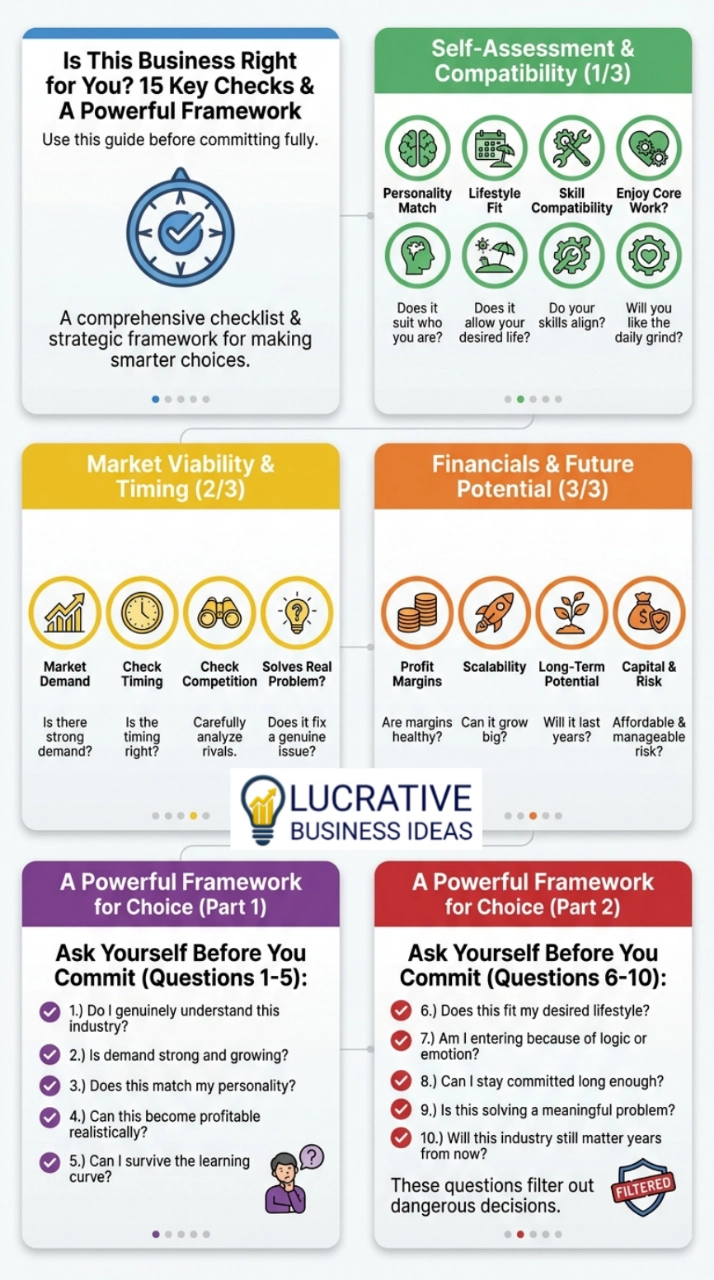
A Powerful Framework for Choosing the Right Business
Use this framework before committing fully.
Ask Yourself:
- Do I genuinely understand this industry?
- Is demand strong and growing?
- Does this match my personality?
- Can this become profitable realistically?
- Can I survive the learning curve?
- Does this fit my desired lifestyle?
- Am I entering because of logic or emotion?
- Can I stay committed long enough?
- Is this solving a meaningful problem?
- Will this industry still matter years from now?
These questions filter out dangerous decisions.
See Also:
- 30 Best Lucrative Agribusiness Ideas & How to Start Them (Ultimate Guide for Beginners & Investors)
- Could Another Global Pandemic Lockdown Happen Soon? Hidden Opportunities Entrepreneurs Must Prepare For
YouTube Video Guide: How to Know If a Business Is Right for You Before You Invest Time or Money: 15 Important Things to Check!
Final Thoughts
The right business is not necessarily:
- the trendiest
- the fastest-growing
- the most glamorous
- the most talked about online
The right business is the one where:
- your strengths align
- market demand exists
- timing makes sense
- profitability is realistic
- your psychology fits
- your lifestyle goals match
- long-term sustainability is possible
Business is not merely about making money. It is about building a vehicle that supports the life you actually want. And that requires honesty.
Real entrepreneurship is not copying what everyone else is doing.
It is understanding:
- yourself
- the market
- timing
- opportunity
- risk
- human behavior
- sustainability
When those things align, business stops feeling like constant internal warfare. And that is when you finally build something powerful enough to last.
Frequently Asked Questions (FAQs) About Choosing the Right Business
1. How do I know if a business is truly right for me?
A business is right for you when it aligns with:
- your personality
- strengths
- interests
- lifestyle goals
- financial expectations
- risk tolerance
- long-term vision
The mistake many people make is choosing a business only because it appears profitable or trendy.
A better approach is asking:
- Can I realistically enjoy this work long term?
- Can I handle the pressure this industry creates?
- Does this business fit the kind of life I want?
- Am I willing to stay committed through difficult periods?
The best businesses are usually the ones where your natural strengths and market demand meet.
2. Should I choose a business based on passion or profitability?
The smartest answer is: both matter. Passion alone is dangerous if there is no market demand. Profitability alone is dangerous if you hate the work.
A strong business opportunity usually exists at the intersection of:
- genuine interest
- market demand
- profitable economics
- sustainable execution
You do not need to be obsessed with the business every second, but you should at least enjoy the core activities enough to stay consistent over time.
Long-term business success requires emotional endurance, and it is difficult to endure work you completely dislike.
3. Why do many people fail after starting a business?
Many people fail because they enter businesses blindly without properly analyzing:
- market demand
- competition
- profitability
- timing
- scalability
- capital requirements
- personal compatibility
Some people also quit too early because they underestimate:
- the learning curve
- emotional pressure
- uncertainty
- delayed results
Others fail because they chose businesses based on hype instead of logic.
Business success usually requires patience, adaptability, and strategic thinking — not just excitement.
4. How important is market demand when choosing a business?
Market demand is everything. Without real demand, even the most creative business ideas struggle to survive.
Before starting a business, you should verify:
- Are people already paying for similar solutions?
- Is demand growing or shrinking?
- Does the business solve a real problem?
- Is the problem urgent enough for customers to spend money?
The strongest businesses solve painful, expensive, recurring, or emotional problems.
A business with strong demand has a much higher chance of surviving difficult economic conditions.
5. How do I know if a business has long-term potential?
To evaluate long-term potential, study:
- industry growth
- technological changes
- consumer behavior
- market sustainability
- future demand trends
Ask yourself:
- Will people still need this solution in 5–10 years?
- Is this business adaptable to future changes?
- Could automation or AI replace this industry?
- Is demand increasing globally?
Businesses built around temporary hype often collapse quickly.
Long-term wealth is usually created through businesses tied to durable human needs and growing industries.
6. Is competition a bad sign when choosing a business?
Not always. Competition often proves that money exists in the market. If nobody is competing, it may indicate weak demand.
The real question is: “What makes your business different?”
You need:
- a unique angle
- better customer experience
- stronger branding
- lower costs
- better service
- specialized positioning
- innovation
The goal is not necessarily avoiding competition entirely. The goal is finding a way to compete intelligently and sustainably.
7. How important is personality fit in business success?
Personality fit is extremely important.
Some businesses require:
- heavy social interaction
- aggressive sales
- constant networking
- leadership under pressure
Others require:
- technical focus
- patience
- deep concentration
- analytical thinking
If your business constantly fights against your natural tendencies, burnout becomes more likely.
For example:
- Introverts may struggle in high-pressure networking businesses.
- People who dislike uncertainty may struggle in highly volatile industries.
- Highly creative people may dislike repetitive operational work.
Self-awareness is one of the most underrated business advantages.
8. How much money should I have before starting a business?
The answer depends on the business model.
Some businesses require:
- inventory
- equipment
- offices
- staff
- licensing
- infrastructure
Others can start with very little capital using:
- skills
- software
- internet access
- digital tools
Before starting, calculate:
- startup costs
- operating expenses
- emergency reserves
- marketing costs
- cash flow needs
Many businesses fail because founders underestimate how much capital they actually need to survive the early stages. It is usually wise to start lean and control costs carefully.
9. What are the biggest mistakes people make when choosing a business?
Some of the biggest mistakes include:
- Choosing based on hype: Social media often glamorizes businesses without revealing the hidden difficulties.
- Ignoring personal compatibility: Not every business suits every personality or lifestyle.
- Underestimating competition: Entering crowded industries without differentiation is risky.
- Chasing status: Many people choose businesses to appear successful instead of building sustainable wealth.
- Ignoring profitability: Revenue means little if profit margins are weak.
- Quitting too early: Many businesses require years of consistent effort before major success appears.
Business decisions should be based on logic, research, and long-term thinking — not emotional excitement alone.
10. Can the “right business” change over time?
Absolutely. As people grow, their priorities, skills, financial goals, and lifestyles evolve.
A business that fits you at age 22 may not fit you at age 40.
For example:
- Younger entrepreneurs may prioritize speed and aggressive growth.
- Older entrepreneurs may prioritize stability, freedom, or predictable cash flow.
Markets also change over time.
That is why smart entrepreneurs continuously reassess:
- industry shifts
- personal goals
- profitability
- lifestyle alignment
- long-term sustainability
Adaptability is one of the most important business survival skills.