
Why do some entrepreneurs, innovators, investors, and leaders consistently solve difficult problems while others remain stuck in the same cycles of frustration and mediocre results?
The answer often lies not in intelligence, experience, or resources, but in the way they think.
Most people approach challenges by relying on conventional wisdom, copying existing solutions, or making decisions based on assumptions they have never questioned. While this approach may work for simple problems, it often fails when dealing with complex business challenges, disruptive innovations, personal growth obstacles, or rapidly changing markets.
This is where First Principles Thinking becomes a game-changing skill.
First Principles Thinking is a powerful problem-solving framework that involves breaking a problem down into its most fundamental truths and then rebuilding a solution from the ground up. Instead of asking, “How has this always been done?” first-principles thinkers ask, “What do I know to be unquestionably true?” By stripping away assumptions, traditions, and inherited beliefs, they uncover opportunities that others fail to see.
This way of thinking has been used by some of history’s greatest innovators, scientists, inventors, and entrepreneurs to challenge industry norms, create breakthrough products, and solve problems that once seemed impossible. However, First Principles Thinking is not the only powerful mental model available. The world’s best decision-makers combine it with other problem-solving frameworks such as Systems Thinking, Second-Order Thinking, Inversion Thinking, Root Cause Analysis, Probabilistic Thinking, the Pareto Principle, Constraint Thinking, Lateral Thinking, and the OODA Loop.
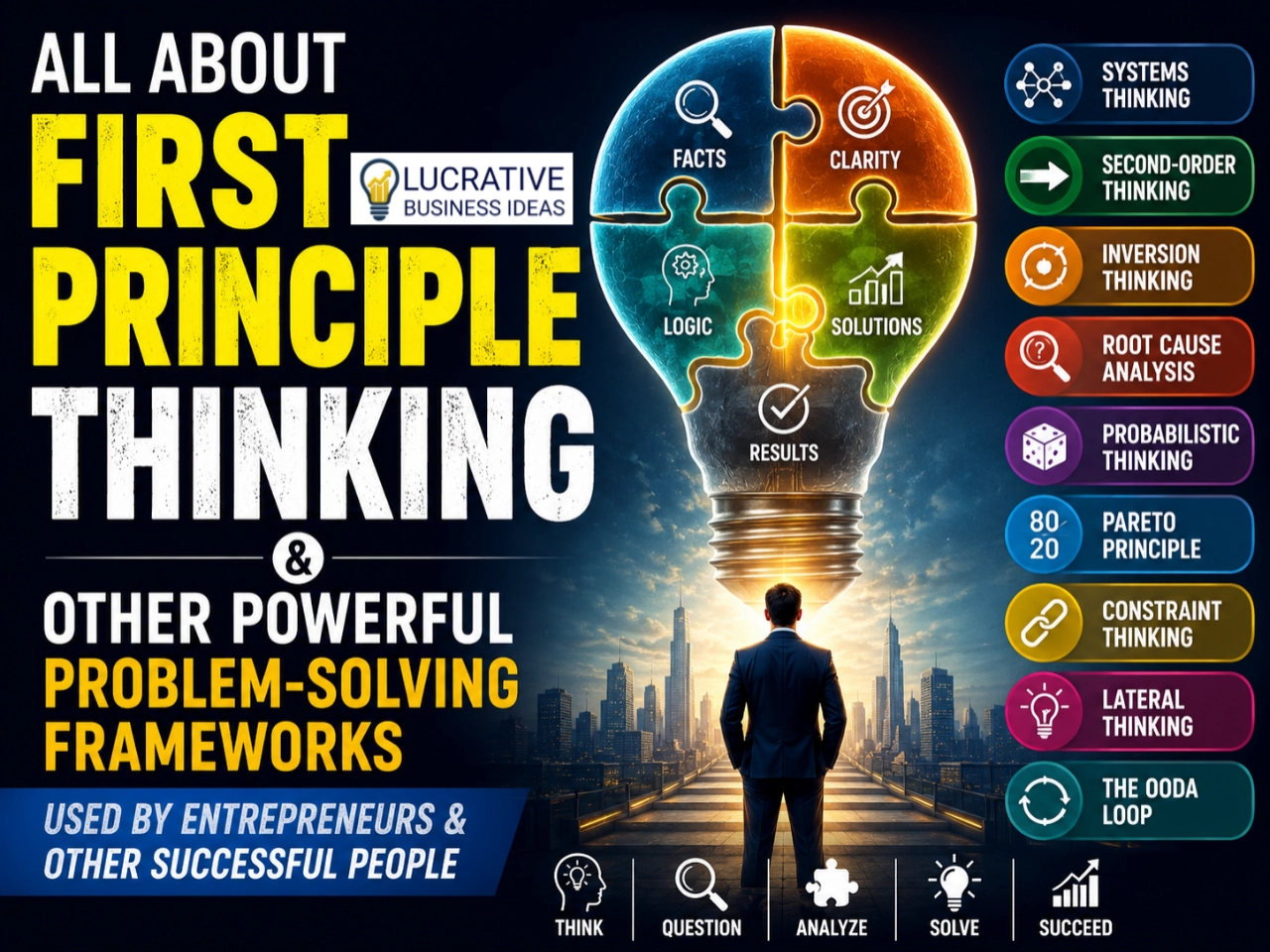
In this comprehensive guide, you will learn what First Principles Thinking is, why it matters, how to apply it in real-life situations, common mistakes to avoid, practical examples, frequently asked questions, and other powerful problem-solving principles that can dramatically improve your decision-making, creativity, business success, and ability to navigate uncertainty.
Whether you are an entrepreneur, business leader, investor, student, professional, or lifelong learner, mastering these mental models can transform the way you approach challenges and help you make smarter, more strategic decisions in every area of life.
What is First Principle Thinking?
At its core, First Principle Thinking is about breaking down complex problems into their most basic truths and building solutions from the ground up. It’s a concept rooted in physics and philosophy, popularized in modern entrepreneurship by visionaries like Elon Musk.
Common Thinking (Analogy Thinking)
Most people solve problems by copying what others do.
Example: “Tesla needs to build a battery like other car companies do.”
First Principle Thinking
You strip assumptions to find fundamental truths.
Example: “What is a battery, at its core? What are the raw materials? How can I make it cheaper and more efficient from scratch?”
Why it works: It avoids the trap of incremental thinking and conventional limitations. By questioning every assumption, you can discover creative, high-impact solutions.
How to Apply First Principle Thinking in Real Life Business Challenges
Here’s a step-by-step guide to using it:
1. Identify the Problem Clearly
Define the challenge in one sentence.
Example: “My startup can’t compete with bigger players on pricing.”
2. Break It Down to the Fundamental Truths
Strip assumptions. Ask: “What do I know is absolutely true?”
Example: “A product costs X dollars to make; pricing is driven by production and distribution costs.”
3. Question Assumptions
Ask yourself: “Why do we do it this way?” and “Is this necessarily true?”
Example: “Do I have to source materials the way everyone else does?”
4. Rebuild from Scratch
Design a solution based only on the fundamental truths.
Example: “If I can source cheaper materials or optimize logistics, I can undercut competitors without sacrificing quality.”
5. Test and Iterate
Implement the solution on a small scale, measure results, and improve.
Practical Challenge Scenarios Using First Principle Thinking
Scenario 1: High Product Costs in a Startup
Problem: Your tech gadget is too expensive to manufacture.
First Principle Approach
- Break down costs: Materials, labor, shipping, marketing.
- Question assumptions: Do I need this specific supplier or component? Can I use alternative materials without quality loss?
- Build solution: Negotiate directly with raw material providers or redesign the product for efficiency.
- Result: You reduce cost by 30%, making the product competitive.
Scenario 2: Struggling to Acquire Customers
Problem: Marketing campaigns are expensive, but customer acquisition is slow.
First Principle Approach
- Break down: How do customers discover us? What motivates purchases?
- Question assumptions: Do I need paid ads? Is social media enough?
- Build solution: Use referral programs, partnerships, or community-driven marketing.
- Result: Lower CAC (Customer Acquisition Cost) and faster growth.
Scenario 3: Investment Decision in a Volatile Market
Problem: You want to invest in renewable energy but fear risks.
First Principle Approach
- Break down: What makes renewable energy profitable? Energy demand, government incentives, technology costs.
- Question assumptions: Must I invest in big solar farms? Are there smaller, niche opportunities?
- Build solution: Micro-investments in emerging hydrogen tech startups or localized energy storage solutions.
- Result: Higher ROI with manageable risk exposure.
Global Icons and Companies Using First Principle Thinking
- Elon Musk (Tesla, SpaceX): Redesigns rockets from raw materials, reducing launch costs dramatically.
- Jeff Bezos (Amazon): Broke down retail to its basic supply chain and customer satisfaction principles to scale globally.
- Steve Jobs (Apple): Questioned assumptions about personal computing and design, creating products that redefined markets.
- Jack Ma (Alibaba): Used first principles to build an e-commerce ecosystem from scratch in China, focusing on logistics and trust.
Key Takeaways for You as a Young Entrepreneur
- Always question assumptions.
- Break problems into their fundamental truths.
- Build solutions from scratch.
- Combine with other thinking frameworks like design thinking or second-order thinking.
- Learn from global icons who applied these principles to create industry-defining solutions.
Other Powerful Problem-Solving Principles Similar to First Principles Thinking
First Principles Thinking is one of the most effective ways to solve problems, but it is not the only mental model that high-performing entrepreneurs, investors, scientists, engineers, and leaders use.
The most successful people rarely rely on a single way of thinking. Instead, they build a toolbox of problem-solving frameworks and apply the right one depending on the situation.
Think of it this way: If all you have is a hammer, every problem starts looking like a nail. The more thinking models you understand, the more accurately you can diagnose challenges and create solutions.
Here are some of the most powerful problem-solving principles that complement First Principles Thinking.
1. Second-Order Thinking
What Is It?
Most people focus on the immediate consequences of their decisions.
Second-Order Thinking goes a step further by asking: “What happens after that?”
Instead of considering only the first outcome, you examine the chain reaction that follows.
While average thinkers focus on today’s result, great thinkers consider tomorrow’s consequences.
Real-Life Example
Imagine a company decides to slash product prices to attract customers.
- First-order result: Sales increase.
- Second-order result: Profit margins shrink.
- Third-order result: The company has less money for marketing, innovation, and customer support.
- Fourth-order result: Product quality declines and customers leave.
What initially looked like a smart decision may eventually hurt the business.
How to Apply It
Before making any important decision, ask:
- What will happen immediately?
- What will happen six months later?
- What unintended consequences might emerge?
- How will this affect other areas?
This simple habit prevents costly mistakes.
2. Systems Thinking
What Is It?
Systems Thinking views problems as parts of interconnected systems rather than isolated events.
Everything influences everything else.
Instead of asking: “What caused this problem?”
Systems thinkers ask: “What system produced this outcome?”
Real-Life Example
A company notices declining employee productivity.
A traditional thinker might blame workers.
A systems thinker investigates deeper:
- Are employees overworked?
- Is communication poor?
- Are incentives misaligned?
- Is leadership creating bottlenecks?
The issue often lies within the system rather than the people.
How to Apply It
Whenever you face a problem:
- Identify all moving parts.
- Map relationships.
- Look for feedback loops.
- Fix root causes instead of symptoms.
This approach is especially valuable in business, management, economics, and public policy.
3. Inversion Thinking
What Is It?
Instead of asking: “How do I succeed?”
Ask: “How do I fail?”
Then avoid those actions.
Many problems become easier when viewed backward.
Real-Life Example
Suppose you want a successful marriage.
Rather than asking how to create a perfect relationship, ask: “What destroys relationships?”
Common answers include:
- Dishonesty
- Disrespect
- Lack of communication
- Neglect
Avoiding those behaviors dramatically increases your chances of success.
How to Apply It
Ask:
- What would guarantee failure?
- What mistakes do successful people avoid?
- What risks could destroy this project?
Often, avoiding major mistakes is more important than finding brilliant solutions.
4. Root Cause Analysis
What Is It?
Root Cause Analysis focuses on identifying the underlying source of a problem rather than treating symptoms.
One popular technique is the “Five Whys.”
You keep asking “Why?” until you reach the true cause.
Real-Life Example
Problem: A machine breaks down.
- Why? Because a bearing failed.
- Why? Because lubrication was insufficient.
- Why? Because maintenance was delayed.
- Why? Because maintenance schedules were poorly managed.
Now you’ve found the real issue.
The problem wasn’t the machine.
The problem was the maintenance process.
How to Apply It
Whenever problems occur:
- Don’t stop at the first explanation.
- Ask why repeatedly.
- Dig beneath surface symptoms.
- Address causes instead of consequences.
This saves enormous amounts of time and money.
5. Probabilistic Thinking
What Is It?
Probabilistic Thinking recognizes that life is uncertain.
Instead of asking: “Will this happen?”
You ask: “How likely is this to happen?”
Great investors and decision-makers think in probabilities rather than certainties.
Real-Life Example
An entrepreneur launches a new product.
Instead of assuming success or failure, they estimate:
- 20% chance of failure
- 50% chance of moderate success
- 30% chance of major success
This mindset encourages better planning and risk management.
How to Apply It
Replace absolute statements like:
- “This will work.”
- “This won’t work.”
With:
- “There is a high probability.”
- “There is a low probability.”
This leads to more realistic decisions.
6. Occam’s Razor
What Is It?
Occam’s Razor states: “The simplest explanation is often the correct one.”
People frequently create complicated explanations when simple answers exist.
Real-Life Example
A business experiences declining website traffic.
First possible explanation: A complex search-engine algorithm update.
Second possible explanation: The website has not published content in six months.
Often the simpler explanation deserves investigation first.
How to Apply It
When solving problems:
- Eliminate unnecessary complexity.
- Test simple explanations first.
- Avoid overthinking.
Complexity impresses people. Simplicity solves problems.
7. Pareto Principle (80/20 Rule)
What Is It?
The Pareto Principle suggests that roughly 80% of results come from 20% of causes.
Not all inputs produce equal outputs.
Real-Life Example
A business may discover:
- 20% of customers generate 80% of profits.
- 20% of products generate 80% of sales.
- 20% of activities produce 80% of growth.
Understanding this allows leaders to focus on what truly matters.
How to Apply It
Ask yourself:
- Which activities generate the biggest results?
- Which customers create the most value?
- Which problems cause most of the headaches?
Then concentrate your energy there.
8. Constraint Thinking
What Is It?
Constraint Thinking focuses on identifying the biggest bottleneck limiting progress.
Every system has at least one constraint.
Improving anything other than the main constraint often produces little improvement.
Real-Life Example
A factory wants higher output.
Management buys more equipment.
Production remains unchanged.
Why?
The real bottleneck was packaging capacity.
Until packaging improves, output cannot increase significantly.
How to Apply It
Ask:
- What is the single biggest obstacle?
- What is slowing everything else down?
- If I solved one problem today, which would create the greatest improvement?
Focus there first.
9. Lateral Thinking
What Is It?
Lateral Thinking encourages looking at problems from unusual angles.
Rather than moving logically from A to B, you intentionally explore unexpected possibilities.
Real-Life Example
A hotel receives complaints about slow elevators.
Installing new elevators would be expensive.
Instead, management places mirrors near the elevators.
Guests spend time looking at themselves and perceive waiting times as shorter.
The problem was not elevator speed. It was customer perception.
How to Apply It
Challenge assumptions by asking:
- What if the opposite were true?
- How would a child solve this?
- How would another industry solve it?
Creative breakthroughs often emerge from unexpected perspectives.
10. The OODA Loop
What Is It?
The OODA Loop stands for:
- Observe
- Orient
- Decide
- Act
The principle emphasizes rapid adaptation in changing environments.
Real-Life Example
A startup notices competitors launching new features.
Instead of spending months analyzing the market, the startup:
- Observes customer feedback.
- Orients around new information.
- Decides quickly.
- Acts rapidly.
The cycle repeats continuously.
The company that learns faster often wins.
How to Apply It
When conditions are changing quickly:
- Gather information.
- Analyze it.
- Make a decision.
- Take action.
- Learn and repeat.
Speed of learning becomes a competitive advantage.
Summary
First Principles Thinking is powerful because it helps you discover the truth beneath assumptions. However, the world’s best problem-solvers rarely stop there.
They combine multiple thinking frameworks:
- First Principles Thinking helps uncover fundamental truths.
- Second-Order Thinking helps predict consequences.
- Systems Thinking helps understand complexity.
- Inversion Thinking helps avoid mistakes.
- Root Cause Analysis helps solve problems permanently.
- Probabilistic Thinking helps manage uncertainty.
- Occam’s Razor helps simplify decisions.
- The Pareto Principle helps prioritize effort.
- Constraint Thinking helps remove bottlenecks.
- Lateral Thinking helps generate innovation.
- The OODA Loop helps adapt quickly.
The more of these mental models you master, the more effective you become at solving business challenges, making decisions, leading teams, building wealth, and navigating life’s uncertainties.
The goal is not to memorize frameworks. The goal is to develop the ability to see problems from multiple angles and choose the right tool for the situation. That is what separates ordinary thinkers from exceptional ones.
How to Know the Best Problem-Solving Principle to Apply When Faced with a Challenge
One of the biggest misconceptions about problem-solving is the belief that there is a single framework that works for every situation. In reality, the most successful entrepreneurs, investors, executives, and leaders do not rely on one thinking model. They select the most appropriate principle based on the nature of the problem they are facing.
Think of problem-solving principles as tools in a toolbox. A carpenter does not use a hammer for every task. Likewise, effective decision-makers do not use First Principles Thinking, Systems Thinking, or any other framework for every challenge. The key is learning when each tool is most useful.
The first step is to clearly define the problem. Many people rush into finding solutions before fully understanding the issue. Ask yourself: Is this a problem of innovation, decision-making, efficiency, uncertainty, complexity, or execution? The answer will often point you toward the most suitable framework.
Use First Principles Thinking When…
Apply First Principles Thinking when conventional solutions are not working, when you want to innovate, or when you suspect that existing assumptions may be limiting your options.
For example, if you are launching a new business, developing a product, entering a new market, or trying to reduce costs dramatically, First Principles Thinking can help you break the problem down into its fundamental truths and build a solution from the ground up.
Ask yourself:
- What assumptions am I making?
- What facts do I know for certain?
- If I were starting from scratch, how would I solve this problem?
Use Systems Thinking When…
Use Systems Thinking when the problem involves multiple interconnected factors and the cause is not immediately obvious.
For instance, if a company is experiencing declining sales, the issue may not be the sales team alone. The problem could involve marketing, customer service, product quality, pricing, competition, leadership, or market trends. Systems Thinking helps you see the bigger picture rather than focusing on isolated symptoms.
Ask yourself:
- What factors are influencing this outcome?
- How are these factors connected?
- What system is producing this result?
Use Second-Order Thinking When…
Apply Second-Order Thinking when making decisions with long-term consequences.
Many decisions look good in the short term but create problems later. Before making a major investment, hiring employees, changing prices, or expanding a business, consider not only the immediate effects but also the consequences that may follow months or years later.
Ask yourself:
- What happens next?
- What are the unintended consequences?
- How will this decision affect future opportunities?
Use Inversion Thinking When…
Inversion Thinking is valuable when the path to success is unclear but the causes of failure are obvious.
Instead of asking how to achieve a goal, ask what would guarantee failure and then avoid those mistakes.
For example, if you want to build a successful business, identify the behaviors that destroy businesses—poor cash flow management, ignoring customers, weak leadership, and lack of innovation—and work to avoid them.
Ask yourself:
- What could cause this project to fail?
- What mistakes should I avoid?
- What risks could be catastrophic?
Use Root Cause Analysis When…
If a problem keeps recurring despite repeated attempts to fix it, Root Cause Analysis is usually the right approach.
Many people spend their lives treating symptoms instead of solving underlying issues. By repeatedly asking “Why?” you can uncover the real source of the problem.
For example, if a business constantly misses deadlines, the real issue may not be employee performance. It could be unrealistic planning, unclear processes, poor communication, or inadequate resources.
Ask yourself:
- Why did this happen?
- Why did that happen?
- What is the underlying cause beneath all the symptoms?
Use Probabilistic Thinking When…
Probabilistic Thinking is especially useful when dealing with uncertainty.
Business, investing, and entrepreneurship rarely offer guarantees. Instead of trying to predict the future with certainty, estimate the likelihood of different outcomes and prepare accordingly.
Successful investors, for example, do not ask whether an investment will succeed. They ask how likely it is to succeed and whether the potential reward justifies the risk.
Ask yourself:
- What are the possible outcomes?
- How likely is each outcome?
- Is the potential reward worth the risk?
Use the Pareto Principle When…
The Pareto Principle is ideal when you feel overwhelmed by too many tasks, problems, or opportunities.
Often, a small number of actions generate most of the results. Identifying those high-impact activities allows you to focus your time and resources where they matter most.
Ask yourself:
- Which activities create the biggest results?
- Which customers, products, or efforts contribute the most value?
- What should I focus on first?
Use Constraint Thinking When…
Constraint Thinking is most effective when progress has stalled.
Every system has a bottleneck. Finding and fixing that bottleneck often produces the greatest improvement.
For example, a growing business may assume it needs more customers, but the real constraint could be poor operations, limited production capacity, or weak customer retention.
Ask yourself:
- What is the biggest obstacle right now?
- What is slowing everything else down?
- If I solved one problem today, which would have the greatest impact?
Use Lateral Thinking When…
Lateral Thinking is valuable when traditional solutions have failed.
This approach encourages creativity and unconventional perspectives. Sometimes the solution is not to work harder but to view the problem differently.
Ask yourself:
- What assumptions am I taking for granted?
- How would someone from another industry solve this?
- What unconventional solution might work?
A Practical Rule of Thumb
If you are unsure which framework to use, start by asking these simple questions:
- Is this an innovation problem? → Use First Principles Thinking.
- Is this a complex, interconnected problem? → Use Systems Thinking.
- Is this a long-term decision? → Use Second-Order Thinking.
- Am I trying to avoid failure? → Use Inversion Thinking.
- Is the same problem recurring? → Use Root Cause Analysis.
- Am I dealing with uncertainty? → Use Probabilistic Thinking.
- Am I overwhelmed by too many priorities? → Use the Pareto Principle.
- Is progress blocked by a bottleneck? → Use Constraint Thinking.
- Do I need a creative breakthrough? → Use Lateral Thinking.
Summary
The best problem-solvers do not ask, “Which framework is the best?” They ask, “Which framework is best for this situation?”
Over time, as you gain experience, you will learn to combine multiple thinking models. In fact, the most effective entrepreneurs and investors often use several frameworks together. They may begin with First Principles Thinking to understand the problem, apply Systems Thinking to see the bigger picture, use Second-Order Thinking to anticipate consequences, and employ Probabilistic Thinking to evaluate risks.
That is where true decision-making mastery begins—not in knowing one powerful principle, but in knowing when and how to apply the right principle at the right time.
See Also:
- Adaptive Thinking & Critical Thinking in Business: The Ultimate Guide to Smarter Decisions, Innovation & Long-Term Success
- How to Know If a Business Is Right for You: 15 Important Things to Consider Before Starting
Conclusion
The quality of your life, business, career, and relationships is largely determined by the quality of your thinking. Every major breakthrough, innovation, business success, and personal achievement begins with the ability to see problems differently and make better decisions.
First Principles Thinking stands out as one of the most powerful problem-solving frameworks because it teaches you to move beyond assumptions and focus on fundamental truths. Instead of accepting the world as it is, you learn to examine reality more deeply, challenge conventional wisdom, and create solutions that others overlook. This mindset opens the door to innovation, adaptability, and long-term success.
At the same time, no single mental model can solve every problem. The most effective thinkers build a diverse toolkit that includes Systems Thinking for understanding complexity, Second-Order Thinking for anticipating consequences, Inversion Thinking for avoiding mistakes, Root Cause Analysis for identifying underlying issues, Probabilistic Thinking for managing uncertainty, and other proven frameworks that strengthen judgment and decision-making.
The goal is not to memorize dozens of theories. The goal is to develop the habit of thinking more clearly, asking better questions, and approaching challenges from multiple perspectives. When you consistently do that, you become better equipped to solve difficult problems, seize opportunities, and make decisions with confidence.
In a world that is becoming increasingly complex and unpredictable, those who learn how to think effectively will always have an advantage over those who simply react to circumstances. Master First Principles Thinking, combine it with other powerful mental models, and you will possess one of the most valuable competitive advantages available in business and in life: the ability to consistently find better answers where others see only obstacles.
Frequently Asked Questions (FAQs) About First Principle Thinking
1. What Is First Principles Thinking in Simple Terms?
First Principles Thinking is a method of solving problems by breaking them down into their most fundamental truths and then rebuilding solutions from the ground up. Instead of accepting assumptions, traditions, or common practices, you ask, “What do I know for certain?”
Most people think by analogy. They look at what others have done and try to improve it slightly. First Principles Thinking challenges you to start from scratch and create entirely new possibilities.
For example, if everyone says a product is expensive to manufacture, a first-principles thinker asks what materials are involved, how much those materials actually cost, and whether there is a completely different way to make the product. This approach often leads to breakthroughs because it removes limitations created by conventional thinking.
2. Why Is First Principles Thinking Important in Business?
Business environments change rapidly. Markets evolve, customer preferences shift, and technologies disrupt entire industries. Companies that rely solely on traditional methods often struggle to adapt.
First Principles Thinking helps entrepreneurs and leaders challenge outdated assumptions and discover innovative solutions. It encourages deeper analysis, better decision-making, and more efficient use of resources.
Many of the world’s most successful businesses achieved their breakthroughs by questioning industry norms rather than blindly following them. When you learn to think from first principles, you stop asking, “How is everyone else doing it?” and start asking, “What is the best possible way to do this?”
3. How Is First Principles Thinking Different from Traditional Problem-Solving?
Traditional problem-solving often relies on precedent. People look at existing solutions and make small improvements. This approach is faster but can limit innovation.
First Principles Thinking takes a different route. Instead of beginning with existing solutions, it begins with fundamental truths. You strip away assumptions, identify the core components of the problem, and rebuild your understanding from scratch.
Think of traditional thinking as renovating an old house, while First Principles Thinking is like clearing the land and designing a completely new structure based on today’s needs and possibilities.
4. Can Anyone Learn First Principles Thinking?
Absolutely. First Principles Thinking is not a talent reserved for scientists, inventors, or billionaires. It is a skill that can be developed through practice.
The key is cultivating curiosity and learning to challenge assumptions. Whenever you encounter a problem, ask questions such as:
- Why is this done this way?
- Is this truly necessary?
- What evidence supports this belief?
- What are the fundamental facts?
The more frequently you question accepted ideas and analyze problems from the ground up, the stronger your first-principles thinking becomes.
5. What Are the Main Steps in Applying First Principles Thinking?
A practical First Principles Thinking process typically involves four steps:
- Step 1: Clearly define the problem.
- Step 2: Break the problem into its most basic components and facts.
- Step 3: Challenge every assumption and identify what is actually true.
- Step 4: Reconstruct a solution based on those fundamental truths.
For example, if a business wants to reduce costs, instead of immediately cutting staff, it can examine every expense category, identify the true cost drivers, and redesign operations from the ground up.
This method often reveals opportunities that would otherwise remain hidden.
6. What Are Some Real-Life Examples of First Principles Thinking?
First Principles Thinking can be applied almost anywhere.
- In business, it can help reduce costs, create innovative products, improve customer experiences, and develop new business models.
- In personal finance, it can help individuals analyze spending habits and create more effective financial plans.
- In education, students can use it to understand concepts deeply rather than memorizing information.
- In career development, professionals can identify the most important skills required for success and focus their learning efforts more effectively.
The beauty of First Principles Thinking is that it works across virtually every area of life.
7. What Are the Biggest Challenges When Using First Principles Thinking?
One of the biggest challenges is overcoming mental habits.
People naturally rely on assumptions, social norms, and established patterns because they save time and mental energy. Questioning everything requires effort and discipline.
Another challenge is uncertainty. When you reject conventional wisdom, you may not immediately know what the right answer is. The process can feel uncomfortable because it forces you to think independently.
Additionally, organizations sometimes resist first-principles thinkers because their ideas challenge long-standing traditions and procedures.
Despite these obstacles, the rewards often outweigh the discomfort.
8. When Should You Use First Principles Thinking?
First Principles Thinking is especially valuable when:
- You face complex problems.
- Existing solutions are failing.
- You want breakthrough innovation.
- You are entering a new industry or market.
- You need to significantly reduce costs or improve efficiency.
- You are making important strategic decisions.
However, it is not always necessary for routine decisions. For simple or repetitive tasks, relying on proven methods can be more efficient. The key is knowing when a problem requires fresh thinking and when existing solutions are sufficient.
9. Can First Principles Thinking Help with Personal Problems?
Yes, and often more than people realize.
Many personal challenges are influenced by assumptions we have accepted without questioning them. These assumptions can shape our finances, relationships, careers, and goals.
For example, someone may believe success requires a traditional career path simply because that is what society expects. A first-principles approach would examine the actual goals, resources, and opportunities available, potentially revealing alternative paths that are more effective and fulfilling.
By focusing on facts instead of assumptions, individuals can make more intentional and informed life decisions.
10. How Can I Develop the Habit of Thinking from First Principles Every Day?
Developing this habit requires consistent practice.
Start by becoming more curious. Whenever you encounter a challenge, resist the urge to accept the first explanation or solution.
Ask deeper questions:
- What do I know to be true?
- What assumptions am I making?
- Is there evidence supporting these assumptions?
- If I had to solve this problem from scratch, how would I approach it?
Reading widely, learning from different disciplines, and engaging in thoughtful discussions can also strengthen your ability to think independently.
Over time, First Principles Thinking becomes less of a technique and more of a mindset—one that helps you see opportunities, solve problems creatively, and make better decisions in both business and life.
Quizzes to Reinforce Learning
- What is the key difference between First Principle Thinking and analogy thinking?
- Why does breaking problems down to their fundamentals help in entrepreneurship?
- Name one global entrepreneur who heavily uses First Principle Thinking.
- How would you apply First Principle Thinking to reduce marketing costs?
- Which other problem-solving frameworks complement First Principle Thinking?