
Most people think angel investing is only for billionaires sitting in private rooms writing million-dollar checks to tech founders. That is outdated thinking.
The truth is this: Angel investing has quietly become one of the most powerful wealth-building vehicles of the modern economy.
Some of the largest fortunes in recent history were created because certain investors recognized extraordinary companies before the rest of the world noticed them.
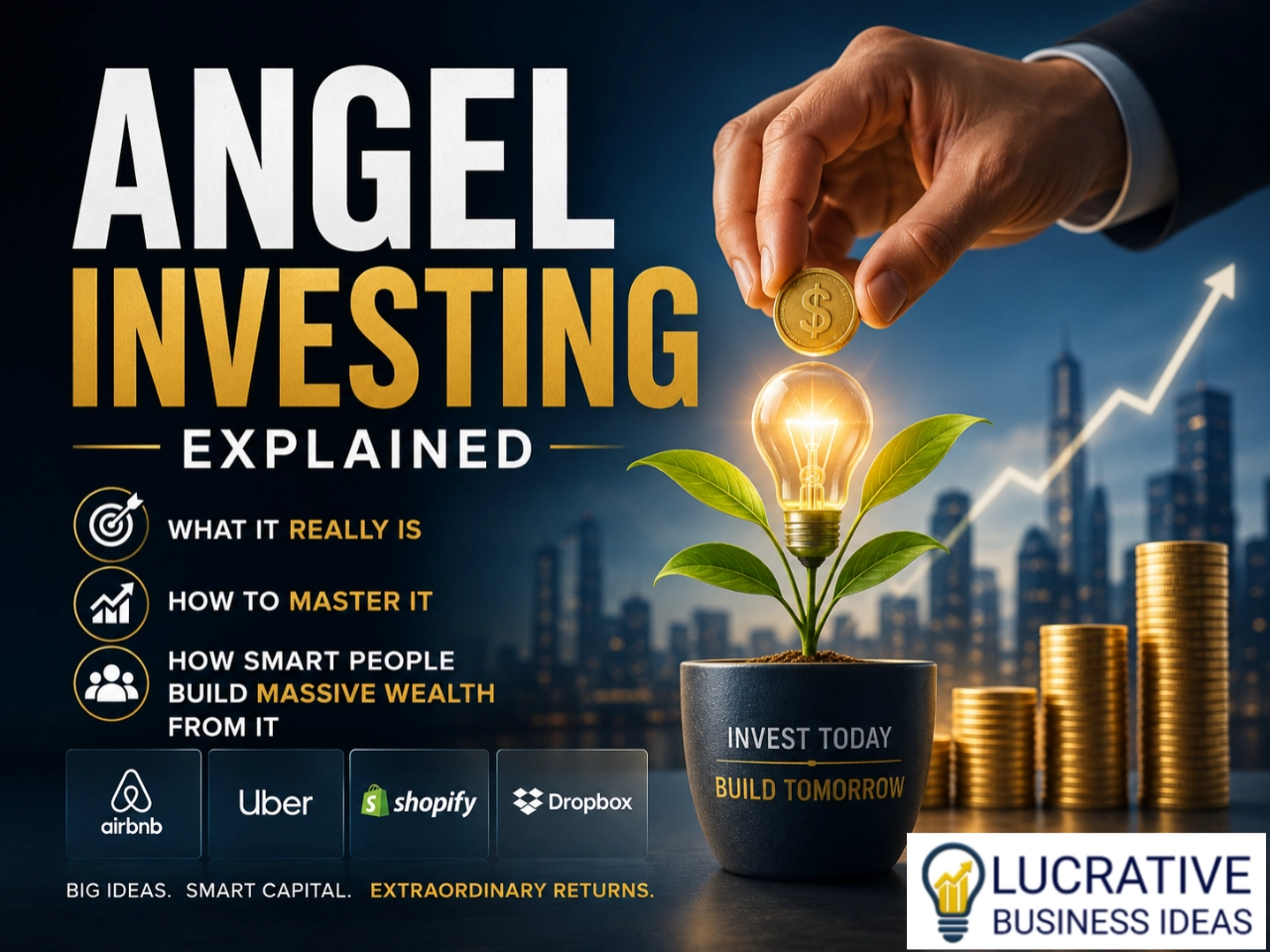
Early angel investors in:
- Uber
- Airbnb
- Stripe
made life-changing returns.
Some investments produced:
- 100x returns
- 500x returns
- even 1,000x outcomes
That is the seductive power of angel investing.
But here is the part most beginners never hear:
Angel investing is not gambling on startups. At its highest level, it is the art of identifying future economic dominance before the mainstream market catches up.
That requires intelligence. Pattern recognition. Emotional discipline. And deep understanding of people, technology, timing, and market psychology.
What Is Angel Investing?
Angel investing is when individuals invest their personal money into early-stage startups in exchange for equity ownership.
Angel investors usually invest:
- before venture capital firms
- during the earliest growth stages
- when risk is highest
- when valuations are still relatively low
That is why the upside can become enormous.
Angel investors often help startups with:
- funding
- mentorship
- strategy
- networking
- credibility
- introductions to larger investors
The best angel investors are not just money providers. They are ecosystem builders.
The Real Difference Between Angel Investors and Venture Capitalists
Many people confuse angel investing with venture capital. They overlap, but they are not the same.
Angel Investors
- invest personal capital
- often invest earlier
- usually make smaller investments
- can move faster
- may take more personal risks
Venture Capital Firms
- invest institutional money
- usually enter later
- deploy larger capital pools
- follow structured investment processes
Angel investors often discover opportunities before VCs arrive. That early positioning is where massive asymmetrical returns are born.
Why Angel Investing Creates Extraordinary Wealth
Because startups operate inside something called power laws. Most startups fail. A few survive. Very few become giants.
But those few giants can generate returns so massive that they compensate for many failed investments.
One successful angel investment can outperform:
- decades of salary income
- traditional stock investing
- real estate appreciation
That is why sophisticated investors pay close attention to startup ecosystems.
The Core Philosophy of Elite Angel Investors
Elite angel investors think differently from ordinary people.
Most people ask: “What is already working?”
Angel investors ask: “What could become inevitable in the future?”
That shift in thinking changes everything.
Great angel investors study:
- emerging technology
- behavioral shifts
- infrastructure gaps
- demographic changes
- scientific breakthroughs
- economic transitions
They invest where the world is moving — not where it currently is.
The Main Things Smart Angel Investors Analyze
1. Founder Quality
This may be the single most important factor in angel investing.
Why?
Because startups constantly evolve.
Products change. Markets shift. Business models pivot.
Exceptional founders adapt under pressure.
Great angel investors look for founders who possess:
- resilience
- obsession
- intelligence
- execution ability
- adaptability
- emotional toughness
- leadership
- communication skills
A weak founder can destroy a brilliant idea.
A great founder can transform an average idea into a massive business.
2. Market Size
A startup operating in a tiny market rarely becomes a giant company.
Angel investors want massive upside.
That usually requires massive markets.
The best startup opportunities often exist inside:
- Artificial Intelligence
- biotechnology
- cybersecurity
- fintech
- robotics
- climate technology
- space infrastructure
- healthcare
- automation
Big markets create room for explosive growth.
3. Product-Market Fit
Product-market fit means customers genuinely want the product.
This is one of the most important signals in startup investing.
Signs include:
- rapid user growth
- customer retention
- strong engagement
- word-of-mouth referrals
- recurring usage
- community excitement
Without product-market fit, most startups eventually struggle.
With strong product-market fit, growth can become explosive.
4. Timing
Timing is brutally important.
Many startups fail not because the idea was bad, but because the market was not ready yet.
History is filled with companies that arrived too early.
The best angel investors study:
- technological readiness
- infrastructure maturity
- consumer behavior
- regulatory shifts
- market psychology
Timing can determine whether a startup becomes a billion-dollar company or disappears completely.
5. Competitive Advantage (Moat)
Angel investors constantly ask: “What stops competitors from copying this?”
Strong startup moats may include:
- proprietary technology
- AI models
- patents
- network effects
- exclusive partnerships
- data advantages
- brand loyalty
- switching costs
Without a moat, successful startups attract dangerous competition quickly.
The Dark Reality of Angel Investing Most Beginners Ignore
Angel investing is extremely risky. Very risky.
Many startups:
- fail completely
- run out of cash
- struggle to scale
- lose market relevance
- collapse during economic downturns
Some statistics suggest most angel investments either:
- fail
- stagnate
- or produce mediocre returns
This is why angel investing requires:
- patience
- diversification
- emotional control
- deep research
Beginners who chase hype usually lose money.
How Angel Investors Actually Make Money
Angel investors make money when startups experience liquidity events.
This usually happens through:
- acquisitions
- IPOs
- secondary share sales
- large funding rounds
If a startup’s valuation rises dramatically, early investors can generate extraordinary returns.
Example: An investor who buys 1% equity in a startup valued at $1 million may eventually own shares worth millions if the company grows into a billion-dollar business.
That is the mathematical beauty of startup equity.
How to Start Learning Angel Investing
Step 1: Study Startup Ecosystems
Start understanding:
- startup culture
- innovation hubs
- founder psychology
- emerging technologies
- venture capital trends
Follow:
- startup founders
- angel investors
- venture capital firms
- accelerators
- incubators
The more exposure you gain, the better your pattern recognition becomes.
Step 2: Learn Business Fundamentals
Many beginners focus only on hype and storytelling.
Serious angel investors understand:
- unit economics
- customer acquisition costs
- burn rate
- scalability
- revenue models
- gross margins
- retention metrics
A startup can appear exciting while secretly having terrible economics.
Step 3: Learn Startup Funding Structures
Understand concepts like:
- SAFE agreements
- cap tables
- dilution
- convertible notes
- pre-seed rounds
- seed funding
- Series A/B/C financing
This knowledge protects you from making naive investment decisions.
Step 4: Build Networks
Angel investing is heavily relationship-driven.
Many great opportunities never become publicly visible.
The best investors often access deals through:
- founder communities
- startup events
- private networks
- accelerator programs
Relationships create opportunity flow.
Step 5: Start Small
One of the biggest beginner mistakes is investing too much too early.
Start carefully. Learn gradually.
Angel investing is a skill developed through experience and repetition.
Treat early investments partly as education.
How Ordinary People Can Benefit Without Becoming Full-Time Angel Investors
Most people assume they need millions to benefit from startup ecosystems.
Not true.
You can benefit by:
- working in startups
- building startup-related businesses
- investing in innovation-focused public stocks
- learning future-focused skills
- joining startup communities
- creating startup media or educational content
Understanding startup ecosystems can improve:
- career positioning
- investment decisions
- entrepreneurial opportunities
- long-term wealth creation
The Biggest Angel Investing Opportunities of the Next Decade
Several industries may produce extraordinary angel investment opportunities over the next 10–20 years:
- Artificial Intelligence
- Longevity Science
- Biotechnology
- Robotics
- Cybersecurity
- Space Technology
- Climate Tech
- Financial Infrastructure
- Autonomous Systems
- Quantum Computing
The next generation of global giants may emerge from these sectors.
The Hidden Skill Behind Great Angel Investing
The real skill is not simply analyzing startups.
It is developing future vision.
Great angel investors become experts at recognizing:
- inevitable trends
- infrastructure bottlenecks
- behavioral shifts
- scalable technologies
- exceptional founders
They train themselves to see tomorrow before the crowd sees it.
That is why the best angel investors often appear “crazy” early and obvious later.
The Final Truth About Angel Investing
Angel investing is not a shortcut to fast wealth.
It is a long-term game of:
- pattern recognition
- intelligent risk-taking
- relationship building
- future forecasting
- emotional discipline
Many people will lose money chasing hype.
But those who truly master startup ecosystems may gain something far more valuable than profits alone: The ability to recognize the future early.
And in the modern economy, that may become one of the most powerful advantages a person can possess.
See Also:
- Startup Ecosystems: The Complete Guide to Understanding, Mastering & Leveraging Them for Extraordinary Success
- Macro Pattern Recognition in Business: The Hidden Skill That Separates Empires from Average Companies
Frequently Asked Questions (FAQs) About Angel Investing
1. What is angel investing in simple terms?
Angel investing is when individuals use their own money to invest in early-stage startups in exchange for ownership (equity).
These startups are usually very young—often just an idea, a prototype, or an early product.
Angel investors take on high risk because many startups fail, but the reward can be extremely large if a company succeeds.
For example, early angel investors in companies like Uber or Airbnb made life-changing returns because they entered at very early valuations before mainstream adoption.
In simple terms: Angel investing = betting early on future winners before the world notices them.
2. How is angel investing different from venture capital?
Angel investing and venture capital are similar but not the same.
Angel investors:
- use personal money
- invest earlier (pre-seed or seed stage)
- take smaller positions
- often invest based on intuition + vision
- may support startups personally
Venture capital firms:
- invest institutional money
- enter slightly later stages
- invest larger amounts
- use structured analysis and committees
- focus heavily on scaling businesses
Angel investors often discover opportunities first, while VCs scale them later.
In many cases, angel investors plant the seeds that venture capital eventually grows into billion-dollar companies.
3. Why do most angel investments fail?
Because startups are inherently high-risk.
Most early-stage companies fail due to:
- lack of product-market fit
- weak execution
- poor timing
- funding shortages
- strong competition
- market rejection
Even experienced angel investors expect that:
- many investments will go to zero
- a few will perform moderately
- a very small number will generate massive returns
The entire system depends on “Power Law Returns,” where one big winner compensates for many losses.
That is why diversification and patience are critical.
4. What makes a startup worth investing in as an angel investor?
Strong angel investors evaluate several key factors:
- Founder quality (most important)
- Market size and growth potential
- Product-market fit signals
- Competitive advantage (moat)
- Scalability of the business model
- Timing of the innovation
- Early traction and user adoption
A strong founder in a growing market with early traction is often more valuable than a perfect product in a weak market.
Angel investing is more about future potential than current performance.
5. How much money do you need to start angel investing?
There is no fixed amount, but traditionally angel investing requires meaningful risk capital.
In practice:
- Some investors start with $1,000–$10,000 through syndicates or platforms
- Others invest $25,000–$100,000 per deal
- Professional angels often invest much more across portfolios
The most important rule: Never invest money you cannot afford to lose.
A smart approach is to treat early angel investments as both:
- learning experiences
- long-term asymmetric bets
6. How do angel investors actually make money?
Angel investors make money when startups experience a liquidity event such as:
- acquisition by a larger company
- IPO (going public)
- secondary share sales
For example, if you invest early in a startup that later becomes a billion-dollar company, your small initial stake can grow exponentially in value.
Some early investors in companies like Facebook or Stripe saw extraordinary returns due to early entry and massive scaling.
The key idea is equity multiplication over time.
7. What are the biggest risks in angel investing?
Angel investing is extremely risky.
Major risks include:
- total loss of capital (most common)
- startup failure
- founder breakdown or mismanagement
- market rejection
- regulatory changes
- poor scaling decisions
- dilution from future funding rounds
Unlike traditional investing, there is no guaranteed recovery.
This is why angel investors must diversify and expect failure as part of the process.
8. Can beginners become successful angel investors?
Yes—but not immediately.
Beginners can learn angel investing by:
- studying startup ecosystems
- following venture capital trends
- analyzing successful startups
- joining angel groups or syndicates
- investing small amounts first
However, success requires:
- patience
- emotional discipline
- pattern recognition
- experience with multiple deals
Most successful angel investors learn through real-world exposure, not theory alone.
9. What industries offer the best angel investing opportunities today?
Some of the most promising sectors include:
- Artificial Intelligence
- Biotechnology and Longevity Science
- Fintech and digital banking
- Cybersecurity
- Robotics and automation
- Climate technology
- Space infrastructure
- Health tech and diagnostics
These industries share one thing: They are early in their growth cycle and undergoing rapid transformation.
Many future unicorn companies are likely to emerge from these sectors.
10. What is the most important mindset for successful angel investing?
The most important mindset shift is learning to think in terms of the future, not the present.
Most people ask: “What is working today?”
Angel investors ask: “What will dominate tomorrow?”
Successful angel investors develop:
- long-term thinking
- comfort with uncertainty
- strong risk tolerance
- deep curiosity about innovation
- ability to identify trends early
Angel investing is not just financial strategy. It is future prediction combined with disciplined risk-taking.