
Artificial intelligence is no longer something you watch in science-fiction movies.
It is already changing how people write, design, research, analyse data, build software, create videos, market products and run businesses.
But here is something you need to understand early:
The people making money from AI are not necessarily the people who know the most about AI. They are the people who know how to use AI to solve valuable problems.
That is where AI prompt engineering becomes interesting.
You have probably typed something into ChatGPT, Gemini, Claude or another AI tool and received a disappointing answer. Then you changed the wording, added context, gave the AI examples and explained exactly what you wanted—and suddenly the quality improved dramatically.
That difference is the beginning of prompt engineering.
Prompt engineering is not simply about writing clever sentences for ChatGPT. It is about communicating with AI strategically so that you can consistently produce useful, accurate and relevant results.
And if you learn it properly, you can turn that skill into something much bigger:
a freelancing service, a consulting business, a content business, an automation service, a training business, or a foundation for a broader AI career.
But don’t rush to buy an expensive course.
Don’t start by memorising hundreds of prompt templates.
And don’t believe anyone who tells you that becoming a prompt engineer is simply a matter of learning a few “secret prompts.”
There is a much smarter way to learn.
Article Content Structure
Part 1 — Foundation
- Introduction: Why Prompt Engineering Matters Now
- What AI Prompt Engineering Really Is
- What a Prompt Engineer Actually Does
- Do You Need to Be a Programmer?
- The Skills You Actually Need
- The Biggest Myths About Prompt Engineering
Part 2 — The Learning Roadmap
- Stage 1: Learn How Generative AI Works
- Stage 2: Master Prompt Fundamentals
- Stage 3: Learn Prompt Frameworks and Techniques
- Stage 4: Practice With Real Problems
- Stage 5: Learn AI Tools Beyond ChatGPT
- Stage 6: Build a Portfolio
- Stage 7: Develop a Specialization
Part 3 — Making Money
- Realistic Ways to Make Money With Prompt Engineering
- Freelancing
- AI Content Creation
- AI Automation Services
- AI Consulting
- Prompt Libraries and Digital Products
- AI Training and Coaching
- Helping Businesses Integrate AI
- How to Price Your Services
- Where to Find Your First Clients
Part 4 — Best Online Learning Strategy
- Best Free Ways to Learn
- Best Paid Courses and Platforms
- How to Learn Without Wasting Money
- A Practical 30-Day Learning Plan
- A 90-Day Skill-to-Income Roadmap
- Common Mistakes Beginners Make
- How to Stay Relevant as AI Evolves
Part 5 — Business Futurist Perspective
- Where Prompt Engineering Is Going
- Why Prompt Engineering Alone May Not Be Enough
- The Rise of AI Workflow Designers and AI Strategists
- The Skills That Will Become More Valuable
- How to Build a Long-Term AI Career
- Conclusion
1. What Exactly Is AI Prompt Engineering?
Let’s make this extremely simple.
A prompt is the instruction, question or information you give an AI system to produce an output.
For example:
“Write a blog article about small businesses.”
That is a prompt.
But it is a weak one.
You haven’t told the AI who the audience is, what tone to use, how long the article should be, what problem it should solve or what outcome you want.
Now compare it with:
“Act as an experienced small-business consultant. Write a 1,500-word blog article for young African entrepreneurs explaining five realistic low-capital businesses they can start. Use simple English, practical examples, realistic challenges and actionable steps. Make the introduction emotionally engaging and optimise the article naturally for search engines.”
That is a much stronger prompt.
Prompt engineering is the skill of designing instructions that help an AI system produce a desired result.
It involves understanding things such as:
- Context
- Objectives
- Instructions
- Constraints
- Examples
- Desired output format
- Audience
- Tone
- Evaluation
- Iteration
The important word here is iteration.
Your first prompt will not always produce the best answer.
A skilled prompt engineer doesn’t simply type one instruction and hope for magic.
They test.
They observe.
They refine.
They compare.
They improve.
That mindset is more important than memorising prompts.
2. What Does a Prompt Engineer Actually Do?
This is where many beginners get confused.
They imagine a prompt engineer sitting at a computer all day writing increasingly complicated instructions to an AI.
That’s not the whole picture.
A good prompt engineer asks:
“What problem are we trying to solve, and how can AI solve it reliably?”
Imagine a company wants to use AI to respond to customer enquiries.
A beginner might create:
“Answer the customer professionally.”
An experienced AI practitioner thinks further.
What information should the AI use?
What should it never say?
What happens when information is missing?
What tone should it use?
When should it escalate the conversation to a human?
How should it handle angry customers?
How should the output be structured?
How do we test whether the system is actually working?
That is the difference between prompt writing and AI problem-solving.
As you become more advanced, you may work on:
- AI content systems
- Customer-support assistants
- Marketing workflows
- Research assistants
- Business intelligence tools
- AI-powered chatbots
- Document analysis
- AI automation
- Internal business knowledge systems
- AI training and consulting
So don’t define your future too narrowly.
Prompt engineering can be your entry point into the much larger AI economy.
3. Do You Need to Be a Programmer?
Here is some good news.
No—not to start.
You can learn prompt engineering without being a professional programmer.
You can begin with basic tools such as ChatGPT, Claude, Gemini and other generative-AI platforms.
You can learn how to:
- Write better instructions
- Structure complex requests
- Give AI useful context
- Provide examples
- Control output formats
- Evaluate responses
- Build reusable workflows
- Improve AI-generated content
However, don’t misunderstand this.
Programming can become extremely valuable as you progress.
If you eventually learn Python, APIs, automation tools, databases, AI agents and workflow platforms, you can move beyond simply prompting AI into building AI-powered systems.
Think of it like this:
Level 1: Use AI.
Level 2: Prompt AI effectively.
Level 3: Build repeatable AI workflows.
Level 4: Automate those workflows.
Level 5: Build AI-powered products and systems.
You don’t need to start at Level 5.
But if you want a serious long-term AI career, don’t be afraid of learning technical skills later.
4. The Skills You Actually Need
You don’t need to know everything about artificial intelligence.
You need a useful combination of skills.
Skill 1: Clear Communication
If you cannot explain what you want clearly to a human, you will struggle to communicate effectively with AI.
Learn to be specific.
Instead of:
“Make this better.”
Say:
“Rewrite this introduction to make it more emotionally engaging while keeping the original meaning. Use simple English and keep it under 150 words.”
Specific instructions produce better results.
Skill 2: Critical Thinking
This is one of the most important skills in AI.
Never assume the AI is correct simply because the answer sounds intelligent.
AI can make mistakes.
It can misunderstand your objective.
It can invent information.
It can produce outdated information.
It can confidently present something that is completely wrong.
Your job is not simply to generate answers.
Your job is to evaluate answers.
Skill 3: Problem-Solving
A business doesn’t pay you because you know how to write prompts.
A business pays you because you solve a problem.
For example:
A business owner may struggle to produce social media content consistently.
You could design an AI-assisted content workflow.
A company may spend hours answering repetitive customer questions.
You could help create an AI-assisted customer-support system.
A consultant may spend hours summarising reports.
You could create a structured AI workflow to accelerate the process.
The money is attached to the problem—not the prompt.
Skill 4: Understanding AI Capabilities and Limitations
You need to understand what modern AI models can and cannot do.
Learn about:
- Large language models
- Context windows
- Hallucinations
- Reasoning
- Multimodal AI
- Structured outputs
- Tool use
- AI agents
- Retrieval-augmented generation
- APIs
- AI automation
You don’t need to become a machine-learning researcher.
But you should understand enough technology to know which problems AI can realistically solve.
Skill 5: Experimentation
This is where your real education begins.
Don’t spend six months only watching tutorials.
Open an AI tool and experiment.
Give it a task.
Change the prompt.
Add context.
Remove unnecessary information.
Provide examples.
Change the output format.
Compare the results.
Ask yourself:
“Why did this version work better?”
That question will teach you more than simply collecting prompt templates.
5. The Biggest Myth: “Prompt Engineering Is Just About Secret Prompts”
Let’s kill this myth immediately.
There is no magical sentence that turns you into an elite prompt engineer.
You will find people online selling:
“1,000 Secret ChatGPT Prompts!”
or:
“Master Prompt Engineering in 7 Days!”
Be careful.
Prompt libraries can be useful. Templates can save time. Frameworks can accelerate learning.
But copying prompts is not the same as understanding prompt engineering.
If the AI model changes tomorrow, some prompts that worked yesterday may become less useful.
Your deeper skill should therefore be:
understanding how to communicate with AI and how to design reliable AI workflows.
Learn principles.
Don’t build your entire career around templates.
6. The Best Way to Start Learning
Now we are getting to the important part.
If you are starting from zero, don’t make your learning complicated.
Follow this sequence:
Step 1 — Learn the fundamentals
Understand:
- What generative AI is
- What large language models do
- What prompts are
- Why context matters
- Why AI makes mistakes
- How different AI tools behave differently
Step 2 — Start prompting immediately
Don’t wait until you “finish learning.”
Use AI every day.
Ask it to:
- Explain concepts
- Rewrite content
- Analyse information
- Generate ideas
- Compare alternatives
- Create structured outputs
- Role-play professional situations
- Critique your work
Step 3 — Study why prompts work
Don’t just save successful prompts.
Analyse them.
Ask:
What made this prompt effective?
Was it the context?
The examples?
The constraints?
The role?
The output structure?
The evaluation criteria?
Step 4 — Solve real problems
This is the turning point.
Stop asking:
“What prompt can I write?”
Start asking:
“What useful problem can I solve with AI?”
That single change in thinking can completely transform your learning journey.
Step 5 — Build projects
Create practical projects that demonstrate what you can do.
For example:
- AI content creation system
- Customer-service assistant
- Business idea research assistant
- CV improvement workflow
- Social-media content generator
- Market research assistant
- Study assistant
- Business proposal generator
- YouTube content workflow
Your portfolio should demonstrate results, not merely prompts.
7. Your First Principle as an Aspiring Prompt Engineer
If you remember only one thing from this first part, remember this:
Don’t become obsessed with writing prompts. Become obsessed with solving problems with AI.
Prompt engineering is the tool.
Problem-solving is the value.
Business understanding is the multiplier.
And continuous learning is what keeps you relevant.
The AI industry is moving incredibly fast. The specific models and prompting techniques you learn today may evolve.
But if you learn how to understand problems, communicate clearly with AI, evaluate outputs, design workflows and create measurable value, you will have a skillset that can evolve with the technology.
And that is exactly what you need if your goal isn’t merely to “learn AI,” but to build an income from it.
In Part 2, we will go much deeper into the actual learning process.
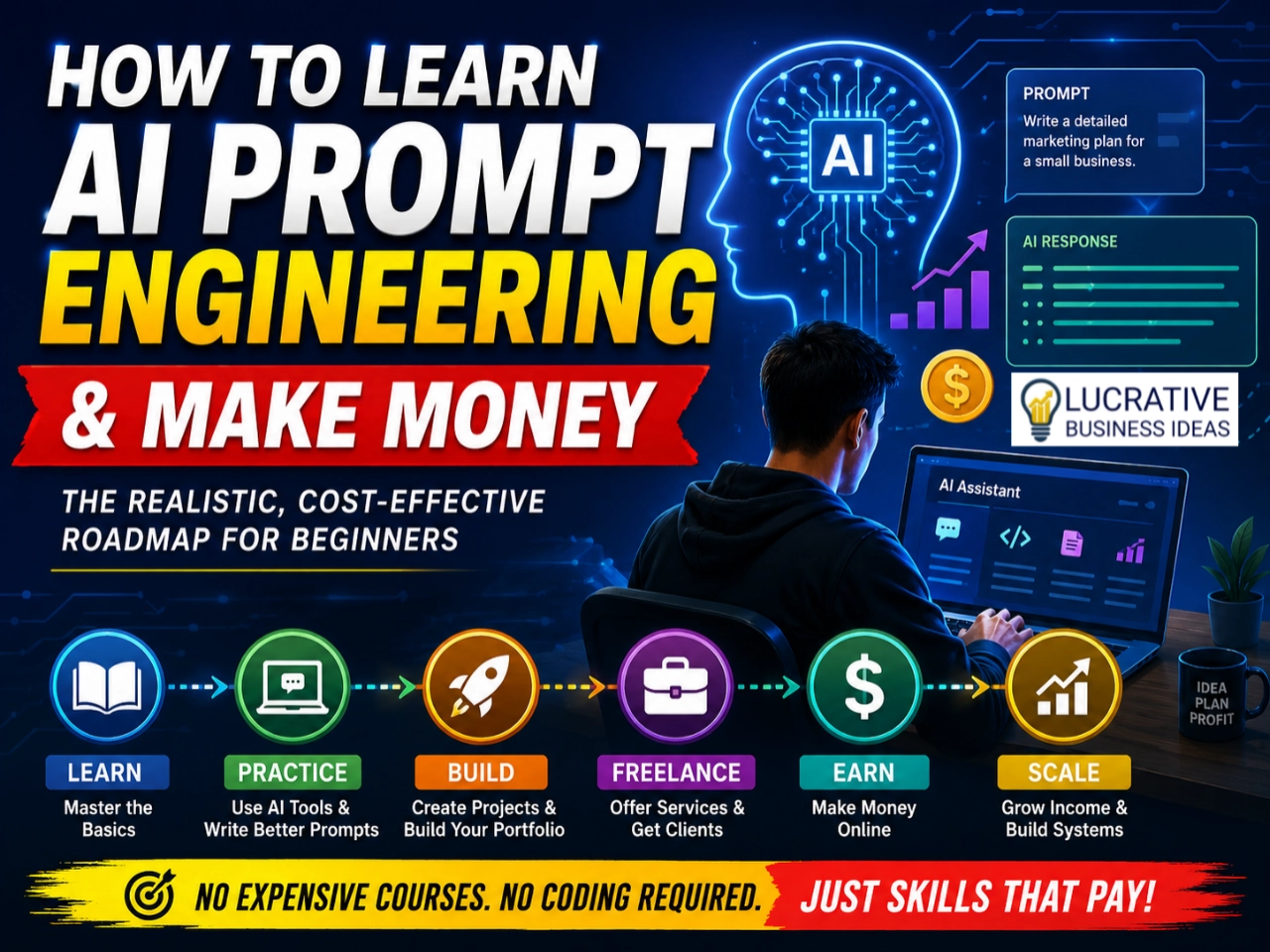
We will build your step-by-step AI Prompt Engineering Roadmap—from absolute beginner to competent practitioner, including what to learn first, what to practise, what tools to use, what projects to build, when to start freelancing, and what you should not waste your money learning.
prompts.
Part 2: The Step-by-Step AI Prompt Engineering Learning Roadmap
If you have understood Part 1, you already know the most important principle:
You are not learning prompt engineering simply to write better prompts. You are learning it to use AI to solve real problems.
Now let’s build the actual learning system.
And I’m going to be very direct with you:
Do not spend six months watching AI tutorials before you ever build anything.
That is one of the biggest mistakes beginners make.
AI is a practical skill. You learn it by learning, experimenting, building, failing, improving and repeating.
Think of your journey as a ladder.
You don’t jump from the ground to the roof.
You climb one level at a time.
Stage 1: Understand How Generative AI Works
Before becoming good at prompting, you need a basic mental model of the technology.
You don’t need a PhD in artificial intelligence.
You don’t need to understand every mathematical detail behind neural networks.
But you should understand what you are actually talking to.
Start by learning the basics of:
- Artificial intelligence
- Machine learning
- Generative AI
- Large language models
- Tokens
- Context windows
- Training data
- Model limitations
- Hallucinations
- Multimodal AI
- AI agents
- APIs
Your goal at this stage is simple:
You should be able to explain, in plain English, what a large language model does and why it sometimes gets things wrong.
If you cannot explain the technology simply, don’t rush ahead.
Build the foundation first.
Your practical exercise
Take one AI tool and ask it:
“Explain how a large language model works to a complete beginner using a simple real-world analogy.”
Then ask:
“Now explain the same concept to a software engineer.”
Compare the responses.
This teaches you something important:
The quality of an AI response depends heavily on context and audience.
Stage 2: Master the Anatomy of a Good Prompt
Now you are ready to study prompting itself.
A useful prompt commonly contains several important components.
1. Role
Tell the AI what perspective or expertise it should adopt.
Example:
“Act as an experienced digital marketing consultant…”
2. Objective
Clearly state what you want.
“Develop a 30-day social media strategy…”
3. Context
Give the AI the information it needs.
“The business is a small Nigerian fashion brand targeting young professionals…”
4. Audience
Explain who the output is intended for.
“The target audience is young adults aged 20–35…”
5. Constraints
Tell the AI what limitations it must follow.
“Use simple English. Keep each post below 150 words.”
6. Output Format
Tell it how you want the answer presented.
“Present the result as a table containing the date, topic, hook and call-to-action.”
7. Examples
When necessary, show the AI what good output looks like.
This is often called few-shot prompting.
For example:
“Here is an example of the writing style I want…”
Then provide your example.
Stage 3: Learn the Major Prompting Techniques
Once you understand prompt anatomy, start learning the major prompting approaches.
Don’t try to memorise every technique you find online.
Understand the principles behind the most useful ones.
Zero-Shot Prompting
You give the AI a task without providing an example.
Example:
“Classify this customer review as positive, neutral or negative.”
Simple.
Few-Shot Prompting
You provide examples before asking the AI to perform the task.
Example:
Positive: “The product is excellent.” → Positive
Negative: “The product broke after one day.” → NegativeNow classify: “The product works, but the battery is disappointing.”
Examples help the model understand the pattern you want.
Role-Based Prompting
You give the AI a role or perspective.
For example:
“Act as a senior cybersecurity consultant…”
This can help establish the context, expertise level and style you want.
But don’t make the mistake of thinking that simply writing “Act as an expert” magically makes the AI an expert.
The rest of your instructions still matter.
Chain-of-Thought and Reasoning-Oriented Prompting
You may encounter techniques designed to encourage models to reason through difficult problems.
The important lesson isn’t to obsess over a particular phrase such as “think step by step.”
Instead, learn to structure difficult tasks into manageable stages.
For example:
Research → Analyse → Compare → Recommend → Present
This is often far more useful than throwing a huge complicated request at the model.
Structured Output Prompting
This is extremely useful in professional work.
Instead of:
“Analyse these customer reviews.”
Try:
“Analyse these customer reviews and return the result using the following fields: Customer Issue, Sentiment, Product Area, Severity, Recommended Action.”
Now the output becomes much easier to use in a workflow.
Stage 4: Learn Prompt Iteration
This is where beginners start becoming practitioners.
Your first prompt will often be mediocre.
That’s normal.
The mistake is thinking:
“The AI didn’t give me a good answer, so AI is bad.”
No.
Sometimes your instruction was bad.
Learn to diagnose the problem.
Suppose you ask:
“Write me a business plan.”
The result is generic.
Don’t immediately start searching for another AI tool.
Ask yourself:
What information did I fail to provide?
Maybe you didn’t specify:
- The industry
- Location
- Target market
- Budget
- Business model
- Customer profile
- Competitive environment
- Desired length
- Business objective
Now improve the prompt.
This is called prompt iteration.
You write.
Test.
Evaluate.
Modify.
Test again.
Repeat.
That loop is one of the most important habits you can develop.
Stage 5: Learn How to Evaluate AI Outputs
This is where serious AI practitioners separate themselves from casual users.
Generating an answer is easy.
Determining whether the answer is actually good is harder.
Create your own evaluation criteria.
For example, if you’re generating marketing content, evaluate:
- Accuracy
- Relevance
- Clarity
- Originality
- Tone
- Persuasiveness
- Completeness
- Audience fit
Give your output a score.
For example:
- Accuracy: 8/10
- Relevance: 9/10
- Clarity: 7/10
- Originality: 6/10
Then improve the prompt.
You are now turning prompting into a measurable process.
That’s a major step forward.
Stage 6: Stop Practising Random Prompts — Start Building Projects
This is probably the most important stage of your learning journey.
Many aspiring prompt engineers have hundreds of prompts saved on their computers.
But when someone asks:
“What have you actually built?”
They have nothing to show.
Don’t make that mistake.
Build projects.
And start small.
Project 1: AI Content Assistant
Create a workflow that can transform a topic into:
- Blog ideas
- Headlines
- Social media posts
- Video scripts
- Calls-to-action
Project 2: Business Research Assistant
Design a system that can help analyse:
- Target customers
- Competitors
- Market opportunities
- Business risks
- Potential revenue models
Project 3: Customer Support Assistant
Create a prompt system that:
- Understands customer questions
- Classifies enquiries
- Produces appropriate responses
- Escalates complicated cases
Project 4: CV and Cover Letter Assistant
Create a workflow that analyses a person’s experience and helps tailor applications to specific job descriptions.
Project 5: Research Assistant
Build a structured workflow for:
- Extracting information
- Summarising documents
- Comparing sources
- Identifying gaps
- Producing reports
The objective isn’t to create the world’s most sophisticated AI system.
The objective is to prove:
“I can use AI to solve a real problem.”
Stage 7: Learn Multiple AI Tools
Don’t become dependent on one AI model.
You may start with ChatGPT.
That’s perfectly fine.
But eventually explore other major AI platforms and understand their strengths and weaknesses.
For example, learn how to work with:
- ChatGPT
- Claude
- Gemini
- Microsoft Copilot
- Perplexity
- Image-generation tools
- AI video tools
- AI coding assistants
- Automation platforms
You don’t need to become an expert in all of them.
Instead, develop tool awareness.
When a client gives you a problem, you should be able to ask:
“Which AI tool or combination of tools is best suited to solving this?”
That’s a much more valuable skill than being a “ChatGPT prompt expert.”
Stage 8: Learn AI Automation
Now we are entering a higher-value area.
Suppose you create an excellent prompt.
A person still has to manually copy information into the AI tool every time.
That’s useful—but limited.
Now imagine connecting AI to an automated workflow.
For example:
Customer enquiry → AI analyses enquiry → AI categorises it → AI generates response → Human approves → Response is sent.
Now you are not simply writing prompts.
You are designing an AI workflow.
Explore tools such as:
- Zapier
- Make
- n8n
- APIs
- AI automation platforms
You don’t need to master them immediately.
But learning automation can dramatically increase the commercial value of your AI skills.
Stage 9: Learn Basic Programming
Again, don’t panic.
You don’t need to become a software engineer overnight.
But if you want to move toward advanced AI work, learn some programming.
Start with Python.
Learn:
- Variables
- Functions
- Loops
- Conditions
- Lists and dictionaries
- Working with files
- APIs
- JSON
- Basic data processing
Then learn how to connect applications to AI models through APIs.
This opens a completely different world.
You can begin moving from:
“I can write a prompt.”
to:
“I can build an application that uses an AI model.”
That distinction matters.
Stage 10: Choose a Specialisation
This is where your learning becomes commercially focused.
Don’t remain a generalist forever.
Choose an area where AI can solve expensive or frequent problems.
Possible niches include:
1. AI Content and Marketing
Help businesses create:
- Blog content
- Social media campaigns
- Email sequences
- Advertisements
- Video scripts
2. AI Business Automation
Help businesses automate repetitive processes.
3. AI Research
Help companies analyse information faster.
4. AI Customer Support
Design AI-assisted support workflows.
5. AI Education
Create learning assistants and educational systems.
6. AI Sales
Build AI-assisted lead generation and sales workflows.
7. AI Consulting
Help businesses identify where AI can reduce costs or increase productivity.
8. AI + Cybersecurity
This is particularly interesting if you eventually develop technical cybersecurity expertise.
The point is simple:
Don’t sell “prompts.” Sell outcomes.
Your Daily AI Learning Routine
You don’t need eight hours every day.
If you are starting alongside school, work or business, even 1–2 focused hours a day can produce significant progress if you use the time correctly.
Try this structure:
20 minutes — Learn
Study one concept.
30 minutes — Experiment
Test prompts and compare outputs.
30 minutes — Build
Work on a practical project.
20 minutes — Analyse
Record what worked, what failed and why.
20 minutes — Document
Save useful prompts, workflows, lessons and project results.
Do this consistently.
After 30 days, you won’t simply have consumed AI content.
You will have created a body of practical experience.
The 30-Day Beginner Challenge
If I were personally training you from zero, I would give you a challenge.
For the first 30 days:
Week 1: Learn AI and prompting fundamentals.
Week 2: Practise different prompting techniques every day.
Week 3: Build three small AI projects.
Week 4: Choose one niche and build a more serious project around it.
At the end of those 30 days, create a simple portfolio containing:
- What problem you solved.
- Your original approach.
- The AI workflow you designed.
- Before-and-after results.
- What you learned.
- What business value the solution could create.
That portfolio becomes more valuable than a folder containing 500 random prompts.
The Golden Rule: Learn → Practise → Build → Document → Sell
Remember this sequence.
LEARN the concept.
↓
PRACTISE it repeatedly.
↓
BUILD something useful.
↓
DOCUMENT the result.
↓
SELL the skill or solution.
Then start again.
This is how you turn knowledge into income.
And notice something important:
You don’t have to wait until you become an “expert” before you start creating value.
Once you can reliably solve a small problem, you can start offering that solution.
Your skills then grow through real-world experience.
What You Should NOT Do
Let me save you time and money.
1. Don’t buy ten courses at once.
One good course plus serious practice is better than ten courses you never finish.
2. Don’t spend months collecting prompts.
Learn the principles behind them.
3. Don’t chase every new AI tool.
The AI ecosystem changes constantly.
Focus on transferable skills.
4. Don’t believe unrealistic income promises.
Prompt engineering is not a guaranteed shortcut to wealth.
5. Don’t build your career around one AI model.
Models change.
Platforms change.
Your underlying skills should survive those changes.
6. Don’t avoid business knowledge.
If you understand business problems, your AI skills become much more valuable.
Your Real Goal
Your ultimate goal should not be:
“I want to become someone who writes prompts.”
Think bigger.
Your goal should be:
“I want to become someone who understands AI deeply enough to use it to solve valuable problems for individuals and businesses.”
Prompt engineering is one of the doors into that world.
Walk through the door.
Then keep expanding.
Learn automation.
Learn data.
Learn APIs.
Learn business.
Learn communication.
Learn a technical domain.
Learn how to measure results.
Eventually, you stop looking like someone who merely knows how to use ChatGPT.
You start looking like an AI professional.
And that is where the serious opportunities begin.
What Comes Next
In Part 3, we move from learning to money.
I’ll break down the most realistic ways you can turn AI prompt engineering into income—from freelancing and AI content services to consulting, automation, digital products, training and AI-powered businesses.
More importantly, we’ll examine which opportunities are actually realistic for a beginner, which ones require advanced skills, how to price your services, where to find clients, and how to get your first paying customer without pretending to be an AI guru.
Part 3: How to Make Money With AI Prompt Engineering
Now we get to the question almost every aspiring prompt engineer eventually asks:
“How do I actually make money from this?”
Let me give you the honest answer.
You don’t make money simply because you know how to write good prompts.
You make money when your AI skills help someone make money, save money, save time, improve quality, reduce repetitive work, or solve a problem they are struggling with.
That distinction is extremely important.
If you approach prompt engineering as a collection of clever ChatGPT tricks, your earning potential will be limited.
If you approach it as a business problem-solving skill, your opportunities become much bigger.
1. The Simplest Way to Understand AI Prompt Engineering Income
Think about the journey like this:
AI knowledge → Practical skill → Useful solution → Business value → Paying customer
For example:
You learn how to create high-quality AI-assisted content.
↓
You build a content workflow.
↓
You help a small business produce a month’s worth of social media content faster.
↓
The business saves hours of work.
↓
The business pays you.
That’s the model.
The client isn’t really buying your prompt.
They’re buying the result your prompt helps produce.
This is why you should stop introducing yourself as:
“I sell ChatGPT prompts.”
Instead, think in terms of:
“I help small businesses create and manage their content using AI.”
Or:
“I help businesses automate repetitive workflows using AI.”
That sounds completely different—and it represents a completely different level of value.
2. Freelancing: The Fastest Starting Point
If you’re a beginner and want to start earning without building a large company, freelancing is one of the most practical routes.
You can offer AI-assisted services to individuals, entrepreneurs, creators and businesses.
Possible services include:
- AI-assisted content creation
- Prompt development
- AI research
- Chatbot prompt design
- AI workflow design
- Business-document generation
- AI content editing
- AI automation
- AI training
- Custom AI assistants
- AI-powered research
- Social media content systems
But don’t make your offer too broad.
Don’t tell potential clients:
“I do everything with AI.”
That’s difficult to sell.
Instead, create a specific offer.
For example:
“I help small businesses build AI-powered content systems that generate and organise their social media content.”
Now the client immediately understands what problem you solve.
3. Start With a Problem You Already Understand
Here’s a powerful shortcut.
Don’t choose your niche based only on what sounds fashionable.
Choose an area where you already understand the problems.
If you understand:
- Marketing
- Education
- Agriculture
- Cybersecurity
- Real estate
- E-commerce
- Finance
- Human resources
- Small business
- Technology
you already have an advantage.
Why?
Because prompt engineering becomes much easier when you understand the subject you’re prompting AI about.
Imagine two people creating an AI marketing system.
Person A understands only prompting.
Person B understands prompting and digital marketing.
Person B can ask better questions, recognise bad AI output faster and design more useful workflows.
Domain knowledge + AI skills is a powerful combination.
4. AI Content Creation Services
This is one of the easiest areas for beginners to enter.
Businesses constantly need content.
They need:
- Blog posts
- Social media posts
- Email newsletters
- Video scripts
- Product descriptions
- Advertisements
- LinkedIn posts
- Website copy
- SEO content
But here’s the catch.
Don’t become another person who simply copies AI-generated articles and sends them to clients.
That’s low-value.
Instead, learn to use AI as part of a professional content-production system.
For example:
Research → Outline → AI-assisted drafting → Human editing → Fact-checking → SEO optimisation → Final publication
Your value comes from the complete process.
Your human judgement matters.
Your understanding of the audience matters.
Your editing matters.
Your fact-checking matters.
Your ability to turn generic AI output into useful human communication matters.
5. AI Social Media Management
Small businesses often struggle to maintain consistent social media activity.
You can build an AI-assisted system that helps them create:
- Monthly content calendars
- Post ideas
- Captions
- Hooks
- Short-form video scripts
- Content variations
- Calls-to-action
- Repurposed content
For example, one long article could become:
1 blog article → 5 LinkedIn posts → 10 short social posts → 3 video scripts → 1 email newsletter → several content ideas.
The AI helps accelerate the process.
You provide the strategy, quality control and human judgement.
That’s a service businesses can understand.
6. AI Automation Services
Now we move into a potentially higher-value area.
Businesses perform repetitive tasks every day.
For example:
- Copying information between systems
- Sorting emails
- Responding to common enquiries
- Summarising documents
- Generating reports
- Processing leads
- Creating meeting summaries
- Updating spreadsheets
- Producing routine content
You can learn to identify these repetitive processes and determine where AI can help.
Imagine this workflow:
New customer enquiry
↓
AI reads the enquiry
↓
AI identifies the customer’s request
↓
AI categorises the lead
↓
AI drafts a response
↓
Information is recorded
↓
Human reviews important cases
That’s more valuable than simply giving someone a clever prompt.
You’re designing a business process.
7. AI Research Services
Research can consume enormous amounts of time.
You can use AI to assist with:
- Market research
- Competitor analysis
- Industry research
- Product research
- Customer feedback analysis
- Document summarisation
- Report preparation
- Research organisation
But be careful.
AI-generated research must be verified.
This is one of the areas where inexperienced AI freelancers can damage their reputation.
Never assume that an AI-generated fact is automatically true.
A professional workflow should include:
Generate → Verify → Cross-check → Analyse → Present
Your client should receive useful information—not confidently written misinformation.
8. AI Business Consulting
Once you develop stronger business knowledge, you can move into consulting.
Instead of asking:
“How can I write better prompts?”
you begin asking businesses:
“Where are you wasting time?”
“Which tasks are repetitive?”
“Where are employees spending hours on low-value work?”
“Which processes could AI assist with?”
“What information does your business repeatedly create?”
“Where could AI improve productivity?”
You then identify opportunities.
This is much closer to being an AI consultant than a traditional prompt engineer.
And this is where I believe the long-term opportunity becomes particularly interesting.
9. AI Training and Workshops
You don’t have to build AI systems for everyone.
You can also teach people how to use AI effectively.
Potential customers include:
- Small-business owners
- Students
- Teachers
- Content creators
- Marketing teams
- Administrative staff
- Entrepreneurs
- Professionals
You could offer:
Beginner AI Training
“How to use generative AI effectively for everyday work.”
Business AI Training
“How your team can use AI to improve productivity.”
Prompt Engineering Training
“How to write better instructions for AI.”
AI Content Training
“How content creators can use AI without producing generic content.”
The key is to teach outcomes, not just features.
10. Sell Digital Products
Once you have experience, you can package your knowledge.
Possible products include:
- Prompt packs
- AI workflow templates
- AI business templates
- AI content calendars
- AI writing systems
- AI research templates
- Industry-specific prompt libraries
- AI training guides
- E-books
- Video courses
- Notion templates
- Business process templates
But here’s another warning:
Don’t sell generic prompt bundles that contain hundreds of mediocre prompts.
Instead, create something specific.
For example:
“100 AI Workflows for Real Estate Agents”
is more commercially meaningful than:
“1,000 Amazing ChatGPT Prompts.”
The first solves a specific problem for a specific audience.
The second is just a collection.
11. Build AI-Powered Content Businesses
You can also use your AI skills to build your own business rather than selling services to clients.
For example:
- AI-assisted publishing
- Niche websites
- AI-assisted newsletters
- Educational communities
- Industry research platforms
- AI-powered content brands
- Digital product businesses
AI can dramatically reduce the amount of time required to research, draft, repurpose and organise content.
But don’t confuse lower production costs with guaranteed success.
AI makes content cheaper.
It doesn’t automatically make content valuable.
Your competitive advantage must still come from:
Original ideas + expertise + trust + distribution + quality.
12. Build Custom AI Assistants
As your skills improve, you can create specialised AI assistants for specific purposes.
For example:
For a real estate company
An assistant could help agents draft property descriptions and respond to common enquiries.
For an educational organisation
An assistant could help students understand difficult concepts.
For a marketing agency
An assistant could transform client information into campaign ideas.
For a small business
An assistant could help employees find information from internal documents.
This is where prompt engineering starts merging with:
- Knowledge management
- Automation
- APIs
- Data
- Software
- Business processes
And that’s why I don’t recommend treating prompt engineering as an isolated career.
Use it as a gateway into the wider AI ecosystem.
13. How to Get Your First Client
This is where many beginners freeze.
They create a profile on a freelance platform and wait.
Don’t do that.
Your first client may come faster if you demonstrate value directly.
Start with people and businesses around you.
Look for businesses with obvious problems.
For example:
A business has inconsistent social media content.
You can offer to build a small content system.
A company spends hours answering repetitive questions.
You can demonstrate an AI-assisted support workflow.
A consultant struggles to turn research into reports.
You can demonstrate a research workflow.
You aren’t saying:
“Please hire me because I’m a prompt engineer.”
You’re saying:
“I noticed this problem. I created a simple AI-assisted solution. Let me show you what it can do.”
That’s a much stronger approach.
14. Build Before You Sell
If you have no clients, you may ask:
“How do I build a portfolio when nobody has hired me?”
Simple.
Create your own demonstration projects.
Call them case-study projects.
For example:
Case Study: AI Content Workflow for a Nigerian Restaurant
Create a hypothetical restaurant.
Develop:
- Customer profile
- Content strategy
- Prompt system
- Content calendar
- Social media examples
- Workflow
- Expected business benefits
Then explain:
Problem → Solution → Process → Result
You have now created evidence of your ability.
Do this three to five times.
You can then show prospective clients what you can actually build.
15. How Much Should You Charge?
There is no universal price.
Your pricing depends on:
- Your skill level
- Complexity
- Client type
- Market
- Deliverables
- Business value
- Time required
- Ongoing support
As a beginner, avoid making your pricing ridiculously complicated.
You could structure your services around packages.
Basic
One simple AI workflow.
Standard
Several workflows plus implementation.
Premium
AI strategy + workflow design + implementation + training + support.
As your skills improve, shift from charging for your time toward charging for the value and complexity of the solution.
For example, there’s a major difference between:
“I will write 20 prompts for you.”
and:
“I will design and implement an AI-assisted content workflow your marketing team can use every week.”
The second offer represents a system.
Systems are generally more valuable than isolated prompts.
16. Where Can You Find Clients?
You can explore:
- Upwork
- Fiverr
- X
- Facebook groups
- Local business communities
- Professional networks
- Personal referrals
- Your existing contacts
- Direct outreach
- Your own website
- Industry communities
But don’t rely entirely on freelance marketplaces.
Build your personal brand.
Share what you’re learning.
Publish useful AI tutorials.
Show your projects.
Explain business use cases.
Publish case studies.
Demonstrate before-and-after results.
Eventually, people should associate your name with a particular type of AI solution.
That’s how you move from:
“I need to find clients.”
to:
“Potential clients are beginning to find me.”
17. The Most Powerful Strategy: Combine AI With Another Skill
Here is one of the biggest lessons I can give you.
Don’t throw away the skills you already have.
Combine them with AI.
For example:
AI + Marketing = AI Marketing Specialist
AI + Cybersecurity = AI Cybersecurity Specialist
AI + Agriculture = AI Agritech Specialist
AI + Finance = AI Finance Analyst
AI + Education = AI Learning Specialist
AI + Software Development = AI Application Developer
AI + Business = AI Business Consultant
This creates what I call a skill multiplier.
Your existing knowledge gives AI context.
AI gives your existing knowledge greater speed and scale.
That combination can be far more powerful than trying to compete as a generic “prompt engineer.”
18. Your First-Money Strategy
If you’re starting from zero, don’t try to launch ten businesses simultaneously.
Use this sequence:
Month 1 — Learn
Build foundational AI and prompt engineering skills.
Month 2 — Build
Create three to five practical projects.
Month 3 — Specialise
Choose a niche and develop a specific service.
Month 4 — Start Selling
Approach potential clients.
Month 5 — Improve
Deliver projects, collect feedback and create case studies.
Month 6 — Productise
Turn what you repeatedly do into a package, system, template or product.
This isn’t a guaranteed-income formula.
It’s a practical progression from learning to commercialisation.
19. The Biggest Money Mistake Beginners Make
They want to make money before becoming useful.
They ask:
“What’s the fastest way to make money with ChatGPT?”
Wrong question.
Ask:
“What problem can I become exceptionally good at solving with AI?”
Then:
“Who has that problem?”
Then:
“How expensive or painful is that problem?”
Then:
“Can I build a solution?”
Then:
“Can I demonstrate the result?”
Then:
“Can I sell that solution?”
That’s how a business thinker approaches AI.
20. The Future Is Bigger Than Prompt Engineering
This is where I want you to think like a futurist.
Prompt engineering is important, but I don’t believe the future belongs exclusively to people whose job title is Prompt Engineer.
AI models are becoming increasingly capable.
Interfaces are becoming easier.
Models are getting better at understanding natural language.
That means the ability to simply write a good prompt may become less differentiated over time.
So what should you do?
Move up the value chain.
Learn to:
- Understand business problems
- Design AI workflows
- Evaluate AI systems
- Automate processes
- Work with data
- Use APIs
- Build AI applications
- Manage AI implementation
- Train teams
- Develop AI strategies
The prompt is only one component.
The real future belongs to people who can connect AI capability with human and business needs.
Your New Mental Model
Stop thinking:
Prompt → Answer
Start thinking:
Problem → AI Strategy → Prompt → Workflow → Evaluation → Improvement → Business Result
That is the mindset shift I want you to make.
Because when you think this way, you stop being fascinated by AI.
You start becoming useful with AI.
And useful people get paid.
What Comes Next
In Part 4, we will tackle the practical question:
“Where exactly should I learn AI Prompt Engineering online—and how do I do it without wasting money?”
We’ll break down the best free resources, paid courses, online platforms, hands-on practice methods, learning sequence, portfolio strategy, and a realistic 30-day and 90-day learning plan.
I’ll also show you how to decide whether a course is genuinely worth paying for—or whether someone is simply selling you hype wrapped in an AI certificate.
Part 4: Where and How to Learn AI Prompt Engineering Online Without Wasting Your Money
You now understand what prompt engineering is, how to develop the skill and how you can eventually turn it into income.
Now let’s answer the question that can save you months of confusion and hundreds of dollars:
“Where should I actually learn AI prompt engineering?”
My answer is simple:
Don’t start by buying an expensive course.
Start with the people and organisations actually building the technology.
Then combine structured courses with deliberate practice and real projects.
That is the cost-effective route.
1. The Best Learning Formula
If I were starting from zero today, my learning formula would be:
Official resources + structured courses + daily practice + real projects + community + continuous experimentation
Not:
YouTube + random TikTok videos + expensive certificates + endless prompt collections.
There is a massive difference.
You don’t need more information.
You need a learning system.
2. Start With Free Official Resources
Before spending money, exhaust the high-quality resources available from the companies building today’s leading AI systems.
This gives you something extremely valuable:
First-hand knowledge.
For example, Anthropic currently provides an interactive prompt-engineering tutorial, prompting documentation and an AI Fluency course covering generative AI, delegation, effective prompting, discernment and diligence.
Google Cloud also provides current prompt-engineering guidance and hands-on learning resources, including a Prompt Design course in its learning ecosystem.
Microsoft Learn offers beginner-level modules covering prompt engineering fundamentals, effective prompts, context, instructions and evaluation.
And OpenAI’s developer resources let you move beyond chatting with AI toward actually building applications, testing prompts and working with APIs.
This should be your first classroom.
You don’t need to pay someone simply to repeat information that the technology companies themselves already publish.
3. My Recommended Online Learning Stack
Here is the learning stack I would recommend.
Level 1 — AI Fundamentals
Start with beginner-friendly material explaining:
- Generative AI
- Large language models
- Tokens
- Context
- Hallucinations
- Multimodal AI
- AI limitations
- Responsible AI
Your objective isn’t to become a machine-learning engineer.
Your objective is to develop a mental model of AI.
4. Level 2 — Learn Prompt Engineering Properly
At this stage, study:
- Clear instructions
- Context
- Examples
- Role and audience
- Constraints
- Output formats
- Prompt iteration
- Task decomposition
- Prompt chaining
- Evaluation
- Error analysis
Anthropic’s current learning resources are particularly useful here because they combine prompting with broader AI fluency and practical interaction skills.
Google’s prompt-engineering guide is another strong reference for understanding the principles behind effective prompts rather than merely collecting templates.
5. Level 3 — Take a Structured Course
Once you have experimented on your own, take one structured course.
A particularly useful beginner option is ChatGPT Prompt Engineering for Developers from DeepLearning.AI, taught by Isa Fulford of OpenAI and Andrew Ng. It is currently listed as a beginner-level, approximately 90-minute course with nine lessons and hands-on code examples. It covers prompting best practices, iterative prompting, summarisation, inference, transformation, expansion and building a custom chatbot.
This is important:
The course is designed with developers in mind.
So if you’re completely non-technical, don’t panic if some API concepts feel unfamiliar.
You can first learn the general prompting concepts and return to the technical sections later.
6. Then Learn to Build AI Systems
This is where I want you to go beyond ordinary prompt engineering.
DeepLearning.AI also offers Building Systems with the ChatGPT API, which focuses on multi-step systems, prompt chains, evaluation and practical AI workflows.
This is an important transition.
You move from:
“What should I type into ChatGPT?”
to:
“How can I design a repeatable AI process?”
That second question is much more commercially valuable.
7. Learn From Multiple AI Ecosystems
Don’t become loyal to one AI platform.
That’s a beginner’s mistake.
Your objective is to understand AI principles that transfer across models.
Spend time experimenting with several major systems.
For example:
ChatGPT
Learn general prompting, structured outputs, files, multimodal capabilities and eventually API-based development.
Claude
Study its prompting practices, AI Fluency material and production-oriented resources. Anthropic specifically encourages practitioners to iterate, break complex tasks into smaller prompts and evaluate results.
Gemini
Explore Google’s prompting and multimodal ecosystem.
Microsoft Copilot
Explore Microsoft’s business-oriented AI ecosystem and prompt resources.
The objective isn’t to collect accounts.
It’s to develop model literacy.
You should eventually be able to say:
“This problem requires a model with these capabilities, this context strategy and this workflow.”
That’s professional thinking.
8. YouTube Is Useful—But Use It Correctly
YouTube can be an incredible learning resource.
It can also become a massive time trap.
You search:
“Learn prompt engineering.”
You watch one video.
Then another.
Then:
“10 secret ChatGPT prompts.”
Then:
“Make $10,000 with AI.”
Then:
“Top 50 AI tools.”
Three hours later, you’ve learned almost nothing.
Don’t consume AI content randomly.
Search for a specific skill.
For example:
- “Prompt evaluation tutorial”
- “Few-shot prompting explained”
- “AI workflow automation tutorial”
- “OpenAI API beginner tutorial”
- “Python for AI beginners”
- “Build AI chatbot tutorial”
- “AI agent fundamentals”
Watch.
Take notes.
Then immediately build something.
One hour of learning followed by one hour of implementation is better than four hours of passive watching.
9. Don’t Buy an Expensive Course Too Early
This deserves emphasis.
You do not need a $500, $1,000 or $2,000 course to learn basic prompt engineering.
Before paying, ask:
Question 1
Does the instructor actually have demonstrable experience?
Question 2
Does the course teach principles or just prompt templates?
Question 3
Is the material regularly updated?
Question 4
Are there practical assignments?
Question 5
Will you build real projects?
Question 6
Does it teach evaluation?
Question 7
Does it cover automation or APIs where appropriate?
Question 8
Are there genuine student outcomes?
Question 9
Does the curriculum solve the problem you actually want to solve?
Question 10
Could you learn 70–80% of the material from official resources and cheaper courses?
If the answer to that final question is yes, don’t rush to buy.
10. Certificates Are Not Your Main Goal
A certificate can be useful.
It can demonstrate that you completed a course.
It can strengthen a CV.
It can help establish credibility when you’re starting.
But don’t confuse a certificate with competence.
Imagine two candidates.
Candidate A
Has ten AI certificates but has never built anything.
Candidate B
Has two certificates but has built five useful AI workflows and can demonstrate their results.
Who would you rather hire?
Exactly.
Your portfolio should become more important than your certificate collection.
11. Build a Public AI Portfolio
You need somewhere to demonstrate your skills.
This could be:
- A personal website
- GitHub
- Notion
- A simple portfolio page
- A public document
- A combination of these
For each project, explain:
The Problem
What were you trying to solve?
The Approach
How did you use AI?
The Prompt/Workflow
What process did you design?
The Iteration
What went wrong initially?
How did you improve it?
The Result
What changed?
The Business Value
How could the solution save time, reduce cost, increase productivity or improve quality?
That final section is extremely important.
Clients buy outcomes.
12. Your 30-Day Prompt Engineering Learning Plan
If you want a simple starting point, follow this.
Days 1–5: Understand AI
Study:
- Generative AI
- LLMs
- AI limitations
- Context
- Hallucinations
- Multimodal AI
Spend at least 30 minutes practising each day.
Days 6–10: Learn Prompt Fundamentals
Practise:
- Clear instructions
- Context
- Roles
- Examples
- Constraints
- Output formats
Take the same task and write five different prompts.
Compare the results.
Days 11–15: Learn Advanced Prompting
Study:
- Few-shot prompting
- Task decomposition
- Prompt chaining
- Structured outputs
- Iterative prompting
- Evaluation
Don’t merely read.
Build examples.
Days 16–20: Build Projects
Create at least three small projects.
For example:
Project 1: AI content assistant.
Project 2: Research assistant.
Project 3: Customer-support assistant.
Document everything.
Days 21–25: Explore Other Tools
Experiment with multiple AI platforms.
Compare:
- Accuracy
- Writing quality
- Reasoning
- Context handling
- Speed
- Multimodal capability
- Ease of use
You’re developing model literacy.
Days 26–30: Build Your Portfolio
Choose your best projects.
Document them professionally.
Create a simple portfolio.
Publish at least one project publicly.
Then ask yourself:
“What problem can I now solve well enough that someone would pay me for it?”
That’s your first commercial question.
13. Your 90-Day Roadmap
Thirty days gives you a foundation.
Ninety days can give you something much more valuable:
marketable capability.
Month 1 — Foundation
Learn AI fundamentals and prompt engineering.
Practise every day.
Complete one structured course.
Build three small projects.
Month 2 — Specialisation
Choose one niche.
For example:
- AI content
- AI marketing
- AI automation
- AI research
- AI customer support
- AI education
- AI business consulting
Build two or three projects specifically for that niche.
Month 3 — Commercialisation
Create:
- Portfolio
- Service offer
- Case studies
- Pricing structure
- Outreach strategy
Start contacting potential clients.
Start publishing content.
Start demonstrating your expertise.
Start selling.
Do not wait until you feel perfectly ready.
You won’t.
14. The 70/20/10 Learning Rule
Here’s another framework I recommend.
Spend approximately:
70% — Practical projects
20% — Structured learning
10% — Theory
Why?
Because prompt engineering is a practical skill.
If you spend 90% of your time watching people explain prompting and only 10% actually practising it, you’re training yourself to be a spectator.
Don’t become an AI spectator.
Become an AI practitioner.
15. The Best Free Learning Resources to Start With
Here is the shortlist I would personally put at the top of your learning list.
Anthropic Academy
Excellent for AI Fluency, practical prompting and broader understanding of working effectively with AI.
Google Cloud Prompt Engineering Resources
Useful for understanding prompt engineering principles and moving toward more technical applications.
Google Cloud Prompt Engineering Guide
Microsoft Learn
Excellent for structured beginner-level learning, including prompt fundamentals and practical exercises.
Microsoft Learn: Create Effective Prompts
DeepLearning.AI
Especially useful once you’re ready to move from basic prompting toward application development and AI systems. Its prompt-engineering course is beginner-level and includes hands-on examples.
DeepLearning.AI Prompt Engineering Course
16. Your Learning Budget Should Be Small at First
If you’re starting with limited money, here’s what I’d do.
Stage 1
Spend almost nothing.
Use free official resources.
Practise with whatever AI tools you already have access to.
Stage 2
Take one good structured course.
Stage 3
Only pay for additional training when you know exactly what skill you’re missing.
Stage 4
Invest money into tools only when they help you build or deliver something.
That is a much better strategy than buying every new AI subscription you see advertised.
Your first investment should be your skill—not your software collection.
17. Learn From Real Problems, Not Just Courses
Here’s the secret I wish more beginners understood.
Suppose you learn:
“How to create a customer-support prompt.”
Don’t stop there.
Find a real business.
Study its customer questions.
Create a support workflow.
Test it.
Identify failures.
Improve it.
Measure the results.
Now you’ve learned more than the course could teach you.
Real problems are your advanced classroom.
18. Keep an AI Learning Journal
This sounds simple, but it is incredibly powerful.
Create a document called:
AI Prompt Engineering Lab
Every time you experiment, record:
Problem: What was I trying to solve?
Prompt: What did I use?
Result: What happened?
Failure: What went wrong?
Improvement: What did I change?
Lesson: What did I learn?
Reusable Principle: Can this lesson apply somewhere else?
After several months, you will have something extremely valuable:
your own personal AI knowledge base.
19. When Should You Start Making Money?
Earlier than you think.
But not immediately.
First become capable of solving a small, clearly defined problem.
You don’t need to know everything.
If you can confidently deliver one useful service, start there.
For example:
“I can build an AI-assisted social media content workflow for small businesses.”
That’s enough to begin.
Then improve.
Add automation.
Add analytics.
Add strategy.
Add integrations.
Add consulting.
Your career grows from there.
20. The Ultimate Learning Philosophy
Don’t chase the title:
“Prompt Engineer.”
Chase capability.
Don’t chase certificates.
Build evidence.
Don’t chase every new AI tool.
Learn transferable principles.
Don’t memorise thousands of prompts.
Understand why prompts work.
Don’t spend all your time studying.
Build.
Don’t wait to become an expert.
Start solving small problems.
And most importantly:
Don’t learn AI merely to impress people. Learn AI to become useful.
Because usefulness is what creates opportunity.
Your Best Cost-Effective Path
If I had to reduce this entire batch to one practical roadmap, it would be:
1. Learn AI fundamentals for free.
↓
2. Study prompt engineering from official resources.
↓
3. Take one structured course.
↓
4. Practise every day.
↓
5. Build real projects.
↓
6. Learn evaluation.
↓
7. Explore multiple AI models.
↓
8. Learn automation.
↓
9. Learn basic Python and APIs.
↓
10. Choose a profitable niche.
↓
11. Build a portfolio.
↓
12. Start selling a specific solution.
↓
13. Keep upgrading your skills.
That is the path I would recommend to someone starting today.
Not because it is flashy.
Because it is practical.
And practical beats hype.
What Comes Next
In Part 5, we’ll take the final step: the future of prompt engineering and the long-term AI career strategy.
We’ll examine whether “prompt engineer” will remain a standalone career, which AI skills are likely to become more valuable, how AI agents and automation are changing the game, how to future-proof yourself, and how to build a career that remains valuable even as AI models become dramatically better.
That is where we turn your short-term prompt-engineering goal into a long-term AI career and business strategy.
Part 5: The Future of Prompt Engineering — How to Build an AI Career That Will Last
We have reached the part of this journey where I want you to stop thinking like a beginner.
You have learned what prompt engineering is.
You have learned how to practise it.
You have learned how to build projects.
You have learned how to turn those skills into services.
Now I want you to look beyond today.
Because there is an uncomfortable question every serious aspiring AI professional should be asking:
“What happens when AI becomes so good at prompting that people barely need prompt engineers?”
My answer is straightforward:
Don’t build your entire future around writing prompts.
Build your future around understanding AI, solving problems, designing systems and creating value.
That is how you future-proof yourself.
1. Will Prompt Engineering Still Be a Career?
Possibly—but probably not in the simplistic way many people imagine.
The market has already been moving beyond the idea that prompt engineering is simply about finding the perfect sentence to give an AI model.
Anthropic has described a broader shift toward context engineering: thinking about the entire set of information and context supplied to a model rather than obsessing over isolated wording.
At the same time, AI platforms are increasingly supporting workflows in which models can use tools, work with files, follow processes and complete multi-step tasks. OpenAI’s current agent resources, for example, focus on repeatable workflows rather than one-off prompting.
This tells you something important.
The future is moving from:
Prompt → Response
toward:
Goal → Context → Tools → Workflow → AI → Evaluation → Human Oversight → Result
That is a much bigger field.
And you should prepare for it.
2. Prompt Engineering Is the Beginning, Not the Destination
Think of prompt engineering as a doorway.
You walk through the doorway and discover a much larger world.
Level 1 — AI User
You know how to use AI tools.
↓
Level 2 — Prompt Practitioner
You know how to communicate effectively with AI.
↓
Level 3 — AI Workflow Designer
You can create repeatable processes involving AI.
↓
Level 4 — AI Automation Specialist
You can connect AI with other tools and automate work.
↓
Level 5 — AI Application Builder
You can use APIs, code and other technologies to build AI-powered products.
↓
Level 6 — AI Strategist / Consultant
You can help organisations decide where, why and how to deploy AI.
You don’t need to reach Level 6 immediately.
But you should know that these levels exist.
Don’t stop climbing at Level 2.
3. The Rise of AI Agents Changes the Game
One of the most important developments you should understand is the rise of AI agents.
A normal chatbot may answer your question.
An agent can be designed to perform a sequence of actions toward a goal, potentially using tools and adapting its approach.
For example:
Traditional AI use:
“Write an email to this customer.”
Agentic workflow:
Receive customer enquiry → identify customer → check relevant information → determine issue → draft response → apply rules → request approval where necessary → send or escalate.
That is a completely different level of AI usage.
Current AI development platforms are increasingly focused on agents, tools, workflows, evaluation and guardrails.
And this is why I want you to learn prompt engineering properly.
Good prompting becomes one component of good agent design.
4. Learn Context Engineering
This is a concept I strongly recommend adding to your learning roadmap.
Traditional prompt engineering asks:
“What should I tell the AI?”
Context engineering asks:
“What information should the AI have available to perform this task successfully?”
That’s a much deeper question.
Imagine you’re building an AI assistant for a company.
The prompt alone isn’t enough.
The system may need:
- Company policies
- Product information
- Customer information
- Previous conversations
- Internal documents
- Business rules
- Examples
- Available tools
- User permissions
- Current information
Now your job becomes designing the information environment around the AI.
That is context engineering.
And it is likely to become increasingly important as AI systems become more capable and more integrated into real workflows.
5. Learn AI Agents
If you want to remain competitive, start learning how AI agents work.
Understand concepts such as:
- Tools
- Instructions
- Workflows
- Memory
- Context
- Tool calling
- Routing
- Handoffs
- Guardrails
- Evaluation
- Human approval
- Monitoring
You don’t need to become an advanced agent developer immediately.
Start by understanding the architecture.
Then build simple agents.
Then make them more reliable.
OpenAI’s current agent training materials, for example, emphasise tools, instructions, handoffs, routing, guardrails and evaluation when moving toward production-grade agents.
Anthropic similarly discusses single-agent, multi-agent and workflow-based architectures and recommends matching technical complexity to the actual business value of the problem.
That’s an important lesson:
Don’t build a complicated AI agent simply because you can.
Build it because the problem requires it.
6. Learn Evaluation
This may not sound exciting.
But it is one of the skills that can separate a hobbyist from a professional.
Imagine you build an AI customer-support assistant.
How do you know whether it works?
You need to test it.
Ask:
- Does it provide accurate answers?
- Does it follow company policies?
- Does it invent information?
- Does it use the correct tone?
- Does it know when to escalate?
- Does it protect sensitive information?
- Does it perform consistently?
You need evaluation criteria.
You need test cases.
You need failure analysis.
You need improvement loops.
AI systems don’t become reliable simply because the prompt is good.
They become reliable through testing, evaluation, iteration and appropriate human oversight.
That principle becomes even more important when AI is connected to business systems and external tools.
7. Combine AI With Human Skills
This is where the future becomes particularly interesting.
Some people assume AI will make human skills irrelevant.
I disagree.
The World Economic Forum’s Future of Jobs Report 2025 identifies AI and big data as the fastest-growing skill area, but it also highlights analytical thinking, creative thinking, resilience, flexibility, leadership and lifelong learning as important skills for the coming years.
That’s not an accident.
AI can generate.
But someone still needs to decide:
What should be generated?
Why does it matter?
Is it correct?
Is it ethical?
Will customers accept it?
Does it solve the business problem?
What should happen next?
That’s where human judgement remains incredibly valuable.
8. Build a “T-Shaped” AI Skillset
Here’s a model I recommend.
Become broad enough to understand AI across multiple areas.
But become deep in one commercially valuable area.
Think of the letter T.
The horizontal line represents broad knowledge:
- AI
- Prompting
- Automation
- Data
- Cybersecurity
- Business
- APIs
- Content
- Agents
- Digital transformation
The vertical line represents your specialisation.
For example:
AI + Cybersecurity
or:
AI + Marketing
or:
AI + Agriculture
or:
AI + Finance
or:
AI + Education
or:
AI + Business Operations
This gives you something much stronger than generic AI knowledge.
You become:
The person who understands AI and knows how to apply it in a particular field.
That is a powerful position.
9. Your Existing Knowledge Is an Asset
This is particularly important if you already have an academic or professional background.
Don’t assume you have to abandon everything you’ve learned to enter AI.
Instead, ask:
“How can AI multiply the value of what I already know?”
An electrical engineer can explore:
AI + Energy
A cybersecurity professional can explore:
AI + Cyber Risk
An accountant can explore:
AI + Financial Operations
A marketer can explore:
AI + Marketing Automation
An agricultural professional can explore:
AI + Agritech
A teacher can explore:
AI + Education Technology
Your previous knowledge gives you domain expertise.
AI gives you leverage.
That combination can become your competitive advantage.
10. Don’t Compete With AI. Learn to Direct It.
This is one of the biggest mindset changes I want you to make.
If AI can write 10,000 words in seconds, don’t compete with AI by trying to type faster.
Instead, become the person who knows:
- What should be written
- Who should read it
- Why it should be written
- What information belongs in it
- What is missing
- What is wrong
- How it should be improved
- How it should be distributed
- How it contributes to a business objective
You are no longer competing with the machine.
You’re directing the machine.
11. Learn Business
If you want to make serious money from AI, learn business.
This is one of the most underrated AI skills.
Understand:
- Revenue
- Costs
- Profit
- Customer acquisition
- Operations
- Productivity
- Sales
- Marketing
- Customer experience
- Risk
- Business processes
Why?
Because businesses don’t wake up saying:
“We need more prompts.”
They wake up saying:
“Our customer support is too expensive.”
“Our employees spend too much time doing repetitive tasks.”
“Our sales team is overwhelmed.”
“We need more leads.”
“Our reports take too long to produce.”
“Our content team can’t keep up.”
These are opportunities.
AI is the technology.
Business problems are the market.
12. Learn to Identify AI Opportunities
Train yourself to walk into a business and notice repetitive work.
Ask:
What tasks happen repeatedly?
What tasks follow predictable rules?
What information is repeatedly copied?
What documents are repeatedly created?
What questions are repeatedly answered?
Where are employees spending hours on administrative work?
Where are customers waiting unnecessarily?
Where could AI assist without creating unacceptable risk?
Those questions can lead you to valuable AI opportunities.
13. Don’t Automate Everything
Here’s another professional principle:
Just because you can automate something doesn’t mean you should.
Some tasks require human judgement.
Some involve sensitive information.
Some have serious consequences if the AI gets them wrong.
Some processes are too unpredictable.
Some tasks are faster to do manually.
The best AI professionals don’t blindly automate.
They assess:
Value + Risk + Complexity + Reliability
Then they decide.
That’s strategic AI thinking.
14. Build Around Trust
As AI becomes more powerful, trust becomes more valuable.
Your clients will want to know:
- Is the information accurate?
- Is confidential data protected?
- Can humans review the output?
- Can the system explain what it did?
- What happens when it fails?
- Can the system be monitored?
- Who is responsible for the final decision?
Therefore, learn about:
- AI safety
- Privacy
- Security
- Data governance
- Human oversight
- Responsible AI
- Risk management
The World Economic Forum’s research also points to cybersecurity and technological literacy among the fastest-growing skill areas alongside AI and big data.
The future won’t just need people who can make AI powerful.
It will need people who can make AI useful, reliable and responsible.
15. Your Long-Term AI Career Options
As you progress, your career could evolve into several directions.
Prompt Engineer
Design and optimise prompts and AI interactions.
AI Workflow Designer
Create repeatable AI-assisted processes.
AI Automation Specialist
Connect AI to business applications and automate workflows.
AI Solutions Consultant
Help organisations identify and implement AI opportunities.
AI Product Manager
Help define AI-powered products and features.
AI Application Developer
Build software powered by AI models.
AI Agent Developer
Build systems capable of using tools and performing multi-step tasks.
AI Trainer / Educator
Teach individuals and organisations how to use AI effectively.
AI Strategist
Help organisations develop long-term AI adoption strategies.
AI Entrepreneur
Build your own AI-powered products or services.
Notice something?
Prompt engineering can be the beginning of almost all of these paths.
16. Your 12-Month AI Career Roadmap
Let’s make this practical.
Months 1–2: Foundation
Learn:
- Generative AI
- LLM fundamentals
- Prompt engineering
- AI limitations
- Evaluation
Practise daily.
Months 3–4: Projects
Build:
- Content assistant
- Research assistant
- Customer-support workflow
- One niche-specific project
Create your portfolio.
Months 5–6: Specialisation
Choose your niche.
Develop deeper knowledge of the industry’s problems.
Start offering a service.
Get your first clients or practical projects.
Months 7–8: Automation
Learn:
- APIs
- Automation platforms
- Webhooks
- Basic Python
- Data handling
Start turning manual AI processes into workflows.
Months 9–10: AI Agents
Learn:
- Agent architecture
- Tool use
- Routing
- Memory/context
- Guardrails
- Evaluation
Build one or two useful agent projects.
Months 11–12: Business
Develop:
- Service packages
- Case studies
- Personal brand
- Client acquisition
- Product ideas
- Consulting capability
At this point, you’re no longer simply “learning prompt engineering.”
You’re building an AI career.
17. The Future Belongs to AI-Augmented Professionals
Here’s a prediction I want you to think deeply about.
The future may not simply be:
AI versus humans.
It may increasingly become:
AI-powered humans versus humans who refuse to adapt.
The person who knows how to use AI effectively can potentially perform certain tasks faster.
The business that integrates AI intelligently can potentially operate more efficiently.
The professional who combines domain expertise with AI capability can potentially become significantly more productive.
This is why the World Economic Forum expects a substantial portion of workers’ core skills to change by 2030 and identifies continuous learning, AI and big data, cybersecurity, technological literacy and creative thinking among important areas of rising demand.
The lesson isn’t:
“AI will replace everyone.”
The better lesson is:
“The nature of valuable work is changing.”
Prepare for the change.
18. Your AI Career Should Have Layers
Don’t build your career on one skill.
Build layers.
Layer 1
Prompting
↓
Layer 2
AI Tools
↓
Layer 3
Workflow Design
↓
Layer 4
Automation
↓
Layer 5
Technical Skills
↓
Layer 6
Domain Expertise
↓
Layer 7
Business Strategy
↓
Layer 8
Leadership
The higher you climb, the harder you become to replace.
Why?
Because you’re no longer performing one narrow task.
You’re connecting technology, people, processes and business objectives.
19. The Most Valuable Skill May Be Learning How to Learn
AI changes quickly.
Today’s best model may not be tomorrow’s best model.
Today’s popular prompting technique may become less important.
Today’s software may disappear.
New tools will emerge.
New workflows will emerge.
New job titles will emerge.
Therefore, don’t ask:
“What AI skill will guarantee my career forever?”
There probably isn’t one.
Ask:
“How can I become exceptionally good at learning and adapting to new AI capabilities?”
That’s a much stronger question.
Build the habit of:
Learn → Experiment → Build → Evaluate → Adapt → Repeat
Do that for years and you’ll remain relevant.
20. Your Personal AI Learning System
Create a system that continues after this article.
Every month:
Learn one major AI concept.
Test one new AI capability.
Build one small project.
Improve one existing workflow.
Publish one useful case study.
Teach someone what you learned.
Review where the industry is heading.
Teaching is especially powerful.
When you explain something to someone else, you discover what you don’t actually understand.
Become both a student and a teacher.
21. Your Final Strategy for Making Money
Let’s bring everything together.
If you’re serious about making money from AI prompt engineering, follow this philosophy:
Don’t sell prompts.
Sell solutions.
Don’t chase tools.
Master principles.
Don’t collect certificates.
Build evidence.
Don’t copy other people’s prompts forever.
Learn to design your own.
Don’t remain a generic AI user.
Choose a domain.
Don’t stop at prompting.
Learn workflows and automation.
Don’t ignore technology.
Learn APIs and basic programming.
Don’t ignore business.
Understand how organisations create and lose money.
Don’t ignore people.
Communication, judgement, creativity and trust remain valuable.
And above everything:
Don’t build your career around what AI can do today. Build it around your ability to adapt to what AI will be able to do tomorrow.
See Also:
- The Trillion-Dollar AI Buildout Explained: Self-Funding, Debt, Stock Issuance—and What It Means for Investors
- Best Cost-Effective Way to Learn App Development & Make Money: The Complete Beginner-to-Expert Roadmap for Android, Web & Cross-Platform Development
Conclusion: Don’t Just Learn AI. Become Valuable With AI.
You started this journey asking a simple question:
“How can I learn AI prompt engineering and make money?”
Now you have the bigger answer.
Yes, learn prompt engineering.
Learn how to communicate with AI.
Learn how to provide context.
Learn how to structure instructions.
Learn how to evaluate outputs.
Learn how to iterate.
But don’t stop there.
Move into workflows.
Move into automation.
Learn APIs.
Learn basic programming.
Understand AI agents.
Learn evaluation and responsible AI.
Develop domain expertise.
Understand business.
Build real projects.
Create a portfolio.
Solve real problems.
Then sell the solutions.
The biggest mistake you can make is becoming obsessed with the title “Prompt Engineer.”
Your real goal should be much bigger:
Become a professional who knows how to use artificial intelligence to solve meaningful problems and create measurable value.
That’s a career.
That’s a business.
That’s a long-term skill.
And that’s why I believe prompt engineering is worth learning—but only if you see it as the beginning of your AI journey, not the end of it.
The AI landscape will continue changing. New models will arrive. New tools will appear. Some current jobs will evolve, while new ones emerge. The World Economic Forum’s latest labour-market analysis reinforces this broader point: technology skills are rising rapidly, but analytical thinking, creativity, adaptability, leadership and continuous learning remain critical.
So start small.
Learn every day.
Build something.
Solve a problem.
Help someone.
Get paid.
Improve.
Then repeat.
You don’t need to become the world’s best AI expert.
You need to become useful enough that people are willing to pay for what you can do with AI.
And if you keep learning beyond prompting, you can eventually become far more valuable than someone who simply knows how to write clever instructions.
Learn AI.
Understand problems.
Build solutions.
Create value.
Get paid.
Keep adapting.
That’s the real AI career roadmap.
Frequently Asked Questions (FAQs) About Understanding AI Prompt Engineering
1. What is AI prompt engineering?
AI prompt engineering is the skill of designing clear, specific instructions that help artificial intelligence tools produce better and more useful results.
A prompt can be as simple as asking an AI chatbot to explain a concept, or as sophisticated as instructing an AI to analyse business data, develop a marketing strategy, write software, create a video script, or structure a research report.
Good prompt engineering is not simply about finding “magic words.” It involves understanding the objective, providing the right context, defining constraints, specifying the desired output and refining the instruction based on the AI’s response.
For beginners, the most important thing is to focus on problem-solving rather than complicated prompt formulas. The better you understand the task you want AI to accomplish, the better you can instruct it to help you.
2. Is AI prompt engineering still worth learning in 2026?
Yes, but it is important to understand what has changed.
AI tools have become significantly better at understanding ordinary language, which means you don’t necessarily need to become an expert at complex prompting techniques to get useful results. However, businesses still need people who know how to use AI strategically to solve real problems.
That distinction is important.
The valuable skill is moving from simply writing clever prompts to combining AI with areas such as content creation, marketing, software development, research, customer service, business analysis and automation.
Therefore, learning prompt engineering in 2026 makes the most sense when you treat it as a gateway skill for AI-powered work, rather than expecting to build an entire career around writing prompts alone.
3. Can a complete beginner learn AI prompt engineering?
Absolutely. You do not need to be a programmer, data scientist or artificial intelligence researcher to begin.
A complete beginner can start by learning how to communicate effectively with AI systems. The basic principles are straightforward: clearly explain what you want, provide relevant context, describe your desired result and review the response critically.
You can gradually progress from simple prompts to more advanced techniques such as role prompting, structured instructions, examples, iterative prompting, prompt chaining and workflow design.
The biggest mistake beginners make is trying to learn everything at once.
A better approach is to learn one technique, practise it on real tasks, evaluate the results and then move to the next technique. Consistent hands-on practice will usually produce better results than spending months consuming tutorials without building anything.
4. Do I need coding skills to learn AI prompt engineering?
No, coding is not required to get started with AI prompt engineering.
You can become highly productive with AI using natural-language instructions alone. This is particularly useful for areas such as content creation, marketing, research, customer support, education, business planning and social media management.
However, learning some coding can become extremely valuable as you progress.
For example, a person who understands prompting and Python, APIs, databases or automation can build AI-powered applications and workflows rather than simply interacting with chatbots manually.
Think of coding as an optional accelerator rather than an entry requirement.
If your goal is freelancing or content creation, you can begin without programming. If your long-term goal is to become an AI automation specialist, AI application developer or AI entrepreneur, adding technical skills later can significantly expand your opportunities.
5. How long does it take to learn AI prompt engineering?
There is no fixed timeframe because “learning prompt engineering” can mean very different things.
A motivated beginner can understand the fundamentals within a few weeks through consistent practice. With one to three months of focused experimentation, you can become considerably more confident at creating prompts for content, research, business and productivity tasks.
Becoming genuinely good at AI problem-solving takes longer because it involves developing judgement—not simply memorising prompting techniques.
A realistic learning path might look like this:
- Weeks 1–2: Learn AI fundamentals and basic prompting.
- Weeks 3–4: Practise structured and iterative prompting.
- Month 2: Apply AI to a specific professional niche.
- Month 3: Build practical projects and a portfolio.
- After that: Develop specialised services, automation skills and client acquisition strategies.
The goal should not be to say, “I have finished learning prompt engineering.”
The better goal is to reach the point where someone gives you a business problem and you can confidently determine where AI can help, how to instruct it, how to evaluate its output and how to turn the result into something useful.
Frequently Asked Questions (FAQs) About How to Learn AI Prompt Engineering Effectively
6. What is the best way to learn AI prompt engineering as a beginner?
The most effective approach is learn → practise → build → evaluate → improve.
Start with one or two leading AI tools rather than trying to learn every AI platform available. Learn how they interpret instructions, handle context, respond to examples and follow constraints.
Then practise on tasks you actually care about. For example, if you are interested in business, use AI to create business plans, analyse competitors, develop marketing campaigns and improve customer communication. If you are interested in content creation, practise writing articles, social media posts, video scripts and content strategies.
Keep a personal prompt library containing your best prompts, the results they produced and the improvements you made.
Most importantly, don’t spend all your time watching tutorials. Prompt engineering is a practical skill. You become better by experimenting with AI repeatedly and learning why some instructions produce better results than others.
7. Can I learn AI prompt engineering for free?
Yes. You can learn the fundamentals of AI prompt engineering without spending a large amount of money.
Free AI tools, documentation, tutorials, educational articles, demonstrations and practical projects can provide enough material to build a strong foundation.
In fact, beginners sometimes make the mistake of buying expensive courses before they understand what they actually need to learn.
A better strategy is to begin with free resources and spend your money only when a paid resource solves a specific problem—for example, providing structured mentorship, advanced technical training, feedback on your projects or specialised instruction in AI automation.
Your biggest investment at the beginning should be time and deliberate practice, not expensive certificates.
If you can consistently spend even 60–90 minutes a day experimenting with AI and building practical projects, you can make significant progress without a large training budget.
8. What AI tools should beginners learn for prompt engineering?
Beginners should avoid trying to master dozens of AI tools simultaneously.
Start with a powerful general-purpose AI assistant such as ChatGPT, then gradually explore other major AI platforms to understand their different strengths.
Depending on your career direction, you can eventually add tools for:
- AI image generation
- AI video creation
- AI research
- Coding and software development
- Marketing and copywriting
- Data analysis
- Workflow automation
- Customer support
- Business intelligence
The important point is that tools are constantly changing.
A person who memorises how one particular AI platform works may quickly become outdated. Someone who understands fundamental AI concepts, prompting principles and workflow design can adapt much more easily when new tools appear.
Learn the principles first. Learn the tools second.
9. What are the most important prompt engineering techniques beginners should learn?
Beginners should first master the fundamentals rather than chasing complicated prompting frameworks.
Some of the most useful techniques include:
Clear task definition: Tell the AI exactly what you want it to accomplish.
Context: Provide the background information necessary to understand the task.
Role or perspective: When useful, tell the AI what expertise or perspective it should adopt.
Constraints: Specify limitations such as word count, audience, tone, format or required information.
Examples: Show the AI examples of the type of output you want when consistency matters.
Structured output: Tell the AI how you want the final answer organised.
Iterative prompting: Review the first response and provide additional instructions to improve it.
Prompt chaining: Break complicated tasks into smaller stages instead of asking the AI to complete everything in one enormous prompt.
The deeper lesson is that good prompting is essentially good communication combined with good problem decomposition.
10. What are the biggest mistakes beginners make when learning AI prompt engineering?
One of the biggest mistakes is believing that prompt engineering is about discovering a secret collection of “perfect prompts.”
It isn’t.
Other common mistakes include:
- Writing vague instructions and expecting precise results.
- Giving AI too little context.
- Asking it to perform too many unrelated tasks at once.
- Accepting AI-generated information without verification.
- Constantly switching between AI tools instead of mastering one.
- Spending more time watching tutorials than practising.
- Collecting hundreds of prompts without understanding how they work.
- Focusing on prompt wording while ignoring the underlying business problem.
- Expecting AI to replace human judgement.
- Trying to sell “prompt writing” before developing a useful service around it.
The strongest prompt engineers eventually stop thinking primarily in terms of “What prompt should I write?”
They start thinking:
“What problem am I solving, what information does the AI need, what should the output accomplish, and how will I know whether the result is good?”
That shift—from prompting to problem-solving—is what turns a beginner into a valuable AI professional.
Frequently Asked Questions (FAQs) About Turning AI Prompt Engineering Into Income
11. Can you make money with AI prompt engineering?
Yes, but it is important to have realistic expectations.
The easiest way to make money is usually not by selling prompts as standalone products. Instead, use prompt engineering as part of a broader service that solves a problem for a client.
For example, you could use AI to provide:
- Content writing and editing
- Social media content creation
- AI-assisted marketing
- Business research
- Customer-support workflows
- AI automation
- AI chatbot development
- Research and report preparation
- Video scripting
- AI-powered productivity systems
A client is rarely interested in how clever your prompt is. They care about the result.
If your AI-assisted workflow helps a business produce content faster, respond to customers more efficiently, generate leads or reduce repetitive work, you have something commercially valuable.
The money is in the outcome, not the prompt.
12. What are the best ways to make money with AI prompt engineering?
There are several realistic monetisation paths, and the best one depends on your existing skills.
1. Freelancing: Offer AI-assisted writing, research, marketing, design or automation services to businesses and individuals.
2. AI consulting: Help organisations identify practical ways to integrate AI into their everyday operations.
3. AI automation: Build workflows that connect AI with business tools to reduce repetitive tasks.
4. Content creation: Use AI to increase your ability to produce articles, videos, newsletters, social media content and other digital products.
5. Digital products: Create prompt libraries, templates, guides, workflows and educational resources around a specific problem.
6. Training: Teach employees, entrepreneurs or organisations how to use AI effectively.
7. AI application development: Combine prompting with programming and APIs to build AI-powered applications.
The strongest long-term opportunity is often to combine prompt engineering + a valuable industry skill + business understanding.
13. Can I make money with AI prompt engineering without getting a job?
Yes. You can build a freelance or entrepreneurial income stream around AI skills without becoming a traditional employee.
For example, you could approach small businesses and offer to improve their content production, customer communication, research processes or repetitive administrative tasks using AI.
You could also build your own online presence and attract clients through platforms such as LinkedIn, freelance marketplaces, communities, email outreach or your own website.
However, freelancing is still a business.
Learning AI does not automatically produce customers. You need to learn positioning, communication, sales, pricing, client management and delivery alongside your technical skills.
A practical beginner strategy is to choose one specific customer group and one problem you can solve.
Instead of saying:
“I am an AI prompt engineer.”
you could position yourself more clearly:
“I help small businesses use AI to produce their weekly marketing content faster.”
The second statement immediately communicates a business outcome.
14. How much can a beginner earn from AI prompt engineering?
There is no reliable fixed income figure because earnings depend on your skills, niche, location, portfolio, ability to find clients, pricing model and the value of the problem you solve.
A beginner may initially earn little or nothing while developing skills and finding their first clients. With experience, a freelancer can charge more for specialised services, while consultants and automation specialists may command significantly higher project fees.
It is better to think in terms of value and progression rather than chasing a guaranteed monthly income.
For example:
Stage 1: Learn and practise.
Stage 2: Complete small projects and build proof of your ability.
Stage 3: Offer a clearly defined service.
Stage 4: Get testimonials and repeat clients.
Stage 5: Increase prices and specialise.
Stage 6: Productise your service or build AI-powered systems.
The biggest earning mistake is trying to charge premium prices before you can demonstrate premium results.
Build evidence first. Increase your earning power as your capability grows.
15. What is the best AI prompt engineering niche for beginners?
There is no single best niche for everyone. The better question is:
“Which market has problems I understand and can solve with AI?”
Beginners should consider areas where they already have some knowledge or genuine interest.
Potential niches include:
- Content marketing
- Social media management
- E-commerce
- Real estate
- Education
- Small-business operations
- Digital marketing
- Customer service
- Research
- Software development
- Finance and business analysis
- Agriculture and agribusiness
- Cybersecurity
- Human resources
For example, someone who understands agriculture could specialise in AI-powered content and business solutions for agribusinesses. Someone with programming experience could focus on AI applications and automation.
Niche selection also makes marketing easier. Instead of competing with thousands of people who simply advertise themselves as “AI experts,” you can become known for solving a particular category of problems.
The strongest combination is often:
AI skills + existing expertise + a specific customer + a painful problem.
That is where sustainable opportunities tend to emerge.
Frequently Asked Questions (FAQs) About Building a Sustainable AI Career and Business
16. Do I need an AI prompt engineering certificate to get clients?
Not necessarily.
A certificate can demonstrate that you completed a course, but clients generally care more about whether you can solve their problems and produce reliable results.
For example, a business owner is more likely to hire someone who can demonstrate how they reduced content production time, improved customer responses or built an effective AI workflow than someone who simply lists several AI certificates on their profile.
This is why beginners should build a portfolio alongside their learning.
Your portfolio could include AI-assisted articles, marketing campaigns, prompt systems, business workflows, research projects, automation demonstrations or small AI applications.
Certificates can support your credibility, particularly when applying for employment, but they should not become a substitute for practical experience.
If you have limited money, prioritise skills, projects and proof of results before collecting certificates.
17. How can I build an AI prompt engineering portfolio with no clients?
You don’t need paying clients to create your first portfolio.
Instead, build demonstration projects that show what you can actually do.
For example, choose a fictional small business and create an AI-powered marketing workflow for it. Demonstrate how you would generate its content calendar, social media posts, email campaigns and customer responses.
You could also take a common business problem and show:
Problem → AI workflow → prompts → output → human review → improved result.
Create several projects around different use cases, but keep them focused on the type of work you eventually want to sell.
Your portfolio should answer three questions:
- What problem can you solve?
- How do you use AI to solve it?
- What does the finished result look like?
That is far more persuasive than simply displaying a collection of impressive prompts.
18. Should I specialise in prompt engineering or learn broader AI skills?
For most beginners, learning broader AI skills is the smarter long-term strategy.
Prompt engineering is extremely useful, but AI systems are becoming increasingly capable of understanding natural language. As that happens, the commercial value will increasingly shift toward people who can design AI-powered solutions and integrate them into real workflows.
A strong career path could therefore look like:
Prompt Engineering → AI Workflows → AI Automation → APIs/No-Code Tools → AI Applications → AI Business Solutions
You don’t have to learn everything immediately.
Start with prompting. Then learn how to structure AI workflows. Next, explore automation tools. If you enjoy the technical side, learn programming, APIs, databases and application development.
This creates a much stronger professional profile than positioning yourself solely as someone who writes prompts.
Think of prompt engineering as a foundation, not necessarily the final destination.
19. What should I learn after mastering AI prompt engineering?
Once you are comfortable with prompting, the next step should depend on the career or business you want to build.
If you want to become an AI content professional, develop copywriting, SEO, storytelling, video production and content strategy.
If you want to become an AI automation specialist, learn workflow automation, APIs, webhooks, databases and business-process design.
If you want to become an AI application developer, learn programming, software architecture, APIs, databases, AI model integration and application deployment.
If you want to become an AI consultant, develop business analysis, process optimisation, change management and AI strategy skills.
If you want to become an AI entrepreneur, combine AI capabilities with market research, product development, sales, marketing and customer discovery.
The goal is to build a skill stack rather than chase every new AI tool.
A valuable skill stack might look like:
AI + Prompt Engineering + Industry Knowledge + Automation + Business Skills.
That combination can remain useful even as individual AI platforms change.
20. What is the most realistic roadmap for learning AI prompt engineering and making money?
A realistic roadmap begins with learning the fundamentals and ends with solving real problems for real people.
Phase 1 — Foundation: Learn how generative AI works, understand prompting fundamentals and practise with a reliable AI assistant.
Phase 2 — Practice: Use AI every day to solve practical tasks. Experiment with context, examples, constraints, structured outputs and iterative prompting.
Phase 3 — Specialisation: Choose a niche where AI can create measurable value. This could be content, marketing, research, business operations, software development, automation or another area you understand.
Phase 4 — Portfolio: Build several practical projects that demonstrate your ability to solve problems rather than simply generate AI outputs.
Phase 5 — Monetisation: Start with a clearly defined service. Find potential customers through networking, direct outreach, social media, freelance platforms or professional communities.
Phase 6 — Improvement: Collect feedback, improve your processes, document successful workflows and gradually increase your rates.
Phase 7 — Scale: Move beyond one-off services by developing retainers, productised services, digital products, training programmes, automated workflows or AI-powered applications.
The most important lesson is this:
Don’t spend six months preparing to make money with AI. Start building and testing small solutions while you’re learning.
The AI landscape will continue changing rapidly. New models, applications and automation platforms will appear. But people who understand how to identify problems, communicate with AI, evaluate its output and turn it into useful business outcomes will continue to have opportunities.
Prompt engineering can open the door. Your ability to solve valuable problems is what keeps the door open.