
What if you could spot a massive market move before it happens?
While most retail traders react to price movements, institutional traders (banks, hedge funds, and market makers)—often called “smart money”—position themselves long before the crowd catches on. They don’t rely on guesswork or hype. Instead, they follow specific signals that quietly reveal where the market is headed next.
These are often called “Smart Money Signals.” They help professionals detect where big money is entering the market before large price moves happen.
In this guide, you’ll discover 5 powerful smart money signals institutions use to anticipate major market moves. Even if you’re a beginner, understanding these signals can completely change how you see the market—and how you trade.
Below are 5 powerful Smart Money signals explained in a beginner-friendly way.
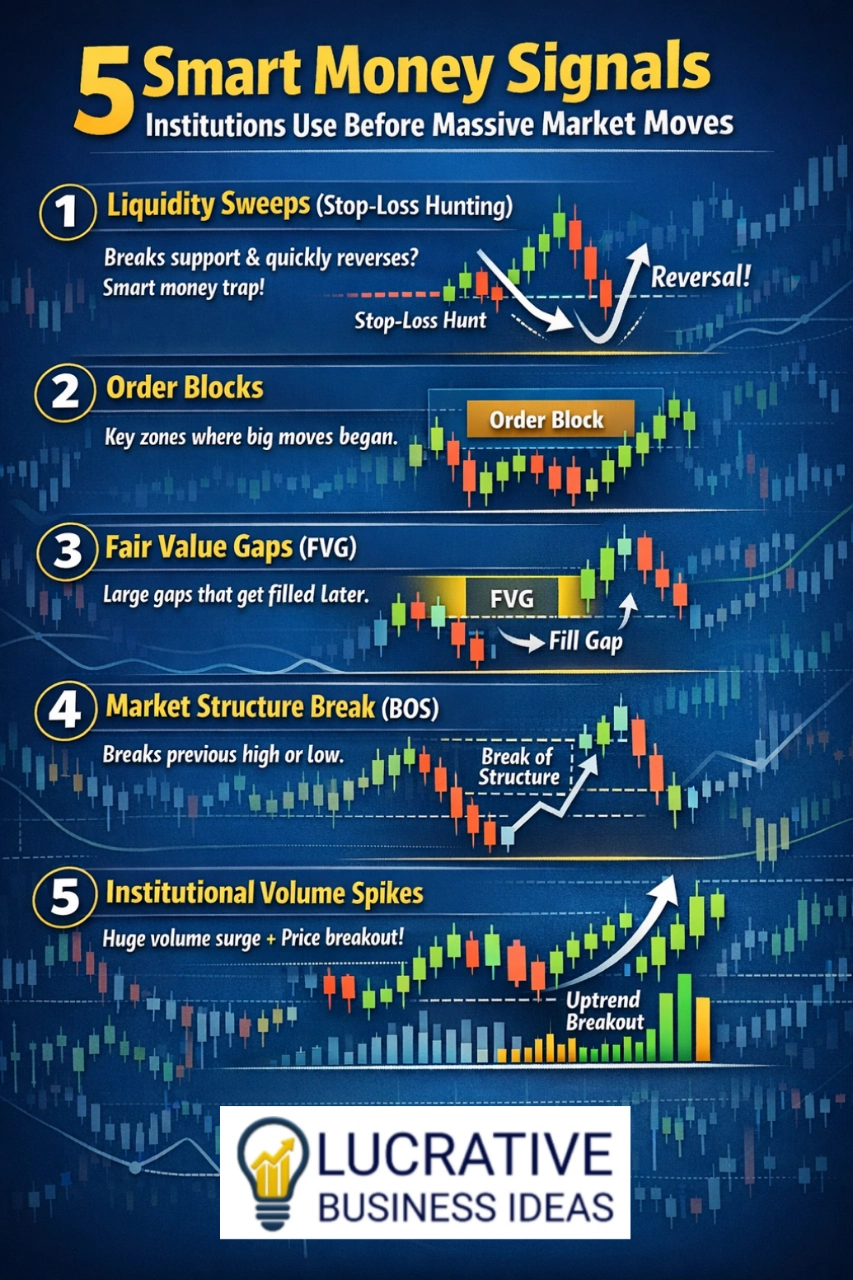
1. Liquidity Sweeps (Stop-Loss Hunting)
This is one of the most common institutional tricks.
What It Means
Big institutions need huge liquidity to enter trades. Retail traders provide that liquidity through stop losses.
So institutions often push price to areas where many stops are located.
Example: If many traders put stop losses below a support level, price may:
- Drop quickly below support.
- Trigger those stop losses.
- Reverse upward strongly.
This is called a liquidity sweep.
Beginner Tip
If price breaks support but quickly reverses, it may be a trap set by smart money.
2. Order Blocks
An Order Block is a price zone where large institutions previously placed massive orders.
What It Means
These zones often become areas where price returns later. Think of them as institutional footprints in the market.
Example: If price exploded upward from a certain zone, it means big buyers entered there. When price returns to that area later, traders expect buyers to step in again.
Beginner Tip
Mark areas where strong impulsive moves started. Those areas are often order blocks.
3. Fair Value Gaps (FVG)
This concept is widely used by professional traders.
What It Means
Sometimes the market moves so fast that it leaves a price imbalance. This creates a gap between buyers and sellers.
Markets often return to fill that imbalance.
Example: If price jumps from $100 to $110 very quickly, there may be very little trading between $102–$106. Price often comes back later to fill that gap.
Beginner Tip
Look for large fast candles. The space they leave behind is often revisited later.
4. Market Structure Break (BOS)
This is one of the clearest trend signals.
What It Means
A Break of Structure (BOS) happens when price breaks a previous high or low.
Example – Uptrend pattern:
- Higher high
- Higher low
- Higher high
If price suddenly breaks the previous low, the trend may be changing.
Smart Trader Interpretation
- Break of previous high → bullish continuation
- Break of previous low → bearish shift
5. Institutional Volume Spikes
Large institutions move billions of dollars. When they enter the market, volume suddenly increases.
What It Means
If price moves strongly with huge volume, it often means smart money is active.
Example: If Bitcoin suddenly jumps 4% with very high volume, it often signals institutional buying pressure.
Beginner Tip
Always combine volume + price breakout. That combination is one of the strongest signals in trading.
How Smart Traders Combine These Signals
Professional traders rarely rely on one signal.
They combine several signals together.
Example of a high-probability setup:
- Liquidity sweep occurs.
- Price enters an order block.
- Market structure breaks upward.
- Volume increases.
When these align, the probability of a strong move increases significantly.
A Simple “Smart Money” Strategy for Beginners
Look for this sequence:
- Liquidity sweep.
- Price reaches order block.
- Market structure break.
- Enter trade.
This strategy is used by many professional traders and hedge funds.
The Most Important Rule Smart Traders Follow
Even the best signals can fail. That is why professionals always use:
- Stop losses.
- Risk management.
- Position sizing.
Most successful traders risk only 1–2% per trade.
See Also:
- 10 Powerful Trading Indicators Smart Traders Use to Make Profitable Decisions Consistently
- How Beginners Turn $100–$500 into Huge Trading Capital During Global Crises (Smart Investors’ Playbook)
Conclusion
The market doesn’t move randomly—it moves where the money flows.
By learning to identify these 5 smart money signals, you shift from reacting to price to anticipating it. That’s the difference between retail traders who chase moves and institutional traders who create them.
Start small, practice consistently, and train your eye to spot these signals in real-time. Over time, you’ll begin to think less like the crowd—and more like smart money.