
Many young entrepreneurs believe that success starts with having big ideas. But listen closely—ideas don’t build businesses; systems do.
Whether you live in Lagos, Nairobi, Accra, London, Dubai, New Delhi or New York…
the process of turning an idea into a real business follows the same universal principles.
This guide breaks it down into 5 simple, practical steps used by companies globally—from Facebook to Airbnb, from Dangote Group to Alibaba.
Imagine you and I sitting together, and I’m walking you through each step gently, ensuring you understand why and how it all works.
Let’s begin.
🔥 Step 1: Validate Your Idea (Don’t Assume—Confirm!)
Imagine you want to start a restaurant.
You believe people will love your food.
But here’s the truth:
👉 You are not your customer.
👉 What you love doesn’t matter.
👉 What the market wants is what wins.
Validation means checking whether real people are willing to use or pay for what you want to offer—even before you build it.
How Global Companies Validated Their Ideas
- Airbnb started by renting out an air mattress in a small apartment before building anything.
- Dropbox validated demand with a simple video demo before writing a single line of code.
- Uber started with one car—just one!—to test demand in San Francisco.
How YOU can validate fast
- Talk to 10–20 real potential customers
- Ask: “Would you pay for this? Why or why not?”
- Create a simple prototype or sample
- Collect pre-orders if possible
- Ask people to join a waitlist
If people don’t show interest, you don’t have a business—yet.
🔥 Step 2: Define the Problem Clearly (Businesses Solve Pain)
Every successful company solves a real problem.
- Google solves the problem of finding information instantly
- WhatsApp solves expensive communication
- Amazon solves slow and inconvenient shopping
- Jumia solves limited local product availability
A business is simply:
👉 A solution to a painful problem that people care enough to pay for.
Your task here is to define:
- Who has the problem?
- How big is the problem?
- How are they solving it today?
- Why is your solution better, faster, or cheaper?
When you understand the problem deeply, your solution becomes powerful.
🔥 Step 3: Build a Minimum Viable Product (Start Small, Stay Smart)
This is where most new entrepreneurs fail.
They want to create a perfect product from day one.
But the world’s biggest companies started with tiny versions of what they are today.
Examples of MVPs
- Facebook was only for Harvard students at first
- Instagram launched with ONE feature: posting photos
- Amazon started as a simple online bookstore
- Flutterwave began with a simple API for African payments
Your MVP should be:
✔ Simple
✔ Functional
✔ Fast to build
✔ Cheap to develop
✔ Able to test your core idea
If your idea is…
- A clothing brand → Start with 20 pieces, not 2,000
- A digital product → Start with a PDF version
- A mobile app → Start with a WhatsApp or Google Form process
- A restaurant → Start with pre-orders or home delivery only
Your MVP is your first proof that you’re solving a real problem.
🔥 Step 4: Build a Business Model (How Will Money Enter?)
A business only becomes a business when there is consistent income.
Ask yourself:
👉 How will this idea generate money consistently?
👉 Who will pay? Why will they pay? How much will they pay?
Common Global Business Models
- Subscription (Netflix, Canva, Spotify, MTN)
- Commission (Uber, Airbnb, Bolt)
- E-commerce (Amazon, Jumia, Alibaba)
- Freemium (Dropbox, LinkedIn)
- Advertising (Facebook, YouTube, TikTok)
- Licensing (Microsoft, Oracle)
Your job:
Choose the model that fits your idea and audience.
Even better—start with ONE business model first, then expand later.
🔥 Step 5: Launch, Get Feedback & Improve (Repeat Until Successful)
Once your MVP is ready:
👉 Launch it to a small audience
👉 Collect real feedback
👉 Improve the product
👉 Relaunch again
👉 Repeat
This cycle—called iteration—is how companies globally grow.
Examples
- TikTok was once an app called “Musical.ly”
- YouTube started as a dating video app
- Twitter was originally “Odeo,” a podcasting tool
They improved, pivoted, and adapted based on real user feedback.
Your First Launch Should Be Small
Don’t spend millions.
Don’t try to impress anyone.
Just get your product into real hands.
Because:
👉 Businesses are not built by perfection. They are built by iteration.
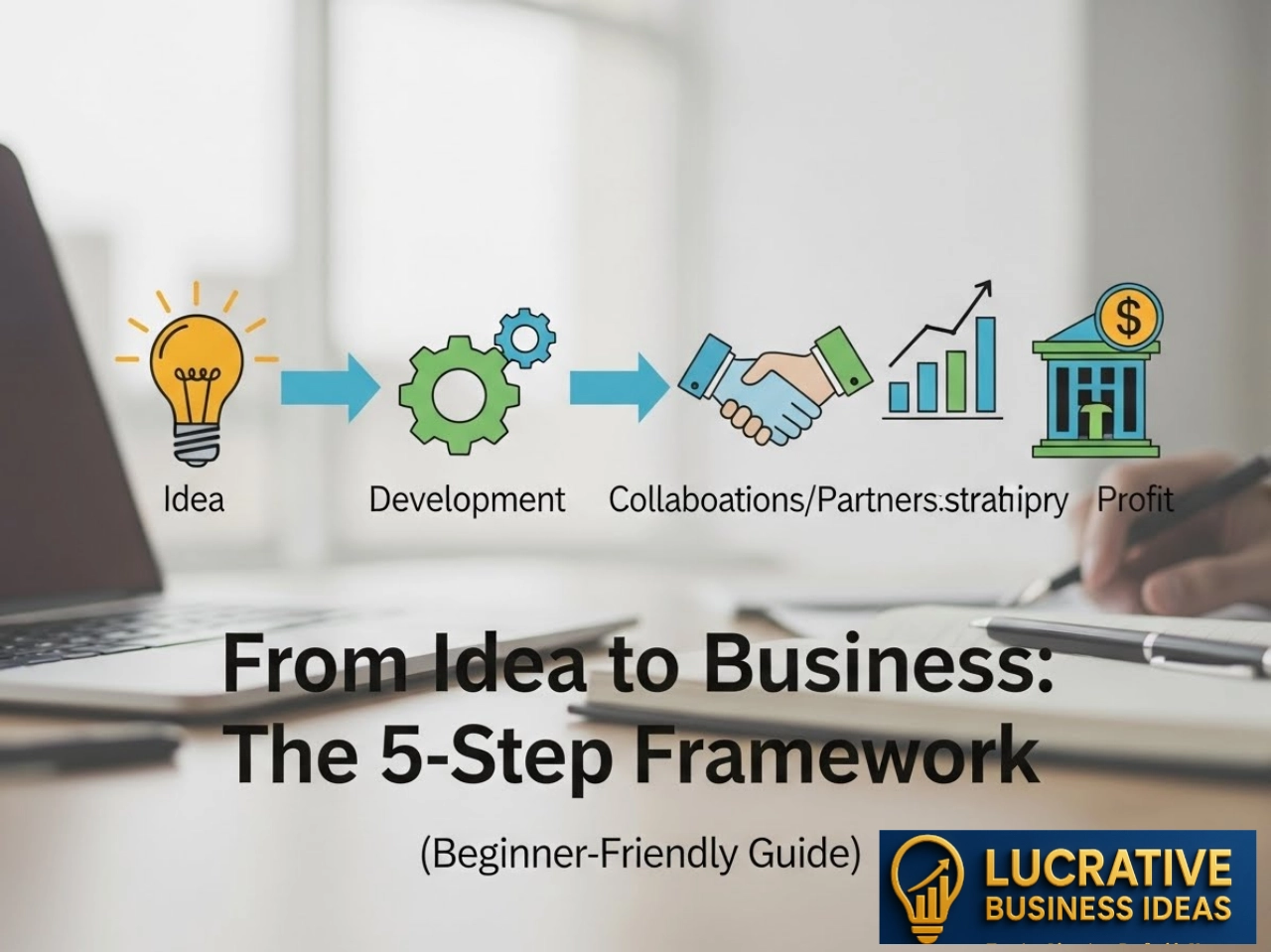
📌 Summary: The 5-Step Framework
- Validate Your Idea — Check if people want it
- Define the Problem — Businesses solve pain
- Build an MVP — Start with something small
- Choose a Business Model — Know how money enters
- Launch & Improve — Grow using real feedback
Master these 5 steps, and you’ll avoid 90% of the mistakes new entrepreneurs make.
📚 QUIZ (Test Your Understanding)
1. What is the first step before building a product?
A. Hiring staff
B. Validating your idea
C. Designing a logo
2. What makes a business different from an idea?
A. The number of social media followers
B. The ability to generate consistent income
C. The beauty of the idea
3. What does MVP mean?
A. Maximum Value Price
B. Minimum Viable Product
C. Market Value Potential
4. Which company validated its idea using a simple video?
A. Dropbox
B. Twitter
C. WhatsApp
5. What is the goal of launching an MVP?
A. To look perfect
B. To test and get feedback
C. To impress investors
(Answers: 1-B, 2-B, 3-B, 4-A, 5-B)
🔍 Frequently Asked Questions (FAQs) & Answers
1. What is the simplest way to turn an idea into a business?
Start by validating demand, building an MVP, choosing a business model, launching small, and improving using feedback.
2. Do I need money to start turning my idea into a business?
Not necessarily. Many global startups began with prototypes and simple tests before raising funds.
3. How do I know if my idea is good?
If real people are willing to pay for it or use it consistently, it’s a good idea.
4. What is the meaning of MVP in entrepreneurship?
Minimum Viable Product—a simple version of your product used to test demand.
5. How long does it take to turn an idea into a business?
It varies, but with the right steps, you can test and launch within weeks.
6. Do I need a business plan immediately?
No. Start by validating your idea, then build a simple business model.
7. Which global companies started as MVPs?
Facebook, Uber, Airbnb, Amazon, Instagram, and Dropbox all began with basic versions.
8. What if my idea fails validation?
Improve the idea, change the market, or pivot to a problem with higher demand.
9. What are the biggest mistakes beginners make?
Building a full product too early, ignoring customer feedback, and assuming without testing.
10. How do I know which business model fits my idea?
Choose based on how your customers prefer to buy and how successful companies in your industry monetize.
See Also: