
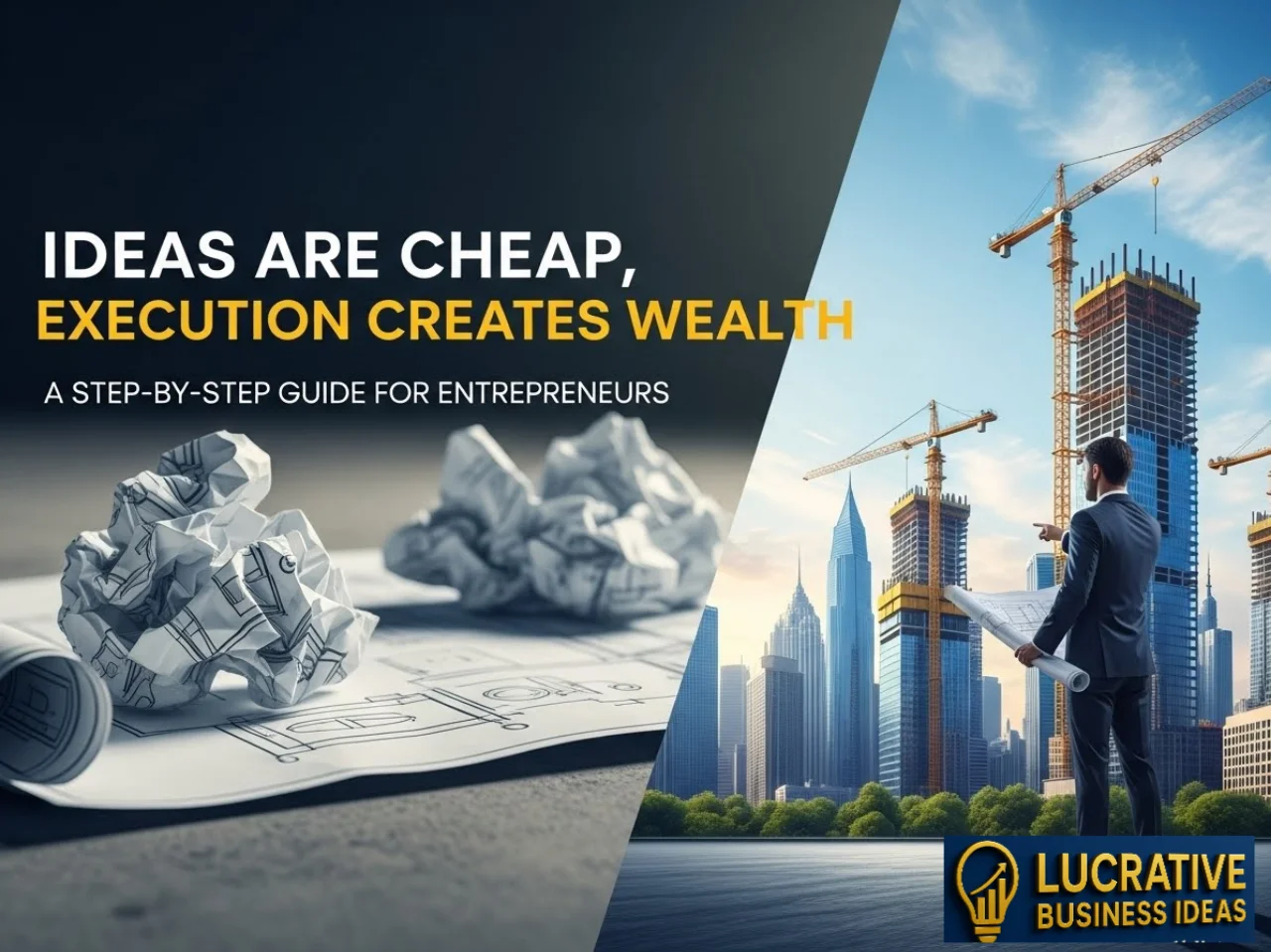
Ideas only are not enough. Imagine you have a smartphone in your hand. It’s a revolutionary idea: sleek design, powerful software, a product millions would love.
Now imagine no one built it, manufactured it, marketed it, or sold it. That idea remains… just an idea.
Here’s the hard truth: ideas are cheap, execution is expensive—but it’s execution that creates wealth.
Many young entrepreneurs and even seasoned professionals spend years dreaming of business ideas or investment plans. They read, they plan, they daydream—but without action, these ideas remain powerless.
“Execution turns ideas into reality. Without it, brilliance is wasted potential.”
📍 Section 1: Why Ideas Alone Don’t Make You Rich
1. Ideas Are Everywhere
- Every entrepreneur thinks of something “new.”
- Example: Steve Jobs didn’t invent the smartphone or the personal computer. He executed differently, better, faster, and created Apple’s empire.
2. The Execution Gap
- Research shows 90% of startups fail, not because ideas were bad, but because they failed to execute.
- Example: Webvan, a dot-com grocery delivery idea, was innovative—but poor execution (over-expansion, operational inefficiencies) led to failure.
3. Execution Builds Credibility and Momentum
- Execution shows you can deliver results consistently, which builds trust with investors, customers, and partners.
4. Ideas Only Have Value When Tested in Reality
- Until you test, prototype, or launch, an idea is hypothetical. Execution transforms it into something tangible.
📍 Section 2: What Execution Actually Means
Execution is not just “doing something.” It’s strategic, disciplined action that aligns with your goals.
Components of Effective Execution
- Planning & Strategy
- Example: Amazon’s Jeff Bezos didn’t just want an online bookstore. He had a step-by-step plan for logistics, inventory, and expansion.
- Action with Consistency
- Daily, repeated efforts matter more than random bursts of activity.
- Analogy: Water drilling a rock daily eventually creates a hole—small, consistent actions matter.
- Adaptation & Learning
- Execution includes learning from failures and refining your approach.
- Example: Elon Musk iterated SpaceX rockets multiple times after failures before achieving success.
- Resource Management
- Effective execution allocates money, time, and human resources efficiently.
- Measurement & Accountability
- Track progress, set KPIs, and hold yourself accountable.
- Example: Spotify used data-driven execution to expand globally while refining their product.
📍 Section 3: Global Examples Where Execution Made the Difference
- Airbnb (USA)
- Idea: Rent out your space to travelers.
- Execution: Focused on building trust, user experience, and global marketing. Result: $100+ billion company.
- Alibaba (China)
- Idea: Connect small Chinese manufacturers to global buyers.
- Execution: Invested in technology, logistics, and cross-border trade strategy. Result: Global e-commerce giant.
- Tesla (USA)
- Idea: Electric cars aren’t new.
- Execution: Built manufacturing, branding, charging infrastructure, and marketing strategy. Tesla leads EV innovation today.
- Jumia (Africa)
- Idea: E-commerce for African consumers.
- Execution: Adapted to local infrastructure, mobile payments, and logistics challenges to scale successfully.
Lesson: Ideas may be identical globally, but execution differentiates billion-dollar companies from forgotten concepts.
📍 Section 4: Steps to Master Execution as an Entrepreneur
Step 1: Prioritize Action Over Perfection
- Don’t wait for the “perfect plan.”
- Launch a minimum viable product (MVP) to test your idea.
Step 2: Break Ideas Into Tasks
- Convert goals into daily, weekly, monthly tasks.
- Example: If your idea is an e-commerce store: research suppliers → set up website → launch ads → track sales.
Step 3: Set Measurable Goals
- KPIs create accountability.
- Example: “Acquire 100 customers in the first month” is better than “grow my business fast.”
Step 4: Embrace Feedback & Iterate
- Execution is iterative. Mistakes are feedback.
- Example: Slack pivoted from a failed gaming platform to a communication tool based on user feedback.
Step 5: Manage Time and Resources
- Avoid distractions. Focus on high-leverage tasks.
- Analogy: A chef can’t cook 50 dishes at once; focus on what brings results.
Step 6: Build a Support System
- Surround yourself with mentors, partners, or a team that complements your skills.
📍 Section 5: Practical Exercise
- List 3 business or investment ideas you’ve been thinking about.
- For each, write 1 actionable step you can take this week to start execution.
- Break that step into daily micro-tasks.
- Identify one metric to measure progress.
- Share your plan with a mentor, friend, or accountability partner for feedback.
📘 Quiz — Test Your Understanding
- Why do ideas alone rarely make people rich?
- Name 3 components of effective execution.
- How did Airbnb’s execution strategy contribute to its success?
- What does “iteration” mean in the context of execution?
- Why is prioritizing action over perfection important?
- Give an example of a company that executed an existing idea better than competitors.
📍 Frequently Asked Questions (FAQs)
1. What is execution in business?
Execution is the process of implementing strategies and ideas consistently to achieve tangible results.
2. Why is execution more important than ideas?
Because an idea without action remains hypothetical, while execution transforms concepts into real-world value.
3. How can I improve my execution skills?
Break tasks into small steps, set measurable goals, track progress, and learn from mistakes.
4. Can a mediocre idea succeed with strong execution?
Yes. Even average ideas can succeed if executed better than competitors (e.g., Tesla’s EV market strategy).
5. What are common barriers to execution?
Fear of failure, over-planning, lack of accountability, poor resource management, and distraction.
6. How do companies like Apple and Amazon excel in execution?
They combine strategic planning, customer focus, iterative improvement, and disciplined resource allocation.
7. How does feedback improve execution?
Feedback helps you identify mistakes, adjust strategies, and optimize outcomes.
8. What is a minimum viable product (MVP)?
An MVP is a basic version of a product launched to test the idea with real customers before scaling.
9. How does execution impact wealth creation?
Consistent, strategic action turns ideas into profitable businesses and scalable investments.
10. Can execution be learned?
Absolutely. By developing discipline, planning, accountability, and iterative learning, anyone can improve execution skills.
See Also: