
Most beginner traders rely on guesswork, hype, or emotions—and that’s exactly why they lose money. Smart traders don’t gamble. They follow data.
Behind every consistent trader is a set of powerful indicators that reveal market trends, momentum, and hidden opportunities before the crowd catches on. These indicators act like a roadmap, helping traders decide when to enter, when to exit, and when to stay out completely.
In this guide, you’ll discover the most effective trading indicators smart traders use to stay ahead of the market—and how you can start using them to make smarter, more confident trading decisions.
Below are some of the strongest indicators professional traders use, explained in a way that beginners can easily understand.
Let’s now break them down one after the other.
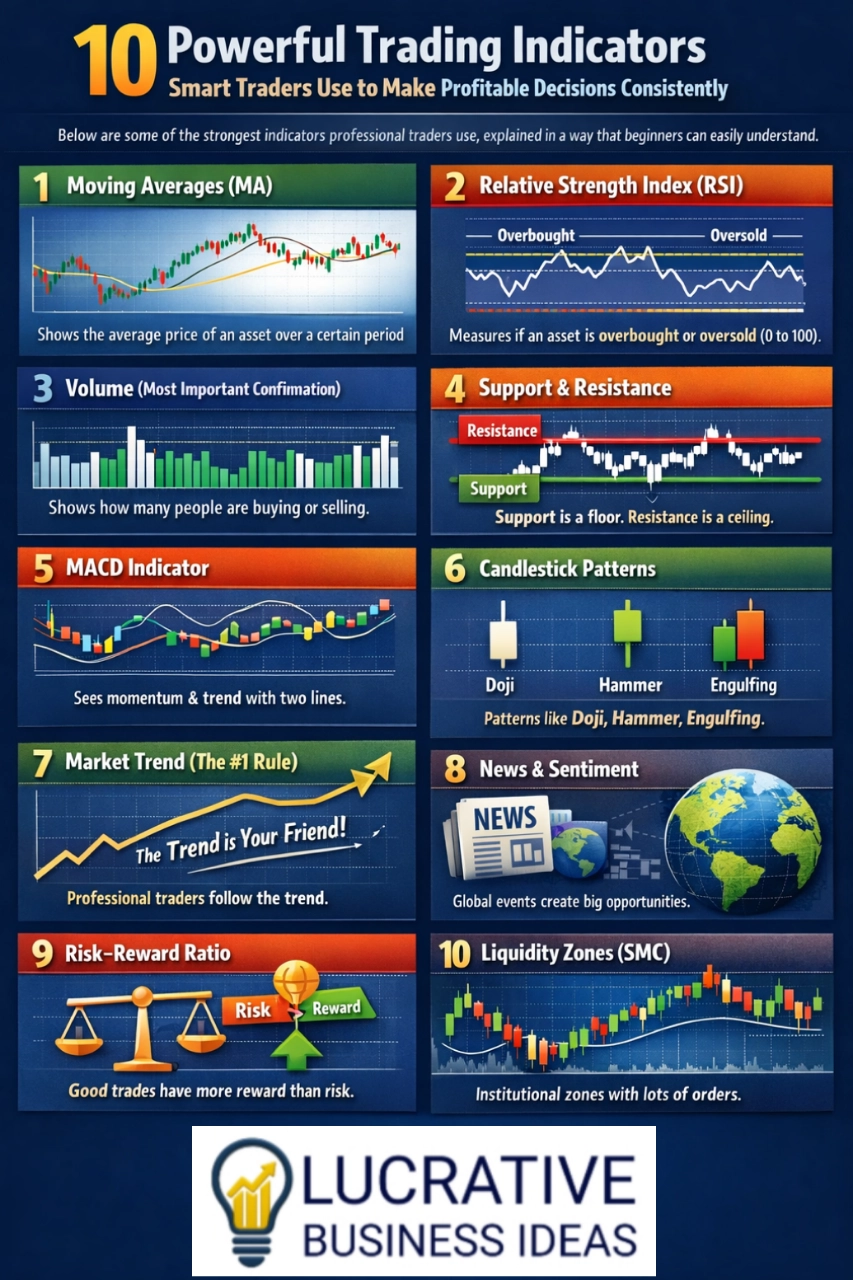
1. Moving Averages (MA)
One of the most popular indicators in trading.
What It Means
A Moving Average shows the average price of an asset over a certain period of time.
Example:
- 50-day moving average
- 200-day moving average
It helps traders see the overall direction of the market.
How Smart Traders Use It
- If price is above the moving average → Uptrend
- If price is below the moving average → Downtrend
Powerful Signal
When a shorter MA crosses above a longer MA, it can signal a buy opportunity.
Example:
- 50 MA crosses above 200 MA → Golden Cross.
- When it crosses downward: Death Cross → possible downtrend.
Why Beginners Love It
It removes noise and shows the real trend clearly.
2. Relative Strength Index (RSI)
What It Means
RSI measures whether something is overbought or oversold. The indicator ranges from 0 to 100.
Key Levels
- Above 70 → Overbought
- Below 30 → Oversold
How Smart Traders Use It
- If RSI shows oversold, traders expect the price to bounce up.
- If RSI shows overbought, traders expect a possible pullback.
Example: If a crypto coin falls heavily and RSI hits 25, traders may prepare to buy the dip.
3. Volume (The Most Important Confirmation)
Many professional traders say: “Price moves, but volume tells the truth.”
What Volume Means
Volume shows how many people are buying or selling.
Why It Matters
A price move with strong volume means the move is real. A move with low volume may be fake.
Smart Trader Rule
- Price breakout + high volume = strong signal
- Price breakout + low volume = risky signal
4. Support and Resistance
This is one of the most powerful trading concepts.
Support
A price level where the market usually stops falling and bounces upward. Think of it as a floor.
Resistance
A level where price usually stops rising and drops. Think of it as a ceiling.
How Traders Use It
- Buy near support.
- Sell near resistance.
Example: If Bitcoin keeps bouncing around $60,000, that level becomes strong support.
5. MACD (Moving Average Convergence Divergence)
Sounds complicated but it’s actually simple.
What It Shows
MACD helps traders see momentum and trend direction. It uses two lines.
Key Signal
- When the MACD line crosses above the signal line → bullish signal.
- When it crosses below → bearish signal.
Why Smart Traders Use It
It often signals trend changes early.
6. Candlestick Patterns
Smart traders read price behavior using candlesticks.
Some powerful patterns include:
- Doji: Indicates indecision in the market.
- Hammer: Shows buyers stepping in after a drop.
- Engulfing Pattern: A strong trend reversal signal.
Traders often combine candlestick patterns with support/resistance for higher accuracy.
7. Market Trend (The #1 Rule)
Professional traders follow one golden rule:
“The trend is your friend.”
Uptrend
Higher highs and higher lows.
Strategy: Buy pullbacks.
Downtrend
Lower highs and lower lows.
Strategy: Sell rallies.
Trading against the trend is very risky.
8. News & Market Sentiment
Smart traders watch global events.
Examples:
- Interest rate decisions.
- War or geopolitical tensions.
- Inflation reports.
- Major company announcements.
For example: The Russia–Ukraine War triggered huge moves in oil, gold, and wheat markets.
Global crises often create big trading opportunities.
9. Risk–Reward Ratio
Professional traders never enter trades without calculating risk.
Example:
- Risk = $100
- Potential profit = $300
- This is a 1:3 risk-reward ratio.
Good traders only take trades where the reward is bigger than the risk.
10. Liquidity Zones (Smart Money Concept)
This is something advanced traders watch carefully.
Big institutions need large amounts of buyers or sellers to enter trades.
They often target areas where:
- Many stop losses exist.
- Many retail traders are trapped.
These areas are called liquidity zones. After liquidity is taken, the market often moves strongly in the opposite direction.
Simple Strategy Many Smart Traders Use
Instead of using 10 indicators, professionals often combine just 3:
- Trend (Moving Average)
- RSI (Overbought/Oversold)
- Support & Resistance
If all three align → high probability trade.
The Biggest Secret of Smart Traders
Indicators do not predict the future. They simply increase probability.
Professional traders win because they focus on:
- Risk management
- Discipline
- Consistency
Not because they have a magic indicator.
See Also:
- 3 Easy Online “War Money” Opportunities Anyone Can Start During Global Crises (No Trading Required)
- 7 Powerful AI Tools Creators Use to Run Faceless Geopolitics & War-Analysis YouTube Channels Almost Automatically
Conclusion
Mastering trading isn’t about using every indicator—it’s about using the right ones with clarity and discipline.
Smart traders combine a few powerful indicators, stick to a strategy, and avoid emotional decisions. They understand that consistency—not luck—is what builds real trading success.
As you begin applying these indicators, focus on practice, patience, and continuous learning. Over time, you’ll start to see patterns more clearly, make better decisions, and move closer to becoming a confident, profitable trader.