

Global volatility often creates fear in financial markets. Headlines scream about inflation, recession, currency crashes, geopolitical conflicts, and economic uncertainty. Many investors panic, withdraw their funds, and wait on the sidelines.
But experienced traders understand something different. Periods of global instability are often the most profitable moments in financial history.
When markets move rapidly, opportunities multiply. Prices fluctuate sharply, new sectors emerge, and certain assets begin to outperform the rest of the global economy. Those who know where to look and how to position themselves can grow their capital far faster than during stable economic periods.
This is why some of the most successful traders and investors in history built their wealth during times of crisis and uncertainty.
In this article, you will discover five powerful markets where small traders can grow money quickly during global volatility. These markets are known for their liquidity, price movements, and opportunity potential—even for traders starting with modest capital.
Understanding them could be the difference between watching global chaos unfold and turning that volatility into financial opportunity.
Below are 5 markets where small traders often grow capital faster during global volatility.
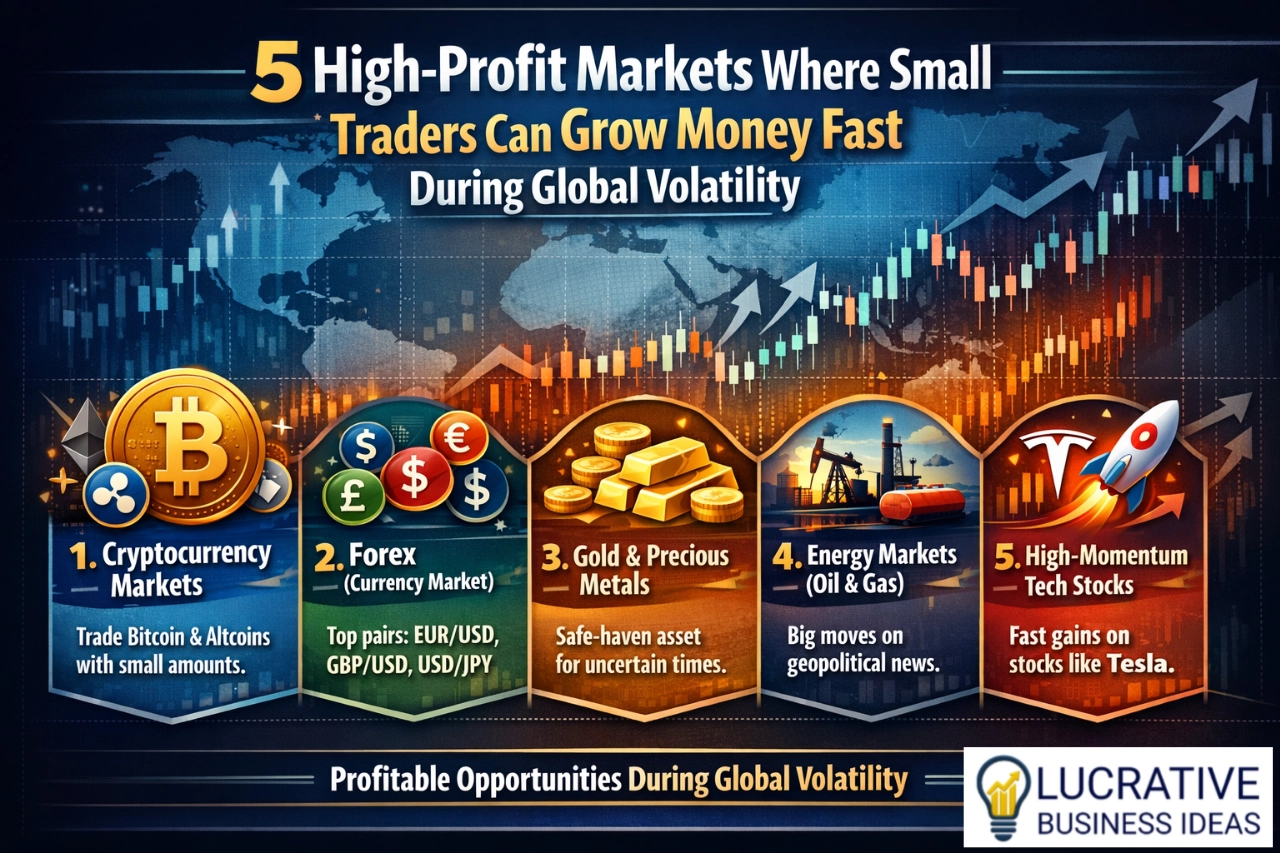
1. Cryptocurrency Markets
The most popular high-volatility market today. The leading asset is Bitcoin, followed by many alternative coins.
Why Traders Love It
- Markets run 24/7.
- Large price swings.
- Easy access with small capital.
Example: It’s common for Ethereum or other major coins to move 5–10% in a single day.
Beginner Advantage: You can start trading crypto with very small amounts.
2. Forex (Currency Market)
Forex is the largest financial market in the world.
Popular trading pairs include:
- EUR/USD
- GBP/USD
- USD/JPY
Why It Moves Fast During Crises
Currencies react quickly to:
- Interest rate changes.
- Economic reports.
- Geopolitical tensions.
During global uncertainty, traders often rush to the U.S. Dollar Index, which measures the strength of the U.S. dollar.
3. Gold and Precious Metals
Gold is a traditional safe-haven asset. The widely traded ETF tracking gold is SPDR Gold Shares.
Why Gold Moves in Crisis
When investors fear inflation, war, banking collapse, they often move money into gold.
Example: During the Russia–Ukraine War, gold saw strong volatility.
4. Energy Markets (Oil & Gas)
Energy markets can explode during geopolitical tension. A major oil benchmark traders watch is United States Oil Fund.
Why Oil Is Volatile
Oil prices react quickly to:
- Supply disruptions.
- War in oil-producing regions.
- Global economic growth.
Even small news can trigger large intraday moves.
5. High-Momentum Tech Stocks
Certain tech stocks move dramatically during market shifts. A well-known example is Tesla, Inc..
Why Traders Watch Them
- Heavy trading volume.
- Strong retail interest.
- Big price swings.
When momentum starts, these stocks can move 10–20% within days.
How Small Traders Multiply Small Capital
Professional traders often follow a simple formula:
1. Focus on volatile markets.
2. Trade only clear setups.
3. Risk small amounts per trade.
4. Compound profits gradually.
Example growth path: $200 → $300 → $450 → $675 → $1,000+
This process takes discipline and patience.
The Most Important Warning
High-volatility markets can grow money fast, but they can also wipe out accounts quickly.
Smart traders always:
- Use stop losses.
- Avoid over-leveraging.
- Risk 1–2% per trade.
See Also:
- 5 Smart Money Signals Institutions Use Before Massive Market Moves (Beginner’s Guide)
- 10 Powerful Trading Indicators Smart Traders Use to Make Profitable Decisions Consistently
Conclusion
Global volatility does not destroy opportunities—it reveals them. While many investors panic during economic uncertainty, smart traders focus on markets where price movements create profitable openings. The key is not avoiding volatility, but learning how to navigate it strategically.
The five markets discussed in this article have repeatedly proven their ability to offer opportunities during turbulent economic periods. With the right knowledge, risk management, and disciplined strategy, even small traders can position themselves to benefit from these fluctuations.
Remember, successful trading is not about chasing quick profits blindly. It is about understanding market behavior, managing risk wisely, and staying consistent in execution.
Global crises will continue to happen. Markets will continue to move. The real question is this:
Will you watch the volatility from the sidelines—or learn how to profit from it?