
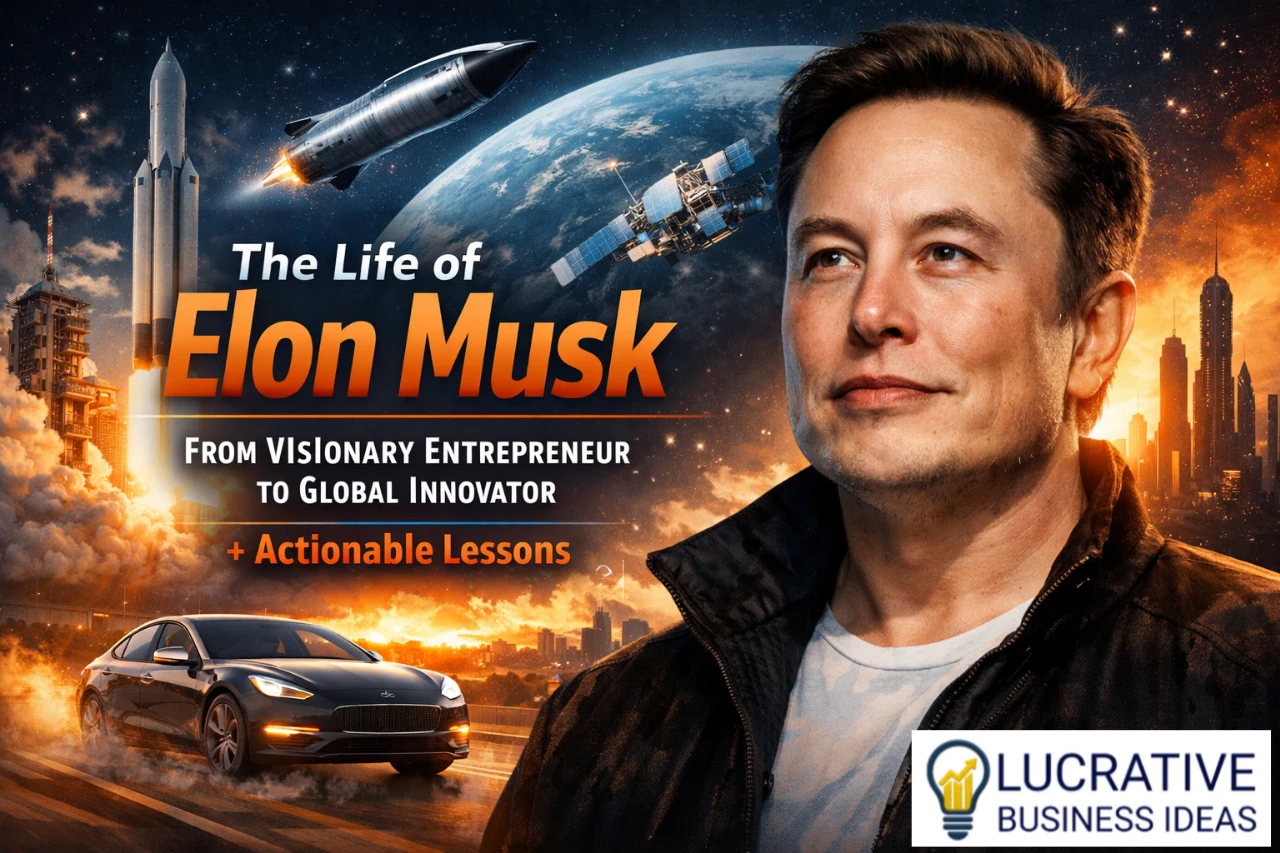
Elon Musk is not just a name—he is a phenomenon. From a curious child in South Africa to the visionary behind Tesla, SpaceX, and multiple revolutionary ventures, Musk has redefined what it means to dream big and act even bigger. His life is a blueprint for audacity, resilience, and relentless execution.
This article takes you through every pivotal stage of Musk’s journey: his early struggles, first ventures, breakthrough moments, leadership style, strategic thinking, and the transformative projects that define his legacy. More than a biography, this is a guide for entrepreneurs, innovators, and anyone striving to make an impact in a rapidly changing world.
Outline: The Life and Lessons of Elon Musk
1. Early Life and Childhood (1971–1988)
- Birth, family background, upbringing in South Africa.
- Early interests, education, and formative experiences.
- Early signs of curiosity, intellect, and resilience.
2. Adolescence and Early Struggles (1988–1995)
- Moving through teenage years and higher education.
- Challenges growing up socially and academically.
- Early entrepreneurial experiments (video games, software).
3. First Ventures and Entrepreneurial Challenges (1995–1999)
- Zip2 Corporation: founding, struggles, eventual sale.
- Lessons from early failure and dealing with venture capital.
4. PayPal Era: Breakthrough in Business (1999–2002)
- X.com, evolution into PayPal.
- Conflicts, pivots, and ultimate acquisition by eBay.
- Strategies that led to breakthrough success.
5. SpaceX: Risking It All on Space Exploration (2002–2012)
- The audacious vision to commercialize space.
- Early failures, near bankruptcy, and persistence.
- Breakthroughs: Falcon 1, Falcon 9, Dragon capsule.
6. Tesla Motors: Revolutionizing Electric Vehicles (2004–2015)
- Early investments, product development struggles.
- Near-bankruptcy moments and scaling production.
- Market impact and branding strategy.
7. SolarCity, OpenAI, Neuralink, The Boring Company, and the Acquisition of Twitter – Now Rebranded as X (2006–Present)
- Expanding into energy, AI, neuroscience, and infrastructure.
- Lessons from diversification and leveraging innovation.
8. Personal Life, Leadership Style, and Public Persona
- Work ethic, management philosophy, and public controversies.
- Influence of personality on business outcomes.
9. Strategies, Principles, and Frameworks Behind His Success
- First-principles thinking, risk-taking, and relentless learning.
- Time management, hiring philosophies, and vision alignment.
10. Legacy, Ongoing Projects, and Lessons for Entrepreneurs
- Current status of business empires.
- Practical takeaways for investors, entrepreneurs, and innovators.
Now, let’s begin!
Section 1: Early Life and Childhood (1971–1988)
Elon Musk was born on June 28, 1971, in Pretoria, South Africa, to a Canadian mother, Maye Musk, a model and dietitian, and a South African father, Errol Musk, an engineer and entrepreneur. From the outset, Elon’s life was far from ordinary. His parents separated when he was young, leaving him to navigate a complicated family dynamic that included a strict father and a supportive, independent mother. This contrast shaped both his resilience and his drive to forge his own path.
Even as a child, Musk displayed remarkable intellectual curiosity. At the age of 10, he taught himself computer programming, and by 12, he had created and sold his first video game, Blastar, for about $500. Musk’s early interests were deeply unconventional—he read voraciously, devouring science fiction and encyclopedias, and often imagined worlds far beyond what was tangible in Pretoria. His love for technology and space exploration would lay the foundation for his future ventures.
Despite his intellectual gifts, Musk faced significant social challenges. He was bullied in school, sometimes severely, and spent many hours isolated, often retreating into reading or his own inventions. These experiences taught him early lessons in self-reliance, mental toughness, and the importance of focusing on one’s own goals rather than external approval.
Musk’s upbringing also instilled a fascination with engineering, physics, and problem-solving. Watching his father build projects at home and experimenting with electronics fueled an innate understanding of how things work—a trait that would become a cornerstone of his entrepreneurial mindset.
Actionable Lessons from Musk’s Childhood
- Curiosity is the Root of Innovation – Musk’s self-directed learning shows that passion-driven curiosity can be a more powerful teacher than formal schooling alone.
- Early Experimentation Matters – Trying small projects, like coding a game at 12, builds skills, confidence, and a bias toward action.
- Resilience Through Adversity – Experiencing bullying or setbacks in childhood can strengthen mental toughness and self-reliance.
- Learn From Your Environment – Observing skilled adults (his father in engineering, his mother in discipline and work ethic) and absorbing practical knowledge is invaluable.
- Think Big, Even Early – Musk’s imagination wasn’t limited by what existed—reading sci-fi and thinking about space set the stage for ambitious, future-oriented goals.
Section 2: Adolescence and Early Struggles (1988–1995)
After an intellectually curious childhood, Elon Musk entered his teenage years facing new challenges and opportunities. By the late 1980s, South Africa was still under apartheid, and Elon, despite his brilliance, often felt like an outsider both socially and culturally. School was a battleground. He was relentlessly bullied, sometimes severely, which forced him to become fiercely independent and resilient at an early age. These hardships would later serve as mental armor for the high-pressure world of entrepreneurship.
During these years, Musk’s intellectual curiosity continued to flourish. He immersed himself in physics, mathematics, and computer science, often teaching himself advanced concepts beyond his school curriculum. He became fascinated with space exploration and the possibilities of technology to change the world—a theme that would define his adult life.
At age 17, Musk made a life-changing decision: he left South Africa to avoid compulsory military service and pursue broader opportunities abroad. He moved first to Canada, enrolling at Queen’s University, which offered a stepping stone to eventually reach the United States. This move was risky—he was young, largely self-reliant, and navigating new cultures—but it marked the first step in a lifelong pattern of taking calculated risks for long-term gain.
Musk also began testing his entrepreneurial instincts during this period. He dabbled in small tech projects and business experiments, learning early lessons about initiative, self-learning, and the realities of earning and managing money. While these ventures were minor compared to his later successes, they planted seeds of confidence and taught him that action, even imperfect action, is critical to learning and growth.
By the end of this period, Musk had developed three core traits that would define his future success:
- Resilience in the face of adversity – cultivated through social challenges and life transitions.
- Self-directed learning – pursuing knowledge independently and deeply.
- Early risk tolerance – willing to leave comfort zones for bigger opportunities.
Actionable Lessons from Musk’s Adolescence
- Adversity Builds Strength – Difficult social or personal circumstances can forge mental toughness and independence if approached with the right mindset.
- Invest in Self-Learning – Mastery doesn’t only come from formal education; curiosity-driven learning can provide a unique advantage over peers.
- Take Calculated Risks Early – Musk’s decision to leave South Africa demonstrates the power of making bold, strategic moves in pursuit of long-term goals.
- Start Small, Learn Fast – Experimenting with small projects develops problem-solving skills and confidence, preparing you for bigger ventures.
- Align with Your Passion – Focusing on areas that genuinely fascinate you (technology, physics, space) sustains motivation even through hardships.
Section 3: First Ventures and Entrepreneurial Challenges (1995–1999)
After transferring from Queen’s University in Canada to the University of Pennsylvania, Elon Musk graduated with dual degrees in Physics and Economics. Equipped with intellectual firepower and a growing appetite for business, Musk was ready to step into the world of entrepreneurship.
In 1995, Musk moved to Silicon Valley with a vision of starting a technology company that could leverage the budding internet. His first venture was Zip2 Corporation, an online city guide designed to help newspapers offer additional services to their readers. Elon, alongside his brother Kimbal Musk, faced relentless challenges.
Zip2 was not an instant success. Venture capital was hard to secure, and Musk experienced firsthand the grueling demands of building a startup from scratch. He worked 80–100 hours a week, coding, pitching investors, and managing the fledgling company. Early meetings were often discouraging; some investors dismissed his ideas outright. Yet, Musk’s relentless focus on problem-solving and product quality kept Zip2 alive.
Through persistence, innovation, and strategic networking, Zip2 eventually attracted major attention. The company’s software improved newspaper listings and maps at a time when online resources were minimal. By 1999, Compaq acquired Zip2 for $307 million, giving Musk his first major financial success.
This period, however, was more than financial reward—it was a crucible for Musk’s entrepreneurial mindset. He learned the importance of:
- Building a product that solves a real problem rather than chasing ideas for the sake of novelty.
- Persistence in the face of rejection—investors and partners often said “no,” but Musk’s conviction never wavered.
- Immersive work ethic—leading from the front, understanding every technical detail, and setting the pace for his team.
Despite the success, Zip2 was just the beginning. Musk realized that wealth alone wasn’t his ultimate goal; he wanted to create companies that changed the world, not just ones that made money. This realization would guide his next ventures.
Actionable Lessons from Musk’s First Ventures
- Solve Real Problems – Businesses succeed when they address genuine needs, not just trendy ideas.
- Persistence Pays Off – Investor rejections, early failures, and long hours are part of the journey.
- Lead From the Front – Understanding every aspect of your business, especially early on, builds credibility and effectiveness.
- Think Beyond Money – True entrepreneurial drive comes from solving meaningful problems, not just accumulating wealth.
- Leverage Networks – Strategic partnerships, mentorships, and investor relationships are critical in turning ideas into scalable businesses.
Section 4: PayPal Era: Breakthrough in Business (1999–2002)
After selling Zip2, Elon Musk had both capital and confidence, but he was hungry for a bigger challenge. In 1999, he founded X.com, an online financial services company with the ambitious goal of revolutionizing banking and payments. The idea was ahead of its time—allowing people to send money over the internet securely, without relying on traditional banks.
X.com quickly faced internal and external challenges. The tech landscape was evolving fast, and the company underwent mergers, ultimately evolving into PayPal. Musk, as the largest shareholder and driving visionary, faced intense conflicts with other executives, eventually losing his CEO position. Even so, he remained committed to the company’s mission, guiding strategy and ensuring the product solved a critical problem: making online payments simple and secure.
During this period, Musk demonstrated a blend of visionary thinking and relentless focus. He pushed the team to innovate constantly, solve technical bottlenecks, and improve the customer experience, often working 16–20 hours a day himself. PayPal’s growth was explosive, capturing a global market and changing how people moved money online.
In 2002, PayPal was acquired by eBay for $1.5 billion in stock, making Musk a multimillionaire. More importantly, this era taught him the dynamics of scaling a company, managing executive conflicts, and building a product that millions of people rely on daily.
This stage also highlighted Musk’s philosophy of visionary risk-taking paired with relentless execution. He realized that breakthrough innovation often comes from pursuing ideas that seem too risky or unconventional to others.
Actionable Lessons from the PayPal Era
- Vision Over Comfort – Pursue ideas that challenge the status quo, even if they seem risky or unconventional.
- Product First – Ensure your company solves a real, tangible problem; user trust and experience are non-negotiable.
- Persistence Through Conflict – Executive disagreements and setbacks are inevitable; stay committed to the mission.
- Scale Strategically – Growth requires not just innovation, but also operational rigor and careful management of teams.
- Learn From Every Role – Even losing the CEO position taught Musk lessons in leadership, negotiation, and corporate governance.
Section 5: SpaceX – Risking It All on Space Exploration (2002–2012)
After PayPal, Elon Musk could have chosen comfort. He had wealth, freedom, and credibility. Instead, he set his sights on something almost unthinkable: revolutionizing space travel. In 2002, he founded Space Exploration Technologies Corp., or SpaceX, with the goal of reducing the cost of spaceflight and making humanity multi-planetary.
The venture was fraught with risk. Musk invested $100 million of his own money, essentially betting his fortune on a dream many thought impossible. The early years were grueling. SpaceX endured three failed launches of the Falcon 1 rocket, each bringing the company closer to bankruptcy. Suppliers failed, engineers quit, and investors grew skeptical. Musk himself faced personal financial strain, living under immense pressure while pouring nearly every penny into the company.
But Musk’s mindset was extraordinary. He applied first-principles thinking, breaking down rocketry to its fundamentals rather than accepting conventional wisdom. He pushed his engineers to innovate, testing relentlessly, learning from failure, and iterating faster than traditional aerospace companies.
Finally, in 2008, after nearly running out of money, SpaceX succeeded: the Falcon 1’s fourth flight reached orbit. That single launch changed everything. NASA awarded SpaceX a contract to supply the International Space Station, validating Musk’s vision and securing the company’s survival. From there, SpaceX rapidly progressed: the Falcon 9, Dragon capsule, and eventually reusable rockets, cementing Musk’s reputation as a transformative entrepreneur.
The SpaceX era teaches that vision alone isn’t enough—it must be combined with relentless execution, innovation, and resilience under pressure. Musk risked it all financially, professionally, and personally to achieve a breakthrough that many said was impossible.
Actionable Lessons from the SpaceX Era
- Bold Risk-Taking Can Yield Unprecedented Reward – Pursuing audacious goals often requires personal and financial sacrifice.
- First-Principles Thinking Drives Innovation – Challenge conventional wisdom by breaking problems into their fundamental truths.
- Iterate Rapidly Through Failure – Failure isn’t the end; it’s feedback to learn and improve faster than competitors.
- Persistence Under Pressure – Musk’s ability to endure financial and operational crises exemplifies resilience.
- Align Vision With Execution – A powerful idea needs equally strong operational discipline to become reality.
Section 6: Tesla Motors – Revolutionizing Electric Vehicles (2004–2015)
In 2004, Elon Musk joined Tesla Motors (founded a year earlier) as chairman and lead investor, eventually becoming CEO and product architect. His goal was ambitious: to transform the automotive industry by creating electric vehicles (EVs) that weren’t just eco-friendly, but desirable, high-performance, and aspirational.
Tesla faced enormous challenges from the start. The automotive industry was dominated by entrenched giants, skeptical suppliers, and a market that largely dismissed electric cars as impractical. Tesla’s first car, the Roadster, faced production delays, cost overruns, and technical setbacks. Musk personally invested millions more to keep the company afloat, even as the global financial crisis of 2008 loomed.
During this period, Musk’s leadership was defined by hands-on involvement, relentless problem-solving, and extreme risk tolerance. He worked alongside engineers, slept at the factory, and personally resolved technical bottlenecks. He demanded perfection while encouraging innovation, pushing the limits of battery technology, software, and design.
Tesla’s breakthrough came gradually. The Roadster proved electric cars could be fast and desirable. The Model S, launched in 2012, set a new standard for EVs: luxury, performance, and cutting-edge technology. By 2013–2015, Tesla had established a strong brand identity, a growing customer base, and a clear path to mass-market models like the Model X and Model 3.
Musk’s experience with Tesla highlighted the intersection of vision, operational rigor, and personal risk-taking. Nearly bankrupt multiple times, Tesla survived because of bold bets, relentless execution, and Musk’s willingness to put his own money and reputation on the line.
Actionable Lessons from Tesla Motors
- Challenge Established Industries – Transforming an entrenched market requires vision, patience, and a willingness to take risks others avoid.
- Lead From the Front – Hands-on leadership during critical phases inspires teams and ensures standards are met.
- Invest Personally in Your Vision – Believing enough in your company to commit personal resources can be a decisive factor in survival.
- Iterative Innovation Wins – Breakthrough products come from continuous improvement, experimentation, and persistence.
- Brand Matters – Tesla’s focus on desirability and experience created a loyal customer base and market differentiation.
Section 7: SolarCity, OpenAI, Neuralink, The Boring Company, and The Acquisition of Twitter – Now Rebranded as X (2006–Present)
By the mid-2000s, Elon Musk was no longer just a tech entrepreneur—he was a visionary tackling some of humanity’s most complex challenges. Building on his success with Tesla and SpaceX, Musk expanded into energy, artificial intelligence, neuroscience, and infrastructure through SolarCity, OpenAI, Neuralink, The Boring Company, and acquisition of X (formerly Twitter).
SolarCity (founded 2006) aimed to accelerate the adoption of sustainable energy. Musk provided funding and served as chairman, linking it closely with Tesla to create an integrated clean-energy ecosystem—solar panels powering Tesla batteries and vehicles. Though SolarCity faced financial scrutiny and operational challenges, it underscored Musk’s ability to think systemically, seeing opportunities where others saw isolated markets.
OpenAI (founded 2015) was born from Musk’s concern about the rapid development of artificial intelligence and its potential risks. Unlike his commercial ventures, OpenAI prioritized safety, ethics, and long-term human benefit. Musk’s involvement demonstrated his commitment to leveraging technology responsibly, even when it meant investing time and money in non-revenue-focused initiatives.
Neuralink (founded 2016) reflects Musk’s fascination with the human brain and the intersection of biology and technology. By developing brain-computer interfaces, he aims to address neurological diseases and, eventually, enhance human cognitive capabilities. This is a high-risk, long-horizon project—exactly the type of venture Musk has repeatedly embraced: high stakes with transformative potential.
The Boring Company (founded 2017) emerged from Musk’s frustration with traffic congestion. Starting with a tunnel beneath Los Angeles, it represents a blend of practical problem-solving and unconventional thinking. Though small compared to Tesla or SpaceX, it illustrates Musk’s ability to identify everyday pain points and tackle them with technology and innovation.
In 2022, Elon Musk acquired Twitter for $44 billion after first buying a major stake, attempting to withdraw over bot concerns, and ultimately completing the deal following legal pressure. He took the company private, replaced leadership, and rebranded it as X in 2023. Musk said his primary motive was protecting free speech and restoring what he called a digital “town square.” Strategically, he aims to transform X into an “everything app” similar to WeChat, combining social media, messaging, payments, and commerce. The acquisition also supports his broader ecosystem—including Tesla and xAI—by providing distribution power and valuable AI training data. Ultimately, Musk’s plan is to turn X into a global platform for communication, finance, content creation, and artificial intelligence integration.
Across all these ventures, Musk applied lessons from previous businesses: integrate operations for synergies, take calculated risks, hire exceptional talent, and push the boundaries of what others deem possible.
Actionable Lessons from Musk’s Diversification
- Think Systemically – Integrating businesses (e.g., SolarCity + Tesla) can create greater impact and long-term competitive advantage.
- Address Big, Complex Problems – Look for areas where technology can solve large-scale human or societal challenges.
- Balance Risk Across Ventures – Diversification spreads risk but allows focus on high-potential, transformative projects.
- Invest in Ethical and Long-Term Innovation – Some projects may not yield immediate profits but can shape the future and establish leadership in emerging fields.
- Leverage Existing Learnings – Apply insights, operational frameworks, and lessons from previous ventures to accelerate success in new domains.
Section 8: Personal Life, Leadership Style, and Public Persona
Elon Musk’s personal life and leadership approach are inseparable from his entrepreneurial journey. Known for an intense work ethic, he routinely works 80–100 hours per week, splitting his time across multiple companies. Musk’s approach is highly hands-on—he dives deep into technical details, reviews engineering designs, and often challenges his teams to think far beyond conventional limits.
His leadership style is demanding and exacting, fostering a culture of high performance. Musk expects commitment, excellence, and resilience from those around him. Employees have described both the pressure and inspiration of working under Musk: a rollercoaster of extreme challenges, rapid innovation, and intense scrutiny. His style isn’t for everyone, but it has repeatedly produced extraordinary results, from reusable rockets at SpaceX to the disruptive vehicles of Tesla.
Musk’s personal life has been equally complex. He has faced public scrutiny over relationships, family matters, and controversial statements. Yet, despite the challenges, he demonstrates singular focus on his mission: advancing technology to solve humanity’s problems. He also practices a form of calculated risk in his personal branding—using social media to communicate directly with the public, influence markets, and shape public perception of his ventures.
At the core, Musk’s leadership and persona reflect a consistent philosophy: vision drives action, and extraordinary goals require extraordinary commitment. His life illustrates that leadership isn’t just about strategy—it’s about setting the tone, modeling dedication, and inspiring others to achieve what seems impossible.
Actionable Lessons from Musk’s Leadership and Persona
- Lead by Example – Deep involvement and personal commitment inspire teams to match your standards.
- Set High Expectations – Cultivating a culture of excellence drives innovation and performance.
- Balance Vision With Execution – A strong public persona can amplify a company’s mission, but only if backed by real results.
- Embrace Scrutiny and Pressure – High-profile leadership will invite criticism; resilience under pressure is essential.
- Communicate Boldly and Strategically – Direct communication and a clear vision can motivate, influence markets, and create momentum.
Section 9: Strategies, Principles, and Frameworks Behind His Success
Elon Musk’s career is defined not only by bold ideas but by how he approaches problems, makes decisions, and executes vision. Across all his ventures, several consistent strategies and frameworks emerge:
First-Principles Thinking
Musk rejects conventional assumptions. Instead, he breaks problems down to their fundamental truths and reasons up from there. This approach allows him to innovate where others follow tradition—whether reducing rocket costs at SpaceX or rethinking energy storage at Tesla.
High-Risk, High-Reward Mindset
Musk consistently invests his own money and reputation in ventures with enormous potential impact, even when failure seems likely. He calculates risks, but he doesn’t shy away from audacious bets.
Vertical Integration
Rather than outsourcing critical components, Musk prefers to control core aspects of production and design. Tesla’s battery development and SpaceX’s rocket manufacturing reflect a philosophy of owning the critical technology to ensure speed, quality, and innovation.
Iterative, Rapid Experimentation
Musk embraces failure as feedback. SpaceX rockets failed multiple times before success; Tesla prototypes iterated constantly. He pushes teams to test, learn, and improve faster than competitors, transforming risk into a competitive advantage.
Work Ethic and Time Leverage
Musk’s schedule is extreme, often splitting 100 hours a week among multiple ventures. He maximizes his influence by focusing on high-impact areas and delegating operational tasks while staying deeply involved in strategy and problem-solving.
Mission-Driven Vision
Every venture aligns with Musk’s overarching missions: sustainable energy, space exploration, and human advancement. By anchoring work to a compelling mission, he motivates teams, attracts talent, and maintains long-term focus.
Cross-Pollination of Knowledge
Insights from one industry feed innovations in another. Lessons from software development, aerospace, and automotive engineering often inform new approaches, giving Musk’s companies an advantage in speed and creativity.
Together, these frameworks create a feedback loop: audacious vision drives focus; disciplined execution and first-principles reasoning enable problem-solving; calculated risk-taking accelerates impact. Musk’s approach is a model for entrepreneurs seeking both innovation and resilience in the face of uncertainty.
Actionable Lessons from Musk’s Strategies
- Break Problems Down to Fundamentals – Don’t accept assumptions; reason from the ground up to innovate.
- Take Calculated Risks – Don’t let fear of failure prevent transformative action.
- Control Critical Elements – Owning core technology or processes can accelerate innovation and reduce dependency.
- Fail Fast, Learn Faster – Treat mistakes as data; iterate quickly to gain a competitive edge.
- Leverage Your Time Effectively – Focus on areas where your influence matters most.
- Anchor Work in Mission – A compelling, purpose-driven vision motivates teams and attracts resources.
- Transfer Knowledge Across Domains – Apply lessons from one field to another to solve complex problems creatively.
Section 10: Legacy, Ongoing Projects, and Lessons for Entrepreneurs
Elon Musk’s life and career are a testament to the power of vision, resilience, and relentless execution. Today, he oversees multiple high-impact ventures:
- SpaceX is reshaping space travel, with reusable rockets, commercial space missions, and plans for Mars colonization.
- Tesla is accelerating the global shift to sustainable energy, with vehicles, solar products, and battery storage solutions leading the market.
- Neuralink and The Boring Company push the boundaries of human-machine interfaces and urban infrastructure.
- OpenAI reflects his dedication to the ethical advancement of artificial intelligence.
- The acquisition of Twitter, now rebranded as X.
Musk’s ongoing projects are ambitious, high-risk, and transformative. They demonstrate a consistent theme: he tackles problems that matter on a planetary scale, often addressing challenges that others avoid due to complexity, cost, or risk. His legacy is not just financial success, but the impact of ideas that redefine industries and inspire global innovation.
For entrepreneurs, Musk’s journey provides a roadmap for building influence, creating impact, and thinking beyond conventional limits. His life shows that success is not linear. It is a product of iterative risk-taking, deep technical understanding, strategic vision, and a willingness to endure setbacks and criticism.
Actionable Lessons from Musk’s Legacy
Focus on Transformative Impact – Pursue ventures that solve large-scale problems rather than chasing incremental gains.
Think Long-Term – Prioritize projects with enduring value and transformative potential, even if immediate rewards are small.
Embrace Risk Strategically – High impact often requires stepping into areas others avoid.
Iterate Relentlessly – Continuous improvement, learning from failure, and rapid experimentation drive sustainable success.
Lead With Vision and Integrity – Inspire teams, customers, and stakeholders through a clear, compelling mission.
Inspire Beyond Yourself – Musk’s work motivates other entrepreneurs, engineers, and innovators worldwide, creating a ripple effect of progress.
See Also:
- The Life of Steve Harvey: From Humble Beginnings to Global Success & Business Empire
- 25 Habit-Power Lessons from Atomic Habits for Entrepreneurs, Business Leaders & Investors
Conclusion
Elon Musk’s journey proves that the intersection of vision, courage, and relentless execution can reshape industries and inspire generations. His life is a study in embracing risk, learning from failure, and pursuing missions that matter on a global scale.
For entrepreneurs and innovators, Musk’s story is more than inspiration—it is a roadmap for creating impact, overcoming challenges, and thinking beyond conventional limits. From his early ventures to his ambitious plans for space and sustainable energy, every step offers lessons in resilience, strategy, and audacious ambition.
Ultimately, Musk reminds us that extraordinary results demand extraordinary effort—and that the future belongs to those willing to challenge the status quo and turn impossible ideas into reality.