

Walk through almost any city, town, or village in Africa, and one thing becomes immediately clear: business is happening everywhere.
A woman sells fresh vegetables by the roadside before sunrise. A young man repairs mobile phones from a small kiosk built with plywood and corrugated iron. Another rides a motorcycle through crowded streets, delivering parcels, groceries, or passengers. Around the corner, a welder fabricates gates and window frames while a tailor completes school uniforms for the new term.
Most of these entrepreneurs are not running businesses from glass office buildings. Many are not backed by venture capital, government grants, or bank loans. Yet together, they keep local economies moving, create jobs, support families, and generate billions of dollars in economic activity every year.
This is Africa’s informal economy.
For decades, discussions about business success have often focused on multinational corporations, technology startups, and large manufacturing firms. Those businesses matter, but they represent only part of Africa’s economic story. Across the continent, millions of people earn a living through small, practical enterprises that respond directly to everyday needs. These businesses may not always appear in glossy magazines, but they feed communities, provide essential services, and often grow into respected companies.
The informal economy is sometimes misunderstood. It is wrongly associated only with poverty or survival. In reality, it is a diverse ecosystem. It includes market traders, artisans, transport operators, repair technicians, food vendors, farmers, recyclers, small manufacturers, digital freelancers, and countless others who create value outside large corporate structures. Many operate legally, even if they are not yet fully registered or incorporated.

The Principle Upon Which This Guide is Built
Some of Africa’s most successful entrepreneurs began in this environment. They started with limited capital, relied on practical skills, built trust one customer at a time, and gradually expanded into larger enterprises. Their stories remind us that every successful business starts by solving a real problem for real people.
This guide is built on that principle.
Rather than promising overnight riches or unrealistic profits, it focuses on proven business fundamentals. Every opportunity presented here addresses genuine market needs, can be adapted to different African countries, and is examined with practical guidance on startup costs, customer acquisition, common mistakes, scaling strategies, and long-term growth.
You will not simply learn what businesses exist. You will learn why they succeed, how to start them cost-effectively, and how to transform a small informal venture into a sustainable enterprise.
The goal is simple: to help you build a business that creates value, generates income, and stands the test of time.
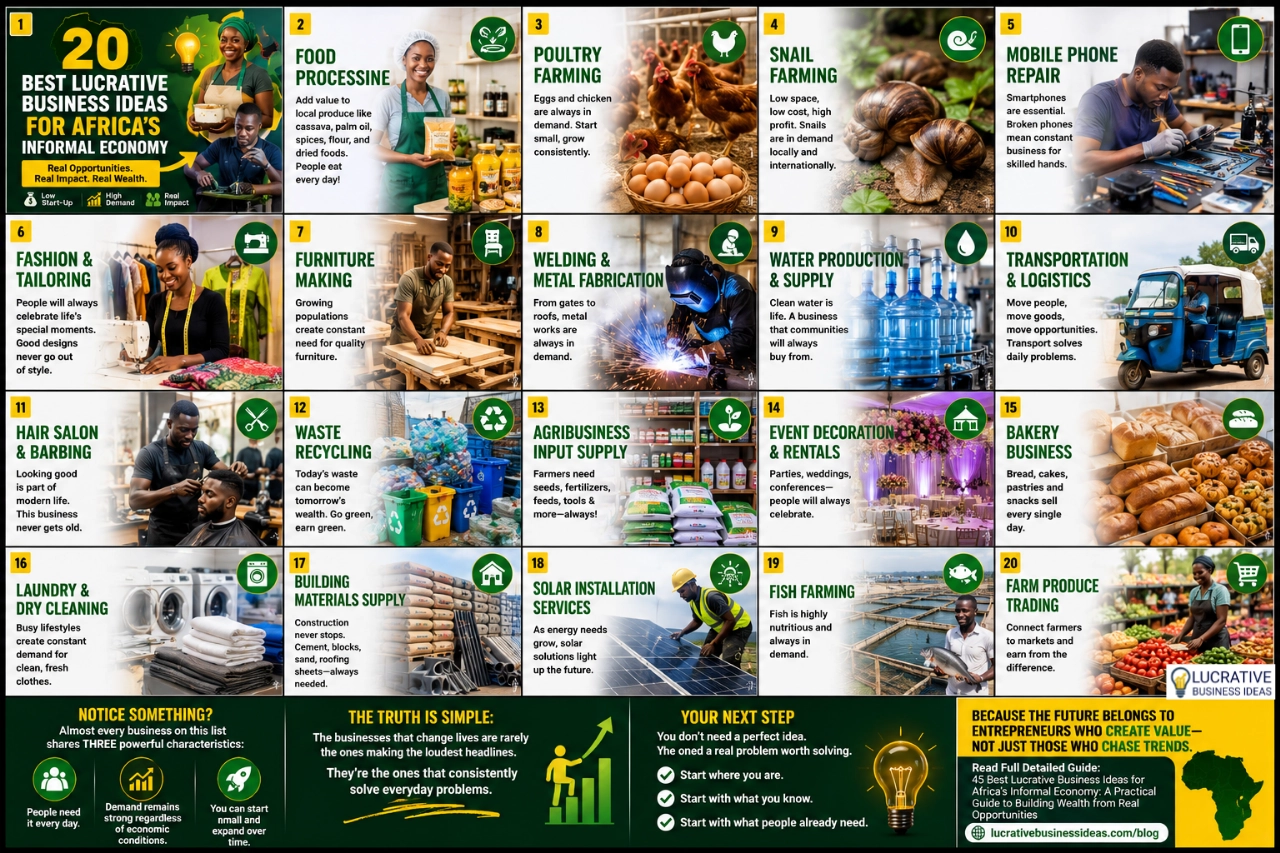
Understanding Africa’s Informal Economy
Before choosing a business, you need to understand the environment in which it will operate.
The informal economy is not a single industry. It is a broad collection of economic activities carried out by individuals and small businesses that operate outside some aspects of formal regulation. Depending on the country, this may mean they are unregistered, lightly regulated, or operate with minimal administrative structures. It does not automatically mean they are illegal.
Across Africa, informal businesses are deeply woven into everyday life. They provide goods and services that many households rely on daily, especially where formal businesses are scarce or inaccessible.
Several factors have contributed to the growth of the informal economy across the continent:
- Rapid population growth.
- Urbanization that outpaces formal job creation.
- Limited access to formal employment.
- Entrepreneurial resilience.
- Strong demand for affordable goods and services.
- The expansion of mobile money and digital payment systems in many countries.
International organizations such as the International Labour Organization (ILO) have consistently reported that informal employment represents a significant share of employment across many African countries. While the exact proportion varies from country to country, the informal economy remains one of the continent’s largest sources of livelihoods.
This reality should not be viewed simply as a challenge. It is also a source of opportunity.
Wherever people face unmet needs, entrepreneurs can create solutions.
The Biggest Myth About the Informal Economy
Many people believe that informal businesses are only temporary “side hustles.”
History proves otherwise.
Across Africa, numerous respected companies began as small roadside enterprises, family workshops, or local trading businesses before expanding into formal organizations with employees, warehouses, and multiple branches. The transition did not happen overnight. It happened because the founders consistently served customers, reinvested profits, and improved their operations over time.
The lesson is important:
Your starting point does not determine your destination. Your systems, discipline, and ability to solve problems do.
Why the Informal Economy Will Continue to Create Opportunities
Several long-term trends suggest that opportunities in Africa’s informal economy will remain strong over the coming decades.
1. Population Growth
Africa has one of the world’s youngest and fastest-growing populations. More people means greater demand for food, housing, transportation, repairs, education, healthcare, and everyday consumer services. Businesses that meet these essential needs are likely to remain relevant.
2. Rapid Urbanization
Millions of people continue to move from rural communities to towns and cities. As urban populations grow, so does the demand for affordable services, convenience, logistics, construction, waste management, and small-scale manufacturing.
3. Technology Is Expanding Access
Affordable smartphones, mobile banking, digital marketplaces, and social media have lowered the barriers to reaching customers. Today, even a small informal business can market its products online, receive digital payments, and build a loyal customer base without owning a physical storefront.
4. Local Problem-Solving
Many communities still lack adequate access to essential products and services. Entrepreneurs who understand local needs are often better positioned to provide practical, affordable solutions than larger organizations.
The Mindset That Separates Successful Entrepreneurs
Capital matters.
Skills matter.
Experience matters.
But none of them matter as much as your ability to solve problems consistently.
Customers rarely pay because a business owner worked hard. They pay because the business makes their lives easier, safer, faster, healthier, or more profitable.
Whenever you evaluate a business idea, ask yourself these questions:
- What problem does this solve?
- Who experiences this problem every day?
- How urgently do they need a solution?
- How much time or money will my solution save them?
- Can I provide the solution better, faster, or more conveniently than existing alternatives?
These questions will become your compass throughout this book.
Three Principles That Will Guide This Article
Every business opportunity discussed in the coming chapters has been selected using three principles:
1. Real Demand
The business must solve a genuine and recurring need, rather than relying on temporary trends.
2. Practical Entry
The business should be accessible to ordinary entrepreneurs, with realistic startup requirements.
3. Growth Potential
The business should offer a pathway to expansion through better systems, improved quality, additional customers, or new locations.
Businesses that satisfy these three principles are more likely to remain profitable over the long term.
10 Lucrative Informal Businesses You Can Start with Less Than $50
Rather than simply listing ideas, we’ll dive deeply into each one, covering:
- Why demand exists.
- Who the ideal customers are.
- The most cost-effective way to start.
- Common mistakes to avoid.
- Proven growth strategies.
- Real-world examples.
- Risks and practical ways to manage them.
- Future opportunities.
- Investor’s Insight.
- Action steps you can take immediately.
These first ten opportunities are designed to show that while capital can accelerate growth, the strongest businesses often begin with a clear understanding of customer needs, disciplined execution, and the willingness to start small and improve consistently.
Businesses You Can Start with Less Than $50
Before You Read This Section
One of the biggest lies in entrepreneurship is that you need a lot of money to start a successful business.
Money certainly helps, but it is rarely the biggest factor. Throughout history, countless successful businesses have started with modest resources. Their founders succeeded because they noticed problems others ignored, used what they already had, and earned trust one customer at a time.
Across Africa, this principle is visible every day. Many thriving enterprises began as a single table in a market, a toolbox carried on a bicycle, or a service offered from a mobile phone. Growth came through consistency, customer satisfaction, and disciplined reinvestment—not large startup capital.
That said, not every low-cost business is a good business. Some are overcrowded, easy to copy, or offer little room for growth. In this book, we focus on businesses that solve recurring problems and can develop into sustainable enterprises over time.
The first ten opportunities generally require less than $50 to get started, though actual costs vary by country, location, and whether you already own some of the necessary tools.
BUSINESS IDEA #1: Mobile Phone Accessories Retail
Why This Business Exists
Mobile phones have become an essential part of daily life across Africa. Whether someone is a student, trader, driver, teacher, artisan, or farmer, there is a good chance they own or regularly use a mobile phone.
However, phones need accessories. Chargers wear out. Earphones get damaged. Screen protectors crack. Charging cables fail. Phone cases become worn or outdated. These are not luxury purchases—they are recurring needs.
That creates a steady market for affordable accessories.
Unlike selling smartphones, which often requires significant capital, accessories are inexpensive to stock, easy to transport, and usually provide healthy profit margins.
Why It Thrives in the Informal Economy
Customers often need these items immediately. They prefer buying from someone nearby rather than traveling to a large electronics store.
Small roadside kiosks, market stalls, transport hubs, and mobile vendors all benefit from this convenience.
Because accessories are lightweight, you can even begin by selling from a backpack or small display table.
Estimated Startup Capital
Approximately $20–$50, depending on your initial inventory.
The Most Cost-Effective Way to Start
Many beginners make the mistake of buying dozens of different products.
A smarter approach is to focus on fast-moving essentials:
- USB charging cables
- Phone chargers
- Screen protectors
- Protective cases for popular phone models
- Earphones
- Memory cards (where demand exists)
Start with small quantities and restock only the products that sell quickly.
Avoid spending heavily on slow-moving or premium accessories until you understand local demand.
Finding Your First Customers
Choose locations with consistent foot traffic, such as markets, bus stops, campuses, or busy streets. Offer simple installation services, like fitting screen protectors, to add value and encourage repeat business.
Common Mistakes
- Buying too much inventory at once.
- Ignoring counterfeit or poor-quality products, which can damage your reputation.
- Failing to understand which phone models are most common in your area.
Investor’s Insight
This business becomes significantly more profitable when combined with services such as phone charging, airtime sales, SIM registration (where permitted), or basic phone repairs.
BUSINESS IDEA #2: Laundry and Ironing Service
Why This Business Exists
Urbanization has changed how many Africans live and work. Professionals, students, and busy families often have limited time for washing and ironing clothes.
A dependable laundry service saves them time and effort.
Importantly, this business can begin with equipment many households already own.
Startup Capital
Often under $50, especially if you already have:
- Buckets
- Soap
- Iron
- Drying lines
As profits grow, you can invest in washing machines and pressing equipment.
Cost-Effective Strategy
Start within your own neighborhood. Ask satisfied customers to refer friends and relatives. Word-of-mouth remains one of the strongest marketing tools for service businesses.
Real-World Example
Across many African cities, successful laundry businesses began with handwashing clothes for nearby residents. Over time, consistent quality and reliable service allowed owners to expand into commercial laundry operations serving hotels, schools, and offices.
Future Opportunity
As cities continue to grow and more people work long hours, demand for convenient laundry services is expected to remain strong.
BUSINESS IDEA #3: Fresh Fruit and Healthy Snack Sales
Why This Business Exists
Consumers are becoming more health-conscious, and fresh fruits remain a daily necessity in many communities.
Unlike processed snacks, fruits have consistent demand throughout the year, although availability varies by season and region.
Startup Capital
Approximately $15–$40.
Cost-Effective Way to Start
Buy directly from local farmers or wholesale produce markets early in the morning. Selling closer to the source can improve your margins.
Start with a few popular fruits rather than offering too many varieties.
Keys to Success
- Keep produce fresh and clean.
- Display it attractively.
- Learn seasonal buying patterns.
- Minimize spoilage by purchasing according to expected daily sales.
Common Mistake
Buying more fruit than you can sell before it spoils.
BUSINESS IDEA #4: Shoe Cleaning and Restoration Service
Why This Business Works
Many people own expensive shoes but lack the time or expertise to clean and restore them properly.
Professionals, students, executives, and event attendees all value clean footwear.
This business requires very little equipment but rewards attention to detail.
Startup Capital
Usually $20–$40.
Equipment
- Brushes
- Polish
- Cleaning cloths
- Cleaning solutions
- Water container
Cost-Effective Strategy
Rather than waiting for customers, offer pickup and delivery within your neighborhood. Convenience can become your biggest competitive advantage.
Investor’s Insight
Once established, you can expand into leather bag restoration, belt repair, and sneaker cleaning.
BUSINESS IDEA #5: Homemade Cleaning Products
Why Demand Exists
Every household, office, restaurant, school, and shop needs cleaning products.
Items such as:
- Liquid soap
- Dishwashing liquid
- Floor cleaner
- Toilet cleaner
are consumed repeatedly, creating recurring demand.
Startup Capital
Generally $30–$50.
Cost-Effective Way to Start
Begin with one or two products instead of trying to manufacture everything.
Focus on quality and consistent packaging.
Sell initially to:
- Neighbors
- Churches
- Schools
- Small businesses
- Local retailers
Common Mistake
Competing only on price.
Customers return because products work well—not simply because they are cheap.
Reflection
Notice something interesting about these first five businesses.
None depends on advanced technology.
None requires expensive equipment.
None relies on government contracts.
Instead, they all succeed because they solve everyday problems that millions of people face repeatedly.
That is one of the defining characteristics of successful informal businesses: they generate repeat demand by providing practical value.
BUSINESS IDEA #6: Mobile Phone Charging and Digital Services Hub
Why This Business Exists
Despite rapid improvements in electricity access across Africa, unreliable power remains a challenge in many communities. At the same time, smartphones have become essential tools for communication, banking, education, and business.
People cannot afford to let their phones remain uncharged.
This creates an opportunity to provide reliable charging services, especially in busy markets, transport terminals, and communities with frequent power interruptions.
But charging phones alone should not be your long-term business model.
The real opportunity is to build a small digital services hub that combines several services in one place.
Why It Thrives in the Informal Economy
Customers often prefer one-stop locations where they can solve several problems at once.
For example, while waiting for their phones to charge, they may also want to:
- Print documents
- Scan IDs
- Make photocopies
- Fill out online forms
- Pay utility bills (where service providers allow)
- Purchase airtime or mobile data
- Receive help with digital applications
Each additional service increases your income without requiring a completely new customer base.
Estimated Startup Capital
$30–$50, depending on whether you already own a smartphone, extension cables, or a power source.
The Most Cost-Effective Way to Start
Start with charging services and one or two digital offerings that match your skills. Reinvest profits into additional equipment rather than borrowing money too early.
If electricity is unreliable, explore affordable backup options such as rechargeable power stations or solar charging equipment as your business grows.
Skills Required
- Basic smartphone literacy
- Good customer service
- Record-keeping
- Careful handling of customers’ devices
Common Mistakes
- Losing track of customers’ phones
- Overloading electrical outlets
- Charging devices without proper security measures
- Ignoring customer privacy when helping with digital services
Growth Strategy
Eventually, your kiosk can become a neighbourhood technology centre offering:
- Basic phone setup
- Software updates
- Digital payments
- Online registrations
- Mobile accessories
- Simple phone troubleshooting
Investor’s Insight
The future of this business is not electricity—it is digital convenience. Every additional service that saves customers time increases your value and makes competitors less likely to replace you.
BUSINESS IDEA #7: Local Produce Aggregation
Why This Business Exists
Across many rural communities, small-scale farmers produce crops in relatively small quantities. Buyers, however, often need larger, consistent volumes.
This creates an opportunity for an entrepreneur to act as a trusted aggregator.
Instead of growing crops yourself, you purchase produce from several farmers, combine it, and sell larger quantities to wholesalers, restaurants, processors, or urban markets.
Why It Thrives
This business solves problems for both sides.
Farmers gain access to larger buyers.
Buyers save time by dealing with one reliable supplier instead of dozens of individual farmers.
Estimated Startup Capital
Many entrepreneurs begin with under $50, especially by working with advance orders or commission-based arrangements before purchasing inventory.
Cost-Effective Way to Start
Choose one crop.
Examples include:
- Tomatoes
- Plantains
- Cassava
- Onions
- Maize
- Groundnuts
Become known as the person who can consistently supply that product.
Avoid trying to trade many products at once until you understand pricing and logistics.
Real-Life Practice
In many African farming regions, produce aggregation has become an important link between smallholder farmers and urban food markets. Entrepreneurs who establish reliable relationships often expand into transportation, storage, or food processing.
Common Mistakes
- Buying without confirmed buyers
- Poor storage leading to spoilage
- Ignoring seasonal price fluctuations
Future Opportunity
As regional trade grows, trusted aggregators will become even more valuable because they reduce transaction costs throughout the supply chain.
BUSINESS IDEA #8: Home and Office Cleaning Services
Why Demand Exists
As cities expand and more households have dual-income earners, many people have less time to clean homes or offices thoroughly.
Small businesses, churches, schools, clinics, and landlords also require periodic cleaning services.
Unlike selling cleaning products, this business sells labour, professionalism, and reliability.
Estimated Startup Capital
Approximately $25–$50.
Basic Equipment
- Buckets
- Mops
- Gloves
- Cleaning cloths
- Cleaning chemicals
Many items can be purchased gradually.
The Most Cost-Effective Way to Start
Begin by targeting one neighbourhood.
Offer:
- Deep cleaning
- Move-in cleaning
- Post-construction cleaning
- Weekly office cleaning
Repeat customers provide more stable income than constantly searching for new ones.
Growth Strategy
As demand increases:
- Hire and train staff.
- Create standard cleaning procedures.
- Introduce uniforms.
- Build a recognizable brand.
Investor’s Insight
Many successful commercial cleaning companies started with one person cleaning a few houses. What transformed them into larger businesses was systems, not expensive equipment.
BUSINESS IDEA #9: Bicycle or Motorcycle Errand Service
Why This Business Exists
People are busy.
They need someone to:
- Deliver documents
- Buy groceries
- Pick up prescriptions
- Transport small parcels
- Run urgent errands
Convenience has economic value.
Estimated Startup Capital
If you already own a bicycle, startup costs may be less than $20.
If using a motorcycle you already own, the additional startup costs can also remain relatively low.
Cost-Effective Strategy
Rather than serving an entire city, dominate one neighbourhood first.
Become the trusted person residents call whenever they need something delivered quickly.
Skills Required
- Reliability
- Time management
- Good communication
- Knowledge of local streets
Common Mistakes
- Accepting more jobs than you can complete.
- Poor record-keeping.
- Mishandling customers’ property.
Future Opportunity
Many logistics startups began by solving simple local delivery problems before expanding into larger transportation networks.
The lesson is simple:
Scale follows consistency.
BUSINESS IDEA #10: Basic Clothing Alteration and Repair
Why This Business Exists
People constantly need:
- Trouser adjustments
- Zip replacements
- Button replacement
- Uniform repairs
- Minor dress alterations
Buying new clothes is often more expensive than repairing existing ones.
That creates recurring demand for skilled alteration services.
Startup Capital
If you already know basic sewing, startup costs can remain below $50, particularly if you begin with hand tools or a second-hand sewing machine shared within your community.
Cost-Effective Way to Start
Instead of advertising to everyone, build relationships with:
- Schools
- Uniform suppliers
- Tailors
- Fashion designers
- Dry cleaners
Many will refer customers needing minor repairs that they do not have time to handle.
Common Mistakes
- Missing delivery deadlines.
- Accepting work beyond your skill level.
- Underpricing services.
Growth Strategy
As your reputation grows, expand into:
- Custom tailoring
- School uniform production
- Corporate uniforms
- Fashion design
- Textile branding
Real-World Observation
Across Africa, numerous tailoring businesses began with simple repair and alteration services before investing in additional machines, hiring apprentices, and eventually producing clothing on a much larger scale.
Reflection: The Hidden Pattern Behind Successful Low-Capital Businesses
By now, a pattern should be emerging.
None of the first ten businesses became opportunities because they were fashionable. They became opportunities because they solve recurring, everyday problems.
People will always need clean clothes, functioning phones, reliable deliveries, fresh food, clean homes, and well-maintained clothing. Trends may come and go, but businesses that address essential needs tend to endure.
There is another lesson worth emphasizing.
Many first-time entrepreneurs ask, “What business can make me rich?”
A better question is:
“What problem can I solve so well that people keep coming back and recommending me to others?”
The most resilient businesses are built on repeat customers, not one-time sales. A loyal customer who returns every month is often more valuable than ten customers who buy once and never return.
As you continue through this guide, you will notice that every successful business—whether it requires $50 or $50,000—shares three common traits:
- It solves a real problem.
- It delivers consistent value.
- It earns trust over time.
Those principles matter far more than the amount of money you start with.
10 Lucrative Informal Businesses You Can Start with $50–$200
A Small Increase in Capital Can Multiply Your Opportunities
One of the biggest turning points in an entrepreneur’s journey is moving from surviving to building.
When you have between $50 and $200, you gain more than additional purchasing power—you gain flexibility. You can stock inventory instead of buying one item at a time, invest in better tools, and deliver higher-quality products or services. This allows you to serve more customers, increase efficiency, and improve your reputation.
However, more capital also brings greater responsibility. Many promising businesses fail not because the idea is poor, but because the owner spends too much on equipment, decor, or inventory before proving there is consistent customer demand.
At this stage, remember a principle followed by many successful entrepreneurs:
Invest in assets that help you serve more customers—not in items that merely make your business look impressive.
Every dollar you spend should either increase sales, improve quality, reduce costs, or save time.
The following businesses offer a good balance between affordability, recurring demand, and long-term growth potential.
BUSINESS IDEA #11: Community Fresh Juice and Smoothie Business
Community Fresh Juice and Smoothie Business
Why This Business Exists
Across Africa, urban consumers are becoming increasingly interested in healthier food and beverage options. At the same time, many countries produce abundant tropical fruits such as mangoes, oranges, pineapples, bananas, watermelons, passion fruit, and avocados.
Turning these fruits into fresh juices and smoothies creates added value while meeting growing demand for convenient, nutritious drinks.
Unlike packaged beverages, freshly prepared juices appeal to customers looking for natural alternatives with fewer artificial ingredients.
Why It Thrives in the Informal Economy
The business can operate from a roadside kiosk, market stall, mobile cart, or small rented space. Customers are often attracted by freshness, cleanliness, and convenience rather than a luxurious shop.
Estimated Startup Capital
$80–$200
Typical expenses may include:
- A quality blender
- Knives and chopping boards
- Food-grade containers
- Cups or reusable bottles
- Initial fruit inventory
- Cooler with ice
The Most Cost-Effective Way to Start
Do not begin with a long menu.
Instead, perfect three or four signature drinks using fruits that are readily available in your area. Fewer products reduce waste and simplify inventory management.
Buying directly from farmers or wholesale produce markets can significantly lower costs.
Finding Customers
Focus on locations where people need quick refreshments:
- Schools
- Markets
- Bus terminals
- Office districts
- Gyms
- Sports centres
Encourage repeat business by maintaining consistent taste and hygiene.
Common Mistakes
- Buying excessive quantities of perishable fruit.
- Neglecting food safety.
- Offering too many drink varieties before understanding customer preferences.
Real-World Insight
Many successful beverage businesses began with one blender and a small roadside stand before expanding into branded juice bars and supplying supermarkets.
Future Opportunity
As awareness of nutrition and healthy lifestyles grows across Africa, businesses that combine quality, cleanliness, and affordability are well positioned to benefit.
BUSINESS IDEA #12: Poultry Feed Retail
Why This Business Exists
Poultry farming is widespread across Africa, from small backyard flocks to larger commercial operations. Every poultry farmer needs feed regularly, making it one of the most consistent expenses in the business.
This creates demand for reliable local feed suppliers.
Why It Thrives
Many small-scale farmers prefer purchasing feed from nearby retailers rather than traveling long distances to larger distributors.
Convenience, availability, and trust often matter as much as price.
Estimated Startup Capital
$100–$200
Cost-Effective Way to Start
Begin by stocking only the fastest-moving feed types for chicks, growers, and layers. As you understand local demand, gradually expand your inventory to include supplements, drinkers, feeders, and vaccines (where regulations permit).
Avoid overstocking products that may expire.
Growth Strategy
As your customer base grows, consider becoming an authorized distributor for reputable feed manufacturers or expanding into agro-input retail.
Investor’s Insight
Farmers who trust your advice often become loyal customers. Learning the basics of poultry nutrition can therefore become a competitive advantage.
BUSINESS IDEA #13: Local Bakery Supply Business
Why This Business Exists
Across African cities and towns, thousands of small bakeries, home bakers, and pastry businesses operate every day. They require a steady supply of ingredients and packaging materials.
Instead of baking bread yourself, you can supply bakers with:
- Flour
- Sugar
- Yeast
- Baking powder
- Cake decorations
- Disposable packaging
- Mixing tools
Estimated Startup Capital
$100–$200
Cost-Effective Way to Start
Identify five to ten local bakers and ask which products they purchase most frequently. Stock those items first rather than guessing what the market wants.
Common Mistakes
- Carrying too many slow-moving products.
- Ignoring expiration dates.
- Buying from unreliable wholesalers.
Future Opportunity
As home baking continues to grow, suppliers who provide consistent quality and timely delivery can build stable, recurring revenue.
BUSINESS IDEA #14: Community Water Purification and Refill Station
Why This Business Exists
Access to safe drinking water remains an important concern in many African communities. Families, offices, schools, and small businesses often purchase treated drinking water regularly.
Providing affordable, clean water through a refill station can therefore meet an essential need.
Estimated Startup Capital
A modest refill operation can often begin within the $150–$200 range where basic equipment and local conditions make this feasible, though costs vary significantly by country and the level of water treatment required.
Important Consideration
Water quality directly affects public health. Before starting, understand and comply with local regulations, licensing requirements, and water quality standards. Regular testing and proper sanitation are essential.
Cost-Effective Way to Start
Begin with refill services rather than investing immediately in branded bottled water. Refill customers often provide more predictable repeat business.
Growth Strategy
Later, expand into home and office water delivery or supply larger refill containers to institutions.
Investor’s Insight
Customers buy drinking water based on trust. Once confidence is lost, it is extremely difficult to rebuild.
BUSINESS IDEA #15:Mobile Hair Grooming Services
Why This Business Exists
Many people struggle to find time to visit salons or barbershops. Others, such as elderly clients, busy professionals, or parents with young children, appreciate services delivered at home.
A mobile grooming business brings convenience directly to the customer.
Estimated Startup Capital
$70–$200
Depending on existing skills, startup expenses may include:
- Clippers
- Scissors
- Combs
- Sanitizing supplies
- Hair products
- Carrying case
The Most Cost-Effective Way to Start
Instead of renting a shop immediately, operate by appointment. This eliminates rental costs while helping you build a loyal customer base.
Finding Customers
Start with:
- Friends
- Families
- Offices
- Student hostels
- Residential estates
Satisfied customers often recommend reliable barbers and hairstylists to others.
Common Mistakes
- Poor hygiene practices.
- Missed appointments.
- Using low-quality equipment.
- Failing to sanitize tools properly.
Growth Strategy
As demand increases, you may eventually open a salon while continuing to offer premium home-service appointments.
Investor’s Reflection: Why These Businesses Have Staying Power
The businesses in this chapter share an important characteristic: they support daily life and other businesses.
A juice vendor serves commuters and workers. A poultry feed retailer supports farmers. A bakery supplier helps food businesses operate. A water refill station provides an essential household need. A mobile grooming service saves customers time while offering a personal service.
These are not businesses built on passing fads. They are rooted in recurring demand and practical value.
Another lesson becomes clear as capital increases: success depends less on having more money and more on making disciplined investment decisions. Entrepreneurs who reinvest profits into inventory, better equipment, customer service, and efficient operations tend to outperform those who spend early profits on lifestyle upgrades.
As you continue reading, remember this principle:
A growing business is built one smart decision at a time. Every reinvested profit is a vote for your business’s future.
From Self-Employment to Enterprise
At this stage, it is important to understand the difference between owning a job and building a business.
Many people become self-employed. They work every day, earn an income, and stop earning when they stop working.
Entrepreneurs, on the other hand, gradually build systems. They create processes that allow the business to continue generating income even when they are not personally involved in every task.
The businesses in this guide are selected because they can evolve from one-person operations into enterprises with employees, repeat customers, and multiple income streams.
As you read, don’t ask, “How much money can I make today?”
Instead, ask:
“Can this business still be growing five or ten years from now?”
Businesses built with long-term thinking often outperform those focused only on quick profits.
BUSINESS IDEA #16: Solar Lantern and Solar Lighting Retail
Why This Business Exists
Across Africa, millions of households, farms, roadside shops, and small businesses continue to experience unreliable electricity or lack access to the power grid altogether. Even in urban areas with grid connections, frequent outages create a strong demand for dependable lighting.
Affordable solar lighting has become a practical solution because it eliminates the recurring cost of kerosene, candles, or disposable batteries.
Why It Thrives in the Informal Economy
Customers often prefer buying from local retailers they trust, especially when they can see a demonstration of how the product works. A neighborhood seller who explains charging, battery life, and basic maintenance can build strong customer loyalty.
Estimated Startup Capital
$100–$200
This can cover a modest inventory of quality solar lanterns and small solar home lighting kits.
The Most Cost-Effective Way to Start
Do not stock every available product.
Begin with two or three reliable models that meet different customer budgets:
- Basic study lanterns for students.
- Medium-sized lanterns for households.
- Small solar lighting kits for shops and kiosks.
Purchase from reputable distributors rather than choosing the cheapest products available. Poor-quality products may increase returns and damage your reputation.
Finding Your First Customers
Focus on:
- Rural communities.
- Market traders.
- Students.
- Small business owners.
- Farmers.
- Roadside food vendors.
Offer live demonstrations, especially during evening hours.
Common Mistakes
- Selling low-quality imports without warranties.
- Failing to educate customers on proper use.
- Ignoring after-sales support.
Growth Strategy
Expand into:
- Solar phone chargers.
- Solar-powered fans.
- Small solar home systems.
- Solar-powered security lights.
Investor’s Insight
Africa’s demand for decentralized energy solutions is expected to remain strong as governments, businesses, and households continue seeking reliable and affordable power. Entrepreneurs who build trust through quality products and good service are well positioned to grow with this market.
BUSINESS IDEA #17: Egg Distribution Business
Why This Business Exists
Eggs are one of the most widely consumed sources of affordable protein across Africa. They are purchased by households, restaurants, bakeries, schools, hotels, and food vendors.
While poultry farmers produce eggs, many do not have the time or logistics to distribute them efficiently. This creates an opportunity for entrepreneurs to serve as reliable distributors.
Estimated Startup Capital
$80–$200
Startup costs typically include:
- Initial stock of eggs.
- Plastic crates.
- Basic transportation.
- Packaging materials.
The Most Cost-Effective Way to Start
Avoid buying from multiple farms initially.
Instead, build a relationship with one reliable poultry farmer. Consistent quality and supply are more important than having many suppliers at the beginning.
Secure a few regular customers before increasing your inventory.
Finding Customers
Target businesses that purchase eggs regularly:
- Restaurants.
- Bakeries.
- Hotels.
- Fast-food outlets.
- Schools.
- Small grocery stores.
Recurring orders provide more stable income than relying solely on walk-in retail customers.
Common Mistakes
- Poor handling that leads to breakages.
- Buying more eggs than can be sold while still fresh.
- Inconsistent delivery schedules.
Growth Strategy
As your customer base expands, add related products such as fresh poultry, packaged eggs, or baking supplies.
BUSINESS IDEA #18: Agricultural Seedling Nursery
Why This Business Exists
Farmers, landscaping companies, institutions, and homeowners regularly need healthy seedlings for crops, fruit trees, vegetables, ornamentals, and reforestation projects.
Growing seedlings requires relatively little land but creates significant value by providing customers with young plants that are ready for transplanting.
Why It Thrives in Africa
Agriculture remains one of Africa’s largest economic sectors. Governments, NGOs, commercial farms, and community groups frequently promote tree planting, horticulture, and improved crop production, supporting demand for quality seedlings.
Estimated Startup Capital
$70–$200
This can cover:
- Seed trays or nursery bags.
- Growing media.
- Quality seeds.
- Watering equipment.
- Shade materials.
The Most Cost-Effective Way to Start
Specialize in a few high-demand seedlings rather than trying to grow everything.
Examples include:
- Tomato seedlings.
- Pepper seedlings.
- Cabbage seedlings.
- Fruit tree seedlings.
- Indigenous tree species.
Understand local planting seasons so your seedlings are ready when farmers need them.
Finding Customers
Build relationships with:
- Farmers.
- Schools.
- Churches.
- Landscaping businesses.
- Agricultural cooperatives.
- Community organizations.
Common Mistakes
- Using poor-quality seeds.
- Inadequate watering.
- Producing seedlings outside the main planting season.
Future Opportunity
As climate-smart agriculture and tree-planting initiatives expand, demand for healthy seedlings is likely to remain strong in many parts of Africa.
BUSINESS IDEA #19: Household Gas Cylinder Exchange and Delivery
Why This Business Exists
Liquefied Petroleum Gas (LPG) has become an increasingly important cooking fuel in many African countries because it burns cleaner than charcoal or firewood and is convenient for households and businesses.
Many customers value businesses that make refilling or exchanging gas cylinders easier, especially when home delivery is available.
Estimated Startup Capital
$150–$200
Depending on local regulations and your business model, this may cover a small inventory of cylinders, safety equipment, and transportation.
Important Consideration
This business involves flammable products and should only be operated in compliance with local laws, licensing requirements, and safety standards. Safe storage, handling, and transportation are essential.
The Most Cost-Effective Way to Start
Instead of establishing a full filling plant, begin as an authorized retailer or delivery partner for licensed gas suppliers where permitted.
This reduces capital requirements and allows you to focus on customer service.
Finding Customers
Target:
- Residential neighborhoods.
- Restaurants.
- Food vendors.
- Small hotels.
- Catering businesses.
Reliable delivery can become your strongest competitive advantage.
Common Mistakes
- Ignoring safety procedures.
- Poor record-keeping.
- Delayed deliveries.
- Failing to educate customers on safe cylinder use.
Investor’s Insight
Businesses dealing with essential household energy often enjoy repeat customers because fuel purchases are recurring rather than one-time events.
BUSINESS IDEA #20: Handmade Household Products Business
Why This Business Exists
Consumers increasingly appreciate practical, locally made products that offer good value for money. Handmade household items can serve everyday needs while allowing entrepreneurs to start with relatively modest investment.
Examples include:
- Storage baskets.
- Laundry baskets.
- Decorative organizers.
- Simple wooden shelves.
- Handmade mats.
- Reusable shopping bags.
- Fabric storage boxes.
The exact products will depend on locally available materials and skills.
Estimated Startup Capital
$50–$200
Costs vary according to the materials and tools required.
The Most Cost-Effective Way to Start
Begin with one or two products that you can produce consistently at a high standard.
Test demand through:
- Local markets.
- Community exhibitions.
- Social media.
- Craft fairs.
- Home décor shops.
Do not invest in large-scale production until you understand which products sell best.
Finding Customers
Good photography and clear product presentation can significantly improve sales, especially when using online marketplaces or social media.
Encourage satisfied customers to share photos and recommend your products.
Common Mistakes
- Inconsistent quality.
- Poor finishing.
- Weak packaging.
- Ignoring customer feedback.
Growth Strategy
Expand into:
- Corporate gifts.
- Hotel décor.
- Export-ready crafts.
- Custom-made household items.
Future Opportunity
Growing interest in locally produced and environmentally conscious products presents opportunities for artisans who combine traditional craftsmanship with modern design and reliable quality.
Reflection: Building a Business That Can Outlive You
The businesses in this guide have something important in common: they address recurring needs while offering room for expansion.
A solar lighting retailer can grow into a renewable energy business.
An egg distributor can become a food distribution company.
A seedling nursery can evolve into a commercial horticulture enterprise.
A household gas retailer can expand into a broader home energy business.
A craft producer can build a recognized manufacturing brand.
The difference lies not in the original idea, but in the entrepreneur’s vision and execution.
One of the most valuable habits you can develop is to think beyond today’s sale. Ask yourself regularly:
- How can I serve customers better?
- What complementary products or services do my customers need?
- Which parts of my work can become standardized?
- When should I hire help instead of doing everything myself?
Businesses grow when owners stop seeing themselves only as workers and begin thinking like builders of systems.
Remember:
Every successful enterprise was once a small operation that consistently solved a real problem. Growth rarely happens overnight—it is the result of disciplined improvements made month after month.
10 Lucrative Informal Businesses You Can Start with $200–$1,000
The Transition from Microbusiness to Small Enterprise
Reaching the $200–$1,000 investment level is more than a financial milestone—it marks a shift in how you should think about business.
At this stage, you are no longer limited to selling products one at a time or providing services on a purely personal basis. You can begin investing in better equipment, modest production capacity, inventory, branding, and simple systems that make your business more efficient.
Many of Africa’s respected family-owned companies began at this level. They started with a small workshop, a rented space, a few pieces of equipment, and a commitment to solving everyday problems better than anyone else.
But this stage also introduces new responsibilities. Poor inventory management, unnecessary borrowing, and weak financial discipline can quickly turn a promising business into a struggling one.
One principle becomes increasingly important:
Don’t borrow to buy what your customers haven’t yet proven they want. Grow your business at the speed of real demand, not wishful thinking.
The next ten businesses are selected because they combine strong demand, room for expansion, and the potential to create employment while serving essential needs across many African communities.
BUSINESS IDEA #21: Community Grain Milling Business
Why This Business Exists
Across Africa, grains such as maize, millet, sorghum, wheat, and cassava are staples in many households. While farmers produce these crops, consumers often need them milled into flour or meal before use.
In many communities, especially peri-urban and rural areas, reliable milling services remain in steady demand because they save households time and effort.
Why It Thrives in the Informal Economy
Unlike seasonal businesses, grain milling serves a recurring need. Customers return whenever they harvest crops or purchase grain for household consumption.
Small food processors, bakeries, and local restaurants may also require milling services.
Estimated Startup Capital
$500–$1,000
Depending on local equipment prices, this may cover:
- A small milling machine.
- Basic installation.
- Safety equipment.
- Initial working capital.
The Most Cost-Effective Way to Start
Begin with one milling machine capable of handling the most common grains in your area.
Instead of renting an expensive location, choose a site close to farming communities or busy markets where customers naturally pass.
Finding Customers
Develop relationships with:
- Farmers.
- Food vendors.
- Small retailers.
- Women’s cooperatives.
- Community organizations.
Reliability and machine maintenance are often more important than offering the lowest price.
Common Mistakes
- Poor maintenance leading to frequent breakdowns.
- Ignoring dust control and workplace cleanliness.
- Overloading machines beyond recommended capacity.
Growth Strategy
Expand into:
- Packaged flour.
- Animal feed production.
- Grain cleaning services.
- Storage facilities.
Investor’s Insight
Businesses that add value to agricultural products generally have greater long-term potential than businesses that simply resell raw commodities.
BUSINESS IDEA #22: Motorcycle Repair Workshop
Why This Business Exists
Motorcycles play an important role in transportation across much of Africa. They are widely used for passenger transport, deliveries, farming, and personal mobility.
Frequent use means regular maintenance and repairs are unavoidable.
Estimated Startup Capital
$300–$800
Startup expenses may include:
- Basic repair tools.
- Workbench.
- Spare parts inventory.
- Air pump.
- Lubricants.
Why It Thrives
Motorcycle owners value mechanics who diagnose problems accurately, charge fairly, and complete repairs on time.
Trust often matters more than location.
Cost-Effective Way to Start
If you already have repair skills, begin with servicing and maintenance before stocking a large inventory of spare parts.
Purchase commonly used parts only after understanding local demand.
Finding Customers
Build relationships with:
- Commercial riders.
- Delivery companies.
- Farmers.
- Motorcycle dealers.
Offering preventive maintenance packages can encourage repeat business.
Common Mistakes
- Misdiagnosing faults.
- Using counterfeit spare parts.
- Poor communication with customers.
Future Opportunity
As e-commerce and delivery services expand across Africa, demand for reliable motorcycle maintenance is likely to remain strong.
BUSINESS IDEA #23: Small-Scale Spice Processing and Packaging
Why This Business Exists
Many African households use spices every day when preparing meals. Restaurants, food vendors, and supermarkets also require packaged spices.
Rather than simply selling raw spices, processing, blending, and packaging them creates additional value.
Estimated Startup Capital
$250–$700
Typical expenses include:
- Grinding equipment.
- Sealing machine.
- Packaging materials.
- Labels.
- Initial raw materials.
The Most Cost-Effective Way to Start
Focus on a few popular spices or blends that are widely used in your region.
Quality, freshness, and proper packaging often matter more than having a large product range.
Finding Customers
Sell through:
- Grocery stores.
- Markets.
- Restaurants.
- Food vendors.
- Online marketplaces.
Offer sample packs to encourage first-time buyers.
Common Mistakes
- Poor hygiene during processing.
- Weak packaging that allows moisture inside.
- Inconsistent product quality.
Growth Strategy
Develop a recognizable brand and gradually expand into seasoning blends, herbs, and specialty products.
Investor’s Insight
Food businesses that build consumer trust through consistent quality often benefit from repeat purchases and strong word-of-mouth marketing.
BUSINESS IDEA #24: Community Cold Storage Business
Why This Business Exists
One of the biggest challenges in Africa’s food system is post-harvest loss. Fruits, vegetables, fish, meat, and dairy products can spoil quickly without proper storage.
Providing cold storage helps traders, farmers, and retailers preserve products for longer, reducing waste and improving profitability.
Estimated Startup Capital
$700–$1,000
Depending on local conditions, this may cover a small cold room, freezer units, or refrigerated storage equipment.
Why It Thrives
Customers save money by reducing spoilage.
Farmers gain more flexibility in deciding when to sell.
Food vendors can purchase inventory in larger quantities.
Cost-Effective Way to Start
Instead of building a large cold room immediately, begin with commercial freezers serving one neighbourhood or market.
Expand as customer demand increases.
Finding Customers
Target:
- Fish sellers.
- Meat vendors.
- Fruit traders.
- Vegetable wholesalers.
- Restaurants.
Offer flexible storage options, such as daily or weekly rental.
Common Mistakes
- Poor electricity backup planning.
- Inadequate hygiene.
- Weak inventory management.
Future Opportunity
As food supply chains become more sophisticated, affordable cold storage services are expected to become increasingly valuable across Africa.
BUSINESS IDEA #25: Mobile Car Wash and Vehicle Detailing
Mobile Car Wash and Vehicle Detailing
Why This Business Exists
Vehicle ownership continues to increase across many African cities. Busy professionals, transport operators, and businesses often prefer convenient cleaning services delivered at home or the workplace.
Unlike fixed-location car washes, mobile services reduce infrastructure costs while offering greater convenience.
Estimated Startup Capital
$300–$700
Startup expenses may include:
- Pressure washer (if available within budget).
- Water storage containers.
- Cleaning chemicals.
- Brushes.
- Microfiber towels.
- Vacuum cleaner (optional initially).
The Most Cost-Effective Way to Start
Start with basic washing and interior cleaning.
Avoid purchasing expensive detailing equipment until customer demand justifies the investment.
Offer scheduled services for businesses with vehicle fleets.
Finding Customers
Focus on:
- Residential estates.
- Office complexes.
- Taxi operators.
- Ride-hailing drivers.
- Delivery companies.
Consistency is more important than speed.
Customers often remain loyal when they know their vehicles will be cleaned carefully every time.
Common Mistakes
- Using harsh chemicals that damage paint.
- Arriving late for appointments.
- Poor water management.
Growth Strategy
Expand into:
- Paint protection.
- Interior detailing.
- Engine cleaning.
- Fleet maintenance contracts.
Real-World Observation
Many successful detailing businesses began with one entrepreneur carrying basic equipment in a small vehicle before growing into multi-location operations with trained staff and commercial contracts.
Investor’s Corner
The Economics of Solving Expensive Problems
Have you noticed a shift in this category?
The businesses we’ve covered are no longer focused solely on convenience. They solve larger economic problems:
- Grain milling helps transform raw harvests into usable food.
- Motorcycle repair keeps transport and logistics moving.
- Spice processing adds value to agricultural products.
- Cold storage reduces food losses.
- Mobile car washing protects valuable assets while saving customers time.
The more expensive the customer’s problem, the more valuable a reliable solution becomes.
However, remember this principle:
Customers do not pay for equipment—they pay for results.
A milling machine sitting idle generates no income. A freezer without customers is simply consuming electricity. A workshop without skilled workmanship quickly loses trust.
Your investment begins to pay off only when it consistently creates value for others.
Key Lessons from this Section
Before moving to the next section, reflect on these five lessons:
- Buy equipment only after confirming market demand.
- Maintain your tools and machines—they are income-producing assets.
- Recurring customers are more profitable than constantly chasing new ones.
- Quality and reliability build stronger businesses than low prices alone.
- Every successful enterprise is built on solving problems that customers willingly pay to have solved.
These principles apply whether your business is worth $500 today or $5 million in the future.
Building Businesses That Multiply Value
There is a noticeable difference between businesses that simply sell products and businesses that increase productivity.
When you help a farmer harvest crops faster, a retailer reduce losses, a carpenter produce more furniture, or a small business reach more customers, you are no longer just making sales—you are increasing someone else’s earning potential.
Businesses that improve productivity often enjoy three advantages:
- Customers are more likely to return.
- Customers are willing to pay for quality.
- Customers often recommend you to others because your success contributes to theirs.
The next five business ideas belong to this category. They may require a little more planning and organization, but they also have excellent long-term potential because they solve structural challenges across many African economies.
BUSINESS IDEA #26: Farm Equipment Rental Service
Why This Business Exists
Across Africa, millions of smallholder farmers cannot afford to purchase equipment such as water pumps, knapsack sprayers, brush cutters, small tillers, shellers, or harvesting tools. Yet these tools can significantly improve productivity and reduce labour.
This gap creates a strong business opportunity: renting equipment instead of selling it.
The rental model allows farmers to access machinery only when they need it, while the owner earns income from the same asset many times over.
Why It Thrives in the Informal Economy
Most small-scale farmers need certain equipment only during specific farming activities, such as land preparation, planting, spraying, or harvesting. Buying expensive equipment for occasional use is often uneconomical.
Rental services solve this problem.
Estimated Startup Capital
$500–$1,000
Your initial investment could cover one or two high-demand tools, depending on local prices and the type of farming common in your area.
The Most Cost-Effective Way to Start
Do not try to serve every type of farmer.
Instead, identify the most common farming activity in your community.
For example:
- Vegetable farmers may need knapsack sprayers.
- Rice farmers may require threshers.
- Maize farmers may benefit from shellers.
- Irrigated farms may need water pumps.
Purchase equipment with the highest rental demand.
Finding Customers
Work with:
- Farmer cooperatives.
- Agricultural extension officers.
- Community farming groups.
- Local produce associations.
These networks can generate repeat business during every farming season.
Common Mistakes
- Poor maintenance.
- Renting equipment without proper user instruction.
- Failing to keep maintenance records.
Growth Strategy
Expand into:
- Equipment delivery.
- Equipment maintenance.
- Operator training.
- Sales of spare parts.
Real-World Observation
Equipment rental businesses have become increasingly common in agricultural regions because they lower farmers’ costs while allowing entrepreneurs to earn recurring income from durable assets.
BUSINESS IDEA #27: Custom Furniture Workshop
Why This Business Exists
Rapid urbanization has increased demand for affordable furniture.
New homeowners, renters, offices, schools, churches, hotels, and restaurants all require tables, chairs, wardrobes, shelves, beds, and office furniture.
Many customers prefer locally made furniture because it can be customized to fit their available space and budget.
Estimated Startup Capital
$500–$1,000
Depending on your existing skills, this may cover:
- Basic woodworking tools.
- Workbench.
- Initial timber.
- Measuring equipment.
- Safety gear.
The Most Cost-Effective Way to Start
Instead of opening a showroom immediately, produce furniture only after receiving customer orders.
This reduces inventory costs and avoids tying up money in unsold products.
Begin with products that are relatively simple to manufacture consistently, such as bookshelves, study tables, and kitchen cabinets.
Finding Customers
Target:
- New homeowners.
- Landlords.
- Schools.
- Churches.
- Offices.
- Interior designers.
Display completed work on social media and encourage customers to share photos.
Common Mistakes
- Poor measurements.
- Missing delivery dates.
- Buying expensive machinery too early.
- Using poor-quality wood.
Growth Strategy
Eventually expand into:
- Office furniture.
- Hotel furniture.
- Kitchen installations.
- Interior finishing.
Investor’s Insight
Customers remember quality craftsmanship for years. One well-executed project can generate multiple referrals.
BUSINESS IDEA #28: Plastic Waste Collection and Recycling Business
Why This Business Exists
Plastic waste has become one of Africa’s most visible environmental challenges. At the same time, manufacturers increasingly use recycled plastic as a raw material for producing new goods.
This creates an opportunity for entrepreneurs to collect, sort, clean, and sell recyclable plastics.
Rather than viewing waste as rubbish, successful entrepreneurs see it as a valuable resource.
Why It Thrives
Many households and businesses generate recyclable materials but lack organized collection systems.
Entrepreneurs who establish reliable collection networks can supply recycling companies consistently.
Estimated Startup Capital
$300–$900
Startup costs may include:
- Collection bags.
- Protective equipment.
- Weighing scale.
- Temporary storage.
- Transportation.
The Most Cost-Effective Way to Start
Focus on one recyclable material initially.
Examples include:
- PET bottles.
- HDPE containers.
- Plastic drums.
Sorting one material correctly is often more profitable than collecting many different materials without proper organization.
Finding Customers
Develop two networks:
Suppliers
- Households.
- Schools.
- Restaurants.
- Offices.
- Markets.
Buyers
- Recycling companies.
- Plastic manufacturers.
- Aggregators.
Common Mistakes
- Poor sorting.
- Wet or contaminated plastics.
- Weak storage systems.
Future Opportunity
As governments and manufacturers place greater emphasis on environmental sustainability, demand for recyclable materials is likely to increase.
BUSINESS IDEA #29: Community Delivery and Logistics Company
Why This Business Exists
Africa’s digital economy is expanding rapidly. Small businesses increasingly sell products through social media, messaging apps, and online marketplaces.
However, many struggle with one critical challenge:
Reliable delivery.
Customers expect orders to arrive safely and on time.
A dependable local logistics company bridges this gap.
Estimated Startup Capital
$500–$1,000
This may cover:
- Motorcycle (where applicable).
- Safety equipment.
- Delivery boxes.
- Branding.
- Communication tools.
The Most Cost-Effective Way to Start
Begin within one city or district.
Do not attempt nationwide operations immediately.
Develop relationships with:
- Pharmacies.
- Restaurants.
- Fashion businesses.
- Grocery stores.
- Online sellers.
Offer scheduled deliveries for businesses with recurring needs.
Common Mistakes
- Poor route planning.
- Delayed deliveries.
- Weak communication.
- Inadequate parcel tracking.
Growth Strategy
Expand into:
- Same-day delivery.
- Business contracts.
- Cold-chain delivery.
- Intercity logistics partnerships.
Investor’s Insight
Logistics is often described as the backbone of commerce. As more businesses sell online, reliable delivery becomes increasingly valuable.
BUSINESS IDEA #30: Small Business Digital Support Centre
Why This Business Exists
Millions of small businesses across Africa now rely on smartphones for communication and marketing, but many owners lack the time or skills to manage their digital presence effectively.
This creates demand for affordable digital support services.
Examples include:
- Social media page management.
- Product photography.
- Business profile setup.
- Basic graphic design.
- Digital catalog creation.
- Online customer support.
- Simple bookkeeping assistance using digital tools.
Estimated Startup Capital
$200–$800
If you already own a computer or capable smartphone, your startup costs may be significantly lower.
Skills Required
- Basic computer literacy.
- Communication.
- Organization.
- Willingness to keep learning digital tools.
The Most Cost-Effective Way to Start
Choose one service you can perform exceptionally well before expanding.
For example, become known locally as the expert in creating attractive WhatsApp Business catalogs or managing Facebook pages for local retailers.
Satisfied clients often request additional services over time.
Finding Customers
Approach:
- Retail shops.
- Restaurants.
- Tailors.
- Salons.
- Pharmacies.
- Private schools.
- Agricultural businesses.
Show examples of your work rather than relying only on verbal promises.
Common Mistakes
- Promising services beyond your ability.
- Poor communication.
- Missing deadlines.
- Ignoring data security and customer privacy.
Growth Strategy
As your client base expands, hire specialists in graphic design, content creation, advertising, or website development.
Your business can evolve into a full-service digital agency serving small and medium-sized enterprises.
Investor’s Corner: Don’t Chase Trends—Build Around Long-Term Problems
A common mistake among entrepreneurs is constantly searching for the “next big thing.”
The reality is that lasting wealth is often built by solving persistent problems, not by chasing short-lived trends.
Think about the businesses in this section:
- Farmers will continue needing affordable access to equipment.
- Homes, schools, and businesses will continue buying furniture.
- Communities will continue generating recyclable waste.
- Businesses will continue needing reliable deliveries.
- Entrepreneurs will continue needing help with digital tools.
Technologies may change, but the underlying needs remain.
This is why experienced investors often ask:
“Will people still need this solution ten years from now?”
If the answer is yes—and if the business can adapt as markets evolve—you may have found an opportunity worth building.
Key Lessons from this $200–$1,000 Capital Requirement Section
By now, several important principles should be becoming second nature:
- Buy assets that generate recurring income rather than one-time sales whenever possible.
- Specialize before you diversify. Becoming known for doing one thing exceptionally well is often more profitable than trying to do everything.
- Protect your reputation. In the informal economy, trust is one of the most valuable forms of capital.
- Think in systems. Create repeatable processes for serving customers, maintaining equipment, managing inventory, and handling finances.
- Reinvest consistently. Every improvement in quality, efficiency, or customer experience strengthens your business over time.
These lessons will become even more important as we move into businesses requiring larger investments.
10 Lucrative Informal Businesses You Can Start with $1,000–$5,000
The Stage Where Businesses Begin to Create Wealth
There comes a point in every entrepreneur’s journey when the question changes.
Instead of asking:
“How can I make money?”
You begin asking:
“How can I build an asset that continues creating value for years?”
That is the stage you are entering now.
Businesses in the $1,000–$5,000 range are fundamentally different from those we’ve discussed earlier. They require more planning, better financial discipline, and a stronger understanding of operations. But they also offer something many smaller businesses struggle to achieve:
Scalability.
A scalable business can serve more customers without requiring the owner to work proportionally harder every day.
This is also where many entrepreneurs make a costly mistake.
They believe that because they have more capital, they should spend it all immediately.
Experienced business owners take a different approach.
They preserve working capital, expand gradually, and allow customer demand—not excitement—to determine the pace of growth.
One principle deserves to be written on the wall of every business:
Revenue is exciting. Cash flow keeps a business alive.
Many profitable businesses fail because they run out of cash while waiting for customers to pay.
As you explore the next ten opportunities, pay close attention not only to how they generate income but also to how they manage costs, inventory, and customer relationships.
BUSINESS IDEA #31: Mini Food Processing Enterprise
Why This Business Exists
Africa produces enormous quantities of agricultural products every year. Unfortunately, a significant share is sold as raw produce, where profit margins are often lower and post-harvest losses can be high.
Processing agricultural products into finished or semi-finished goods creates additional value.
Examples include:
- Cassava into garri or high-quality cassava flour.
- Groundnuts into peanut butter.
- Tomatoes into paste or dried products.
- Plantains into chips or flour.
- Fruits into jams or dried snacks.
- Maize into packaged flour.
Processing extends shelf life, improves convenience, and often allows products to reach new markets.
Why It Thrives
Consumers increasingly prefer products that are clean, properly packaged, and ready to use.
Restaurants, supermarkets, schools, and wholesalers also value consistent quality.
Estimated Startup Capital
$2,000–$5,000
This may cover:
- Small processing equipment.
- Packaging machines.
- Food-grade containers.
- Initial raw materials.
- Branding and labels.
- Basic quality control equipment.
The Most Cost-Effective Way to Start
Focus on one product.
Many entrepreneurs fail because they launch six or seven products simultaneously.
Master one product.
Build one brand.
Develop one loyal customer base.
Expansion becomes much easier afterward.
Finding Customers
Target:
- Retail stores.
- Hotels.
- Restaurants.
- Supermarkets.
- Food distributors.
- Schools.
Offer product samples and maintain consistent quality.
Common Mistakes
- Poor packaging.
- Inconsistent taste.
- Weak quality control.
- Ignoring food safety regulations.
Growth Strategy
Expand into regional distribution, contract manufacturing, and private-label production for retailers.
Investor’s Insight
The greatest wealth in agriculture often comes after harvest, not during production. Businesses that add value through processing can capture a larger share of the value chain.
BUSINESS IDEA #32: Interlocking Brick and Paving Block Production
Why This Business Exists
Africa is urbanizing rapidly. New homes, schools, shopping centres, roads, walkways, and commercial buildings continue to be constructed across the continent.
Interlocking paving blocks are widely used because they are durable, attractive, and relatively easy to install.
Estimated Startup Capital
$1,500–$5,000
Depending on your production method, this may include:
- Block moulds or a small block-making machine.
- Mixing equipment.
- Wheelbarrows.
- Cement.
- Sand.
- Curing area.
The Most Cost-Effective Way to Start
Begin by producing only after receiving confirmed customer orders whenever possible.
This minimizes inventory and protects your cash flow.
Partner with local builders, contractors, and real estate developers.
Finding Customers
Build relationships with:
- Construction companies.
- Estate developers.
- Local governments (where procurement rules allow).
- Property owners.
- Landscapers.
Common Mistakes
- Poor curing practices.
- Low-quality raw materials.
- Inconsistent block dimensions.
- Weak quality control.
Future Opportunity
As infrastructure development continues across Africa, demand for quality paving materials is expected to remain significant.
BUSINESS IDEA #33: Commercial Mushroom Farming
Why This Business Exists
Mushrooms are becoming increasingly popular because they are nutritious, versatile, and require relatively little land compared with many conventional crops.
Restaurants, supermarkets, hotels, and health-conscious consumers often seek reliable suppliers of fresh mushrooms.
Estimated Startup Capital
$1,000–$3,000
Typical expenses include:
- Growing shelves.
- Substrate materials.
- Spawn from reputable suppliers.
- Humidity control equipment.
- Packaging.
Why It Thrives
Unlike many crops, mushrooms can often be cultivated indoors under controlled conditions, making efficient use of space.
The Most Cost-Effective Way to Start
Begin with one mushroom variety that is well suited to your local climate and market demand.
Before expanding production, secure regular buyers.
Finding Customers
Target:
- Restaurants.
- Hotels.
- Grocery stores.
- Farmers’ markets.
- Health food retailers.
Common Mistakes
- Poor hygiene.
- Inadequate environmental control.
- Buying low-quality spawn.
- Expanding before developing reliable markets.
Investor’s Insight
Specialized agricultural products often reward producers who prioritize consistency over volume.
BUSINESS IDEA #34: Solar Water Pump Installation and Maintenance
Why This Business Exists
Reliable water access is essential for farming, livestock production, homes, schools, and businesses.
Solar-powered water pumps reduce dependence on fuel and unreliable electricity, making them increasingly attractive in many parts of Africa.
Estimated Startup Capital
$2,000–$5,000
This may include:
- Installation tools.
- Testing equipment.
- Initial inventory.
- Transportation.
- Training and certification where available.
Skills Required
This business requires technical knowledge. If you do not already have experience, invest in proper training before offering installation services.
The Most Cost-Effective Way to Start
Rather than stocking many systems, begin as an installation and maintenance partner for established solar equipment suppliers.
This reduces inventory costs while allowing you to build technical expertise and customer trust.
Finding Customers
Focus on:
- Farmers.
- Schools.
- NGOs.
- Rural communities.
- Livestock producers.
- Property developers.
Common Mistakes
- Poor installation.
- Incorrect system sizing.
- Weak after-sales support.
Future Opportunity
Renewable energy continues to expand across Africa, and businesses providing installation, maintenance, and technical support are likely to remain important as adoption grows.
BUSINESS IDEA #35: Small-Scale Garment Manufacturing
Why This Business Exists
Africa’s growing population creates continuous demand for clothing.
Schools require uniforms.
Businesses require branded workwear.
Hospitals require protective clothing.
Hotels require linens.
Fashion brands require local production.
Rather than focusing only on custom tailoring, garment manufacturing emphasizes producing multiple items efficiently.
Estimated Startup Capital
$2,000–$5,000
Startup expenses may include:
- Industrial sewing machines.
- Cutting tables.
- Pressing equipment.
- Fabric inventory.
- Storage.
- Packaging.
The Most Cost-Effective Way to Start
Choose one specialty.
Examples include:
- School uniforms.
- Corporate uniforms.
- Medical scrubs.
- Workwear.
- Children’s clothing.
Specialization improves efficiency and simplifies marketing.
Finding Customers
Develop relationships with:
- Schools.
- Hospitals.
- Security companies.
- Manufacturing firms.
- Retail clothing stores.
Recurring institutional contracts often provide more predictable income than one-time retail orders.
Common Mistakes
- Poor quality control.
- Delayed delivery.
- Buying excessive fabric inventory.
- Weak production planning.
Growth Strategy
Expand into branded clothing, exports where feasible, and contract manufacturing for fashion labels.
Real-World Observation
Across several African countries, garment manufacturers have grown from modest workshops into major employers by focusing on quality, dependable delivery, and long-term institutional relationships.
Investor’s Corner: Value Addition Creates Stronger Businesses
A pattern should now be becoming obvious.
The businesses in this section do not simply move products from one place to another.
They transform them.
- Raw cassava becomes packaged food.
- Cement and sand become construction materials.
- Agricultural waste becomes mushrooms.
- Sunlight becomes pumped water.
- Fabric becomes finished garments.
Transformation is one of the most powerful ways to create value in business.
Whenever you can convert a low-value resource into a higher-value product or service, you often increase your earning potential.
This is one reason why manufacturing and processing have played such an important role in the development of economies around the world.
A Strategic Lesson: Build Around Supply Chains
One of the habits shared by successful entrepreneurs is that they rarely look at a product in isolation.
Instead, they ask:
- Where does it come from?
- Who processes it?
- Who transports it?
- Who sells it?
- Who maintains the equipment?
- Who finances the business?
- Who buys the final product?
Every answer reveals another business opportunity.
For example:
A tomato farmer creates opportunities for:
- Seed suppliers.
- Irrigation providers.
- Fertilizer retailers.
- Equipment rental businesses.
- Transport operators.
- Cold storage providers.
- Food processors.
- Packaging manufacturers.
- Wholesalers.
- Retailers.
The wealthiest entrepreneurs often participate in multiple parts of a value chain, rather than relying on only one source of income.
Key Lessons from this Section
As you prepare for the next chapter, keep these principles in mind:
- Processing usually creates more value than selling raw products.
- Protect your cash flow—growth without liquidity can still lead to failure.
- Develop expertise before expanding into technical businesses.
- Institutional customers can provide more stable revenue than relying solely on walk-in customers.
- Think beyond today’s transaction and understand the entire value chain around your industry.
These ideas become even more critical as investment levels increase.
Build Businesses That Become Essential
As businesses grow, competition also grows.
Many entrepreneurs respond by trying to lower their prices.
Experienced entrepreneurs respond differently.
They make their businesses more valuable.
A business becomes difficult to replace when customers begin to depend on it.
Think about the businesses you personally return to repeatedly. It is rarely because they are the cheapest. More often, it is because they are dependable, deliver consistent quality, solve problems quickly, and make your life easier.
That is exactly what you should aim to build.
The remaining five businesses in this section all serve industries that continue to expand across Africa. More importantly, they solve structural problems—problems created by population growth, urbanization, agriculture, construction, and industrial development.
BUSINESS IDEA #36: Small-Scale Animal Feed Manufacturing
Why This Business Exists
Livestock farming is one of Africa’s largest agricultural activities. Poultry farmers, fish farmers, pig farmers, rabbit breeders, and cattle producers all require feed.
For many farmers, feed is the single largest operating expense.
A business that consistently produces quality feed can therefore become an important partner to local livestock producers.
Why It Thrives
Many farmers prefer buying feed from nearby manufacturers because transportation costs increase the price of bulky products.
If your feed performs well and animals remain healthy, repeat business often follows.
Estimated Startup Capital
$2,000–$5,000
This may include:
- Feed mixer.
- Grinding equipment.
- Weighing scale.
- Storage bags.
- Initial raw materials.
- Packaging.
Skills Required
Feed formulation should be based on sound nutritional knowledge. If you do not have this expertise, work with qualified animal nutrition professionals or obtain appropriate training before manufacturing commercial feed.
The Most Cost-Effective Way to Start
Choose one market first.
For example:
- Poultry feed only.
- Fish feed only.
- Pig feed only.
Avoid producing many different feed formulations before building sufficient technical knowledge and customer demand.
Finding Customers
Focus on:
- Poultry farms.
- Fish farms.
- Livestock cooperatives.
- Agro-dealers.
Offer consistent quality rather than competing only on price.
Common Mistakes
- Poor formulation.
- Inconsistent ingredient quality.
- Weak moisture control.
- Poor storage.
Growth Strategy
Expand into feed ingredients, nutritional supplements, and farm advisory services.
Investor’s Insight
Businesses that help farmers improve productivity often build long-lasting customer relationships because their success is tied directly to their customers’ success.
BUSINESS IDEA #37: Community Cold-Chain Distribution
Why This Business Exists
One of Africa’s biggest agricultural challenges is moving perishable products from farms to consumers before they spoil.
Fish, meat, dairy products, fruits, vegetables, and vaccines all require temperature-controlled transportation or storage.
Small-scale cold-chain businesses help preserve product quality and reduce economic losses.
Estimated Startup Capital
$2,000–$5,000
Depending on your business model, this may include:
- Refrigerated freezers.
- Insulated transport boxes.
- Temperature monitoring devices.
- Small refrigerated vehicle modifications where feasible.
The Most Cost-Effective Way to Start
Rather than purchasing expensive refrigerated trucks immediately, begin with one local market using portable insulated systems and reliable delivery schedules.
Expand only after building regular customers.
Finding Customers
Target:
- Fish traders.
- Butchers.
- Supermarkets.
- Restaurants.
- Dairy suppliers.
- Food processors.
Common Mistakes
- Poor temperature monitoring.
- Weak maintenance.
- Inadequate route planning.
Future Opportunity
As food safety standards improve and regional food trade expands, reliable cold-chain businesses are likely to become increasingly valuable.
BUSINESS IDEA #38: Affordable Building Materials Supply Business
Why This Business Exists
Construction continues across Africa in both urban and rural areas.
Builders require consistent access to materials such as:
- Cement.
- Roofing sheets.
- Pipes.
- Paint.
- Fasteners.
- Plumbing supplies.
- Electrical materials.
Small contractors often prefer nearby suppliers who provide dependable service and flexible delivery.
Estimated Startup Capital
$2,000–$5,000
Why It Thrives
Construction projects rarely purchase materials only once.
As projects progress, contractors return repeatedly for additional supplies.
Reliable suppliers therefore benefit from repeat business.
The Most Cost-Effective Way to Start
Rather than stocking every building material available, specialize.
Examples include:
- Plumbing supplies.
- Electrical supplies.
- Roofing materials.
- Interior finishing products.
Expand gradually based on customer demand.
Finding Customers
Develop relationships with:
- Builders.
- Electricians.
- Plumbers.
- Architects.
- Property developers.
Professional relationships often generate more business than traditional advertising.
Common Mistakes
- Overstocking slow-moving inventory.
- Poor storage.
- Weak supplier relationships.
Investor’s Insight
Construction supply businesses often grow steadily because they serve professionals who purchase repeatedly rather than one-time consumers.
BUSINESS IDEA #39: Organic Fertilizer Production
Why This Business Exists
Farmers increasingly recognize the importance of maintaining healthy soils. Organic fertilizers made from composted agricultural residues, livestock manure, and other suitable organic materials can improve soil structure and support crop production.
This business also helps reduce waste by converting organic materials into useful agricultural inputs.
Estimated Startup Capital
$1,500–$4,000
Startup costs may include:
- Composting infrastructure.
- Mixing equipment.
- Drying area.
- Packaging materials.
- Storage.
Skills Required
Understanding composting methods, raw material selection, and product quality is essential. Fertilizer products should meet applicable local standards where required.
The Most Cost-Effective Way to Start
Work with nearby farms, livestock producers, and agro-processors that generate organic residues.
Turning locally available waste into valuable fertilizer can reduce raw material costs.
Finding Customers
Target:
- Vegetable farmers.
- Fruit growers.
- Nurseries.
- Landscaping companies.
- Agricultural cooperatives.
Provide education on correct application to build customer confidence.
Common Mistakes
- Incomplete composting.
- Poor packaging.
- Inconsistent product quality.
Future Opportunity
Growing interest in sustainable farming practices is creating new opportunities for businesses that produce reliable organic soil amendments.
BUSINESS IDEA #40: CNC Cutting and Digital Fabrication Workshop
Why This Business Exists
Across Africa, demand is increasing for customized products used in construction, furniture making, interior decoration, signage, education, and manufacturing.
Computer-controlled cutting technologies allow entrepreneurs to produce accurate components from wood, plastics, and certain other materials.
Estimated Startup Capital
$3,000–$5,000
This may include:
- Entry-level CNC equipment.
- Computer.
- Design software.
- Workshop setup.
- Safety equipment.
Skills Required
This business requires technical training in computer-aided design (CAD), machine operation, and maintenance.
The Most Cost-Effective Way to Start
Rather than designing your own products immediately, begin by offering cutting services for:
- Furniture makers.
- Interior designers.
- Schools.
- Sign makers.
- Construction companies.
Service-based income helps recover equipment costs before expanding into manufacturing your own branded products.
Finding Customers
Build partnerships with businesses that already need precision-cut components.
Reliable turnaround times can become a major competitive advantage.
Common Mistakes
- Poor machine maintenance.
- Weak design skills.
- Accepting projects beyond technical capability.
Growth Strategy
Expand into:
- Educational equipment.
- Furniture manufacturing.
- Decorative panels.
- Architectural models.
- Custom signage.
Investor’s Insight
Technology rarely replaces craftsmanship completely. Businesses that combine skilled design with modern production tools often create stronger competitive advantages than those relying on either one alone.
Investor’s Corner: The Businesses That Quietly Build Fortunes
Many entrepreneurs dream of discovering the next revolutionary invention.
In reality, some of the world’s most durable businesses are remarkably ordinary.
They manufacture feed.
They supply building materials.
They transport food.
They recycle waste.
They produce fertilizer.
None of these businesses usually make headlines.
Yet they continue generating income because society depends on them.
Experienced investors often prefer businesses with predictable demand over businesses driven by temporary excitement.
The question is not:
“Is this business exciting?”
The better question is:
“Will customers still need this product or service regardless of economic conditions?”
Businesses connected to food, housing, energy, transportation, healthcare, and education tend to remain relevant because they satisfy fundamental human needs.
A Strategic Lesson: Learn to See Waste as Wealth
One habit separates many outstanding entrepreneurs from average ones:
They notice value where others see inconvenience.
Consider these examples:
- Agricultural residues become organic fertilizer.
- Plastic bottles become raw materials for recycling.
- Food that would spoil becomes preserved through cold-chain services.
- Wood offcuts become furniture components.
- Scrap materials become inputs for manufacturing.
This ability to recognize hidden value is one of the foundations of entrepreneurship.
The question you should ask regularly is:
“What resource is being overlooked in my community, and how can I turn it into something people will willingly pay for?”
The answer may reveal your next business opportunity.
Key Lessons from this Section
Before moving to the next investment level, remember these principles:
- Essential industries often create the most resilient businesses.
- Strong supplier relationships are just as valuable as strong customer relationships.
- Adding value to waste can create both environmental and financial benefits.
- Technical businesses require continuous learning and quality control.
- Long-term success comes from solving persistent problems, not chasing temporary trends.
These lessons will become even more important as we move into the highest investment category.
10 Lucrative Informal Businesses You Can Start with More Than $5,000
Think Like a Business Owner, Not Just an Entrepreneur
There is an important transition that happens when your business reaches this level.
In the early stages, success depends largely on your personal effort. You sell, produce, deliver, negotiate, and solve problems yourself.
As your business grows beyond $5,000 in investment, your greatest responsibility changes.
Your job is no longer to do everything.
Your job is to build an organization.
Many entrepreneurs unknowingly become the biggest obstacle to their own growth because they insist on making every decision, serving every customer, approving every purchase, and solving every problem personally.
That approach eventually creates a ceiling.
The businesses in this chapter have the potential to employ dozens of people, serve thousands of customers, and generate substantial long-term wealth. But that only happens if they are built on systems rather than personalities.
Remember this principle:
If your business cannot operate for one month without you, you have created a demanding job—not a scalable business.
The final ten businesses in this section are among the most capital-intensive, but they also solve some of Africa’s largest and most persistent economic challenges.
BUSINESS IDEA #41: Commercial Agro-Processing Company
Why This Business Exists
Africa exports significant quantities of raw agricultural products while importing many processed foods. This creates opportunities for entrepreneurs who process local crops into higher-value products.
Examples include:
- Rice milling and packaging.
- Vegetable oil production.
- Flour production.
- Fruit juice processing.
- Dried fruit manufacturing.
- Bean flour.
- Breakfast cereals.
Rather than competing only on raw commodity prices, processing allows businesses to build brands, improve shelf life, and access new markets.
Estimated Startup Capital
$10,000 and above
The exact investment depends on the product, production capacity, equipment, and regulatory requirements.
The Most Cost-Effective Way to Start
Resist the temptation to build a large factory immediately.
Instead:
- Start with one product.
- Build reliable supply relationships with farmers.
- Invest gradually in equipment.
- Standardize quality before expanding.
Many successful processors scaled step by step instead of trying to reach full capacity on day one.
Finding Customers
Develop multiple sales channels:
- Supermarkets.
- Distributors.
- Hotels.
- Restaurants.
- Exporters (where standards are met).
- Online retail.
Diversifying customers reduces dependence on a single buyer.
Common Mistakes
- Poor quality control.
- Weak inventory management.
- Underestimating working capital needs.
- Inconsistent packaging.
Investor’s Insight
Across the world, businesses that add value to agricultural products have played an important role in industrial development because they create employment, increase farmers’ incomes, and reduce dependence on raw commodity exports.
BUSINESS IDEA #42: Regional Transport and Logistics Company
Why This Business Exists
Every growing economy depends on moving goods efficiently.
Manufacturers need raw materials.
Farmers need access to markets.
Retailers need inventory.
Consumers expect deliveries.
As trade expands within African countries and across borders, dependable logistics providers become increasingly important.
Estimated Startup Capital
$20,000 and above
Investment requirements vary depending on whether you begin with light commercial vehicles, trucks, or specialized transport equipment.
The Most Cost-Effective Way to Start
Begin with one vehicle and one route.
Master operational efficiency before expanding your fleet.
Many successful logistics companies started with a single truck.
Finding Customers
Target:
- Manufacturers.
- Agricultural cooperatives.
- Wholesalers.
- Construction companies.
- Retail chains.
Long-term contracts often provide more stable income than occasional transport jobs.
Common Mistakes
- Poor fleet maintenance.
- Weak route planning.
- Inadequate insurance.
- Poor fuel management.
Growth Strategy
Expand into:
- Warehousing.
- Fleet management.
- Cross-border logistics.
- Cold-chain transportation.
- E-commerce fulfilment.
BUSINESS IDEA #43: Plastic Recycling and Manufacturing Plant
Why This Business Exists
Plastic consumption continues to grow, but so does concern about environmental sustainability.
Recycling plants convert collected plastic waste into raw materials that manufacturers can use to produce new products.
Some businesses go a step further by manufacturing finished products such as:
- Buckets.
- Chairs.
- Storage containers.
- Pipes.
- Packaging materials.
Estimated Startup Capital
Typically above $20,000, depending on processing capacity.
Why It Matters
This business addresses two major challenges simultaneously:
- Environmental pollution.
- Industrial raw material supply.
The Most Cost-Effective Way to Start
Many entrepreneurs first establish collection and sorting businesses before investing in processing equipment.
This approach helps build supplier networks while reducing investment risk.
Common Mistakes
- Poor quality control.
- Weak supplier relationships.
- Inadequate equipment maintenance.
Future Opportunity
As governments strengthen environmental policies and manufacturers seek recycled materials, demand for high-quality recycled plastic is expected to remain significant.
BUSINESS IDEA #44: Commercial Construction Services Company
Why This Business Exists
Africa’s growing population requires more homes, schools, hospitals, warehouses, roads, and commercial buildings.
Construction therefore remains one of the continent’s most important industries.
Rather than trying to become a general contractor immediately, many successful businesses begin by specializing.
Examples include:
- Roofing.
- Concrete works.
- Electrical installation.
- Plumbing.
- Painting.
- Steel fabrication.
Estimated Startup Capital
$10,000 and above
The Most Cost-Effective Way to Start
Become exceptionally good at one service.
Develop a strong reputation.
Then expand gradually into additional construction activities.
Finding Customers
Develop relationships with:
- Architects.
- Engineers.
- Property developers.
- Government contractors (through lawful procurement processes).
- Real estate companies.
Professional referrals often generate the highest-quality projects.
Common Mistakes
- Poor project management.
- Weak cost estimation.
- Cash flow problems.
- Delayed project delivery.
BUSINESS IDEA #45: Renewable Energy Solutions Company
Why This Business Exists
Reliable electricity remains essential for households, businesses, healthcare facilities, schools, farms, and industries.
Renewable energy technologies—particularly solar—are increasingly being adopted to improve energy access and reduce dependence on fuel-powered generators in many regions.
Estimated Startup Capital
$10,000–$50,000+
Depending on your business model.
Services You Can Offer
- Solar system design.
- Installation.
- Maintenance.
- Battery replacement.
- Energy audits.
- Commercial energy solutions.
The Most Cost-Effective Way to Start
Instead of stocking large quantities of equipment, begin as an installation and maintenance company working with established manufacturers or distributors.
As your reputation grows, gradually expand into equipment distribution and larger commercial projects.
Finding Customers
Target:
- Schools.
- Farms.
- Hospitals.
- Hotels.
- Factories.
- Residential estates.
Common Mistakes
- Poor system sizing.
- Weak technical training.
- Poor after-sales support.
Investor’s Insight
Renewable energy is not simply an environmental opportunity—it is an economic one. Businesses and households invest in reliable power because it supports productivity, protects equipment, and reduces downtime.
Investor’s Corner: The Wealthiest Entrepreneurs Solve National Problems
Notice how different these businesses are from the ones discussed earlier.
At the beginning of this book, we focused on helping one customer at a time.
Now we are discussing businesses that strengthen entire industries.
- Food processors improve food security.
- Logistics companies connect producers with markets.
- Recycling plants support manufacturing.
- Construction firms build essential infrastructure.
- Renewable energy companies improve productivity.
The larger the problem you solve, the greater your potential impact—and, often, your potential reward.
However, larger opportunities also require stronger leadership, better governance, and a greater commitment to quality.
A Leadership Lesson: Build People Before Buildings
Many entrepreneurs believe their greatest investment is machinery.
It is not.
Their greatest investment is people.
A modern factory operated by an untrained workforce will underperform.
A fleet of expensive trucks managed poorly will lose money.
An impressive office with weak customer service will struggle to retain clients.
As your business grows, invest consistently in:
- Employee training.
- Safety.
- Leadership development.
- Financial controls.
- Operational systems.
- Company culture.
Technology can improve efficiency.
People determine whether the business succeeds.
Key Lessons from this Section
As we conclude the final investment category, remember these principles:
- Build systems that allow your business to grow beyond your personal effort.
- Large businesses require disciplined financial management as much as technical expertise.
- Specialization often leads to stronger reputations than trying to do everything at once.
- Invest in people, processes, and quality—not just equipment.
- The most enduring businesses solve important, long-term economic problems.
Looking Ahead: The Final Section
The next and concluding batch will tie everything together with practical guidance on transforming a small informal business into a resilient enterprise.
We’ll cover:
- How to Transition from Informal to Formal Business
- How to Register and Structure Your Business at the Right Time
- How to Build a Trusted Brand
- How to Find Customers Without Spending a Fortune on Advertising
- How to Price Your Products and Services Profitably
- How to Keep Proper Financial Records
- How to Access Financing Responsibly
- How to Hire and Lead Your First Employees
- The Biggest Mistakes That Cause Informal Businesses to Fail
- The Future of Africa’s Informal Economy to 2040
- A 90-Day Action Plan for New Entrepreneurs
- Final Words: Building Wealth by Solving Real Problems
A Note Before the Final Section
Reviewing the first 45 business ideas, one important insight stands out: the businesses with the greatest long-term potential are not necessarily the ones requiring the most capital. In many cases, the strongest enterprises begin by serving a clearly defined market exceptionally well, then expand steadily through reinvestment, operational discipline, and customer trust.
The informal economy should not be viewed merely as a temporary stage. For many entrepreneurs, it is the starting point from which enduring companies are built. The key is to combine the agility and close customer relationships of informal businesses with the systems, professionalism, and long-term vision of successful formal enterprises. That combination has the power to create jobs, strengthen communities, and contribute meaningfully to Africa’s economic development.
From Informal Business to Lasting Enterprise
The End of One Journey—The Beginning of Another
If you have read this guide from the introduction to this point, you have probably noticed something important.
This guide was never really about 45 business ideas.
Those ideas were simply vehicles for teaching a much bigger lesson.
Business is not about opening a shop.
It is not about selling products.
It is not about making quick money.
Business is about creating value so consistently that people willingly exchange their money for your solution.
Whether you start with $20 selling phone accessories or $50,000 building a food-processing company, the principle remains exactly the same.
Find a problem.
Solve it well.
Keep improving.
Repeat.
That simple formula has built countless successful businesses across the world.
The entrepreneurs who eventually build companies employing hundreds of people rarely begin with extraordinary advantages. They begin with ordinary opportunities, pursued with extraordinary discipline.
How to Transform an Informal Business into a Formal Enterprise
One of the biggest misconceptions among entrepreneurs is that registering a business automatically makes it successful.
It does not.
Registration is important, but customers come before certificates.
Many businesses fail because they spend heavily on registration, office space, furniture, and branding before proving that customers actually want what they are selling.
A more practical progression often looks like this:
Stage One: Validate the Market
Your first goal is simple.
Can you consistently sell your product or service?
If customers are buying repeatedly and referring others, you have evidence that the market exists.
Stage Two: Build Simple Systems
Before expanding, create repeatable processes.
Ask yourself:
- How do I serve customers consistently?
- How do I record sales?
- How do I manage inventory?
- How do I follow up with customers?
Businesses become scalable when good results are repeatable.
Stage Three: Formalize Gradually
Once your business is stable, formalization can make it easier to access opportunities such as larger contracts, financing, and partnerships. The specific steps vary by country, so learn the registration, tax, and licensing requirements that apply where you operate.
Formalization is not the finish line.
It is another tool for growth.
Building a Brand That Customers Trust
Many entrepreneurs think a brand is:
- A logo.
- A business card.
- Attractive packaging.
- A social media page.
Those things are useful.
But they are not your brand.
Your brand is the expectation people have whenever they hear your business name.
If customers immediately think:
“They always deliver on time.”
That is your brand.
If they think:
“Their products are always genuine.”
That is your brand.
If they think:
“They never answer calls.”
That is also your brand.
Every customer interaction either strengthens or weakens your reputation.
Five Ways to Build Trust
1. Deliver what you promise.
Never promise what you cannot deliver.
Customers forgive honest mistakes more easily than broken promises.
2. Communicate clearly.
If there is a delay, explain it.
Silence destroys confidence.
3. Maintain consistent quality.
One excellent product followed by three poor ones damages trust.
Aim for reliability.
4. Treat complaints as opportunities.
Customers who complain are giving you valuable information.
Listen carefully.
Resolve problems professionally.
5. Build relationships, not transactions.
People remember how you made them feel long after they forget the exact price they paid.
Marketing Without Spending a Fortune
One of the biggest myths in business is:
“Good products sell themselves.”
They rarely do.
Customers must first know your business exists.
Fortunately, effective marketing does not always require a large budget.
1. Word-of-Mouth
Satisfied customers remain one of the most powerful marketing channels.
Encourage referrals by consistently exceeding expectations.
2. Partnerships
Work with complementary businesses.
For example:
- Furniture makers can partner with interior decorators.
- Poultry feed retailers can work with veterinary suppliers.
- Logistics businesses can partner with online retailers.
Partnerships often create mutual growth.
3. Demonstrations
Whenever practical, let customers experience your product before purchasing.
Seeing often creates more confidence than hearing.
4. Social Media
You do not need millions of followers.
You need the right followers.
Share:
- Customer success stories.
- Behind-the-scenes content.
- Educational tips.
- New products.
- Frequently asked questions.
Focus on helping rather than constantly selling.
Financial Habits That Build Wealth
Many businesses fail while appearing successful.
Why?
Because sales and profits are not the same.
A business can generate impressive revenue and still struggle if expenses are poorly managed or customers pay too slowly.
Develop these habits early:
1. Separate Personal and Business Money
Mixing personal and business finances makes it difficult to understand whether your business is actually profitable.
2. Pay Yourself a Salary
Even if you own the business, treat yourself like an employee.
This encourages financial discipline.
3. Keep Accurate Records
Track:
- Sales.
- Expenses.
- Inventory.
- Customer payments.
- Supplier payments.
Good records improve decision-making.
4. Build an Emergency Fund
Unexpected events happen.
Equipment fails.
Markets change.
Customers delay payments.
A financial buffer gives your business time to recover.
Hiring Your First Employees
Many entrepreneurs hire too late.
Others hire too early.
A better approach is to hire when additional help will increase productivity enough to justify the cost.
When recruiting, look for:
- Honesty.
- Reliability.
- Willingness to learn.
- Good communication.
Technical skills can often be taught.
Character is usually harder to develop.
As your team grows:
- Train regularly.
- Recognize good performance.
- Create clear responsibilities.
- Build mutual respect.
Strong businesses are built by strong teams.
Why Informal Businesses Fail
Failure is rarely caused by one mistake.
More often, it results from several small mistakes repeated over time.
The most common include:
1. No Market Research
Many entrepreneurs buy products first and look for customers later.
Reverse that order.
Understand demand before investing.
2. Poor Cash Flow Management
Running out of cash is one of the most common reasons businesses close.
Protect your working capital.
3. Weak Customer Service
People remember poor treatment.
One negative experience can drive customers elsewhere.
4. Refusing to Adapt
Markets change.
Technology changes.
Customer preferences change.
Successful entrepreneurs continue learning.
5. Growing Too Fast
Rapid expansion without strong systems often creates more problems than opportunities.
Grow steadily.
The Future of Africa’s Informal Economy
Africa’s business landscape will continue evolving, but several trends are likely to shape opportunities over the coming years.
1. Agriculture Will Become More Technology-Driven
Digital tools, improved irrigation, precision farming, better storage, and stronger supply chains are likely to improve productivity and create new service businesses.
2. Renewable Energy Will Expand
As demand for reliable electricity grows, opportunities in solar installation, maintenance, battery services, and productive-use energy solutions are expected to increase.
3. Digital Commerce Will Continue Growing
More businesses will sell through digital channels, creating demand for logistics, digital marketing, online customer support, and payment services.
4. Recycling and Circular Economy Businesses Will Expand
As urban populations grow, businesses that recover, recycle, and reuse materials may become increasingly important for both economic and environmental reasons.
5. Skills Will Become More Valuable
Technology changes quickly.
Entrepreneurs who continue learning are likely to adapt more successfully than those who rely only on past experience.
See Also:
- 50 Profitable Offline Business Ideas You Can Start Today with Low Capital
- 30 Best Lucrative Agribusiness Ideas & How to Start Them (Ultimate Guide for Beginners & Investors)
A Practical 90-Day Action Plan
Ideas alone do not build businesses.
Execution does.
Days 1–30: Learn and Validate
- Choose one business idea.
- Study competitors.
- Speak with potential customers.
- Understand pricing.
- Identify suppliers.
- Estimate startup costs.
Do not rush to invest.
Learn first.
Days 31–60: Start Small
- Launch with minimum practical investment.
- Focus on excellent customer service.
- Record every sale.
- Request customer feedback.
- Improve continuously.
Progress matters more than perfection.
Days 61–90: Build Momentum
- Reinvest profits.
- Strengthen marketing.
- Build partnerships.
- Improve systems.
- Track financial performance.
Measure what works.
Change what does not.
Repeat.
Final Thoughts
Wealth Is Built by Solving Problems
As we come to the end of this journey, I want to leave you with one idea that has shaped generations of successful entrepreneurs.
The world does not reward effort alone.
It rewards valuable effort.
Two people may work equally hard.
One may struggle financially.
The other may build lasting wealth.
The difference is often not how hard they worked—it is which problems they chose to solve, how well they solved them, and how consistently they created value for others.
Throughout this guide, we explored 45 business opportunities across Africa’s informal economy. Some require only a few dollars to begin. Others demand significant capital, technical expertise, and long-term planning.
Yet they all share one foundation:
They exist because someone, somewhere, needs a solution.
That is the true purpose of entrepreneurship.
If you remember nothing else from this guide, remember these ten principles:
- Solve real problems, not imaginary ones.
- Start with the customer, not the product.
- Begin with the resources you have and grow steadily.
- Protect your reputation—it is one of your greatest business assets.
- Keep learning; markets never stand still.
- Reinvest profits before rewarding yourself.
- Build systems that reduce dependence on you.
- Treat employees, suppliers, and customers with fairness and respect.
- Think in decades, not weeks.
- Success is rarely sudden—it is usually the result of thousands of disciplined decisions made over many years.
One Final Message
Africa is often described by its challenges.
But every challenge also represents a business opportunity for someone willing to solve it responsibly.
The continent does not simply need more entrepreneurs.
It needs entrepreneurs who build businesses that improve lives, strengthen communities, create jobs, and leave future generations better than they found them.
If you become that kind of entrepreneur, you will not only build wealth—you will build a legacy.
And in the end, that is the most valuable business anyone can create.
Frequently Asked Questions (FAQs) About the Best Lucrative Business Ideas for Africa’s Informal Economy
1. What is the informal economy, and why is it so important in Africa?
The informal economy refers to economic activities carried out by individuals and small businesses that often operate outside the formal regulatory system. These businesses may not be officially registered, may employ few or no formal workers, and often rely on cash transactions. Examples include street vendors, small-scale farmers, artisans, mechanics, mobile food sellers, and home-based manufacturers.
The informal economy is vital to Africa because it provides livelihoods for millions of people, creates jobs where formal employment is limited, and supports local communities by making essential goods and services accessible. According to international organizations such as the International Labour Organization (ILO), the informal economy accounts for a significant share of employment in many African countries. While it presents challenges such as limited access to finance and legal protections, it also offers enormous opportunities for entrepreneurship and innovation.
2. Which business is the most profitable to start in Africa’s informal economy?
There is no single “most profitable” business because profitability depends on several factors, including market demand, location, your skills, available capital, competition, and execution.
However, businesses that solve recurring problems tend to generate more consistent income. Examples include food processing, poultry farming, logistics, solar energy services, mobile phone repairs, agricultural input supply, waste recycling, and grain milling.
Rather than chasing trends, focus on businesses that meet everyday needs. Food, transportation, housing, healthcare, agriculture, and energy remain some of the strongest sectors because people continue to need them regardless of economic conditions.
3. How much money do I need to start a profitable business in Africa?
One of the biggest myths in entrepreneurship is that you need a large amount of money before you can start.
Many successful businesses begin with less than $100, while others require several thousand dollars. The right amount depends on the business model you choose.
For example:
- Digital services and freelance businesses can often be started with very little capital.
- Retail businesses may require modest inventory.
- Manufacturing and food processing generally require larger investments in equipment.
- Logistics, construction, and renewable energy businesses usually require more capital but also offer greater scalability.
Start with what you can afford, validate demand, and reinvest your profits to grow gradually instead of taking on unnecessary debt.
4. Should I register my business before I start operating?
Not necessarily.
For many entrepreneurs, it is wise to first validate that customers are willing to pay for the product or service before investing heavily in registration, office space, or branding.
Once your business begins generating consistent income, formal registration can help you:
- Open business bank accounts.
- Access government contracts.
- Apply for business loans.
- Build credibility with customers and suppliers.
- Protect your business name where applicable.
Always comply with the registration, tax, licensing, and regulatory requirements applicable in your country and industry.
5. How can I identify a business opportunity that people actually need?
The best business ideas come from solving real problems rather than copying what everyone else is doing.
Start by asking questions such as:
- What do people complain about regularly?
- Which products are always in short supply?
- What services require customers to travel long distances?
- What problems waste people’s time or money?
- Which businesses always have long queues?
Talk to potential customers before investing. Conduct simple market research, observe buying habits, and identify unmet needs. The strongest opportunities often hide in everyday frustrations.
6. What are the biggest mistakes that cause informal businesses to fail?
Most businesses do not fail because the idea was bad. They fail because of poor execution.
Some of the most common mistakes include:
- Starting without researching the market.
- Mixing personal and business finances.
- Poor customer service.
- Expanding too quickly.
- Buying expensive equipment before proving demand.
- Ignoring record-keeping.
- Underpricing products and services.
- Depending on a single customer or supplier.
- Refusing to adapt to changing market conditions.
Entrepreneurs who focus on financial discipline, customer satisfaction, and continuous learning generally have a much higher chance of long-term success.
7. Which industries offer the greatest long-term opportunities in Africa?
Several sectors are expected to remain attractive because they address fundamental human needs and benefit from long-term demographic and economic trends.
These include:
- Agriculture and agribusiness.
- Food processing.
- Renewable energy.
- Affordable housing and construction.
- Healthcare services.
- Waste recycling and the circular economy.
- Transportation and logistics.
- Digital business services.
- Education and vocational training.
- Water and sanitation solutions.
Rather than trying to predict the next short-term trend, build businesses around industries with long-term demand.
8. How can I grow a small informal business into a large company?
Growth rarely happens overnight. It is usually the result of improving your business little by little over time.
Some practical steps include:
- Deliver exceptional customer service.
- Reinvest profits into the business.
- Build reliable systems and processes.
- Keep accurate financial records.
- Hire carefully as demand grows.
- Develop a strong brand.
- Expand only after mastering your current operations.
- Diversify products or services based on customer needs, not assumptions.
Many successful African companies started as small family businesses before expanding through consistent quality and disciplined management.
9. Is it better to manufacture products or simply buy and resell them?
Both models can be profitable, but they offer different advantages.
Buying and reselling products usually requires less technical knowledge and lower startup costs. It can also generate cash flow more quickly.
Manufacturing or processing products often requires greater investment, but it allows you to create additional value, build your own brand, improve profit margins, and differentiate yourself from competitors.
Many entrepreneurs begin as distributors or retailers before moving into manufacturing once they understand the market and customer preferences.
10. What is the single most important lesson every entrepreneur should remember?
The most important lesson is simple:
Successful businesses exist to solve meaningful problems.
Customers do not pay because you worked hard.
They pay because your product or service improves their lives, saves them time, reduces costs, increases convenience, or helps them achieve a desired outcome.
If you consistently solve real problems better than your competitors, treat customers with integrity, manage your finances wisely, and continue learning, your chances of building a successful business increase significantly.
Remember:
Businesses come and go. Trends rise and fade. Technologies change. But people will always pay for valuable solutions to real problems. That timeless principle has created successful entrepreneurs in every generation and will continue to do so in the future.